Kimi K3.1 Pro Cuts Price to Half of Opus—Don’t Rush to Switch Your Main Model
Kimi K3.1 Pro is available across all platforms on launch day, with benchmark scores close to Claude Opus 5.5 and API price cut in half. But 1.4TB memory, long-task stability, and real token consumption are the key factors in whether to switch your main model.
On October 23, Moonshot AI released Kimi K3.1 Pro. Kimi Web, App, Kimi Work, Kimi Code, and the API all went live the same day, with full weights scheduled for release before November 4. The company says it is its strongest open-weight model to date.
First, two numbers: API input costs $2 per million tokens and output $10, exactly half of Claude Opus 5.5; the model has 2.8 trillion total parameters but activates only about 104 billion per token processed. Tokens can be thought of as chunks of text. This mixture-of-experts architecture makes the model fast to compute, but the entire model still has to fit in memory.
Benchmark Scores Close to Opus, Price Halved First
The company states clearly: K3.1 Pro is post-trained further on top of K3, with no change to model architecture. The main extra investment is compute for reinforcement learning, repeatedly performing tasks across hundreds of domains and improving based on result-based scoring. It can read 1 million tokens at once—equivalent to a medium-sized code repository or hundreds of pages of financial reports—and it can also understand images and video.

The comparisons are against Claude Opus 5.5, Claude Fable 5.1, and GPT-6 Astra, with all models set to maximum reasoning intensity. Some competitor results were measured by Kimi itself; outside parties cannot reproduce these internal tests.
Coding is basically on par. On Terminal-Bench 4.0, a real command-line development task, K3.1 Pro scores 65.7%, Opus 5.5 66.4%, and GPT-6 Astra 58.2%; on the large software project SWE-Marathon, K3.1 Pro ranks first with 51.7 points, while Opus 5.5 scores 46.3. In the scientific computing category Terminal-Bench Science, the gap is large: K3.1 Pro scores 38.1, while GPT-6 Astra scores 68.1.
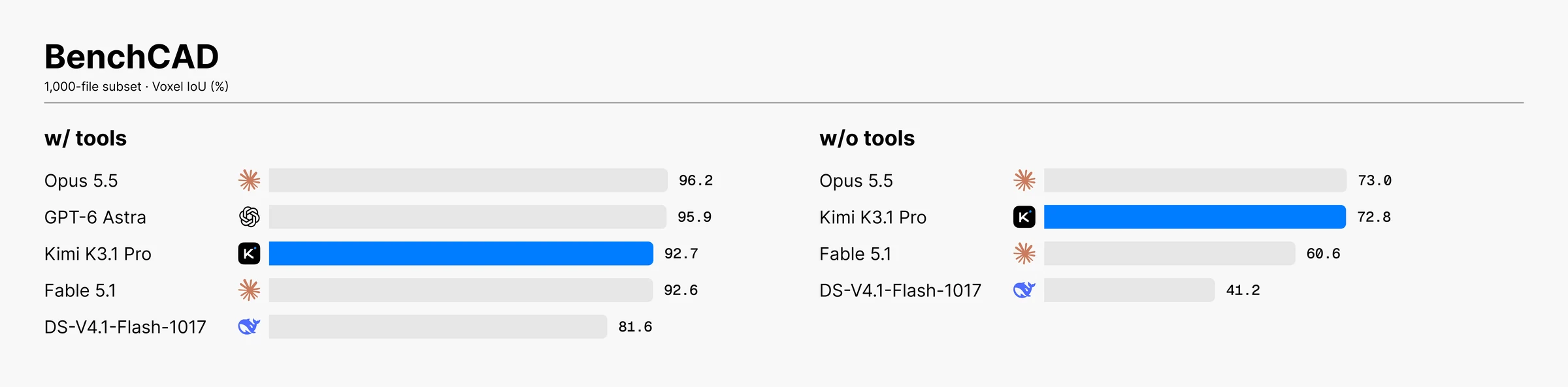
3D modeling is slightly weaker. On BenchCAD, K3.1 Pro scores 92.7%, Opus 5.5 96.2%, and GPT-6 Astra 95.9%.
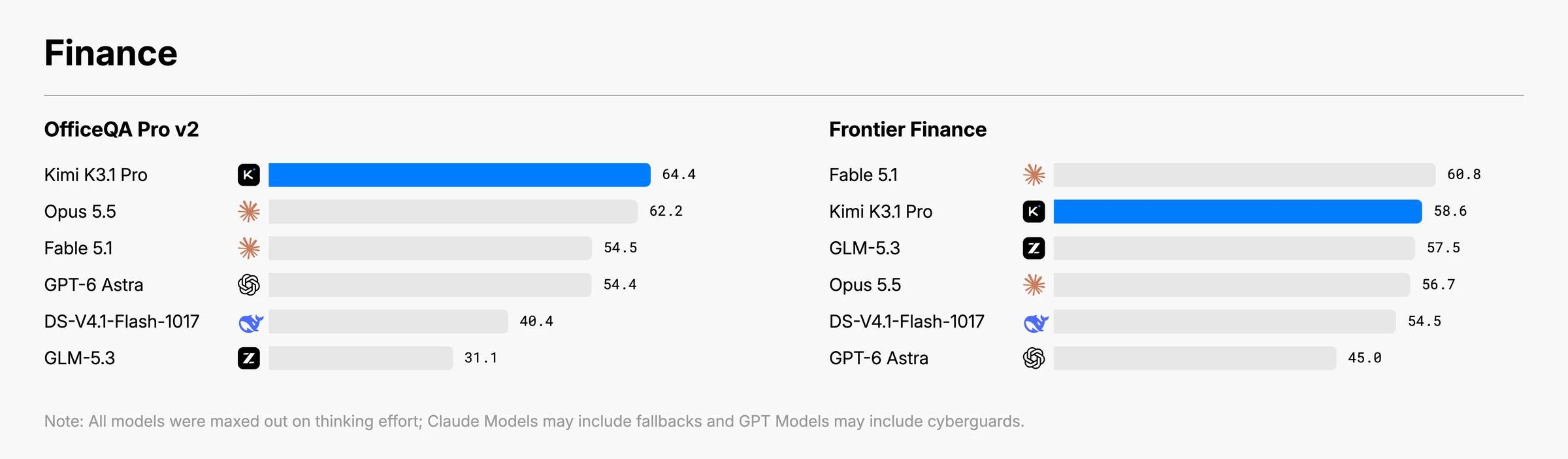
Finance is the headline focus this time. On OfficeQA Pro v2, which involves reading real financial documents and performing multi-step calculations, K3.1 Pro ranks first with 64.4 points, while Opus 5.5 scores 62.2. In internal tests, it scores 7.2 points higher than K3 on financial modeling, 11.6 points higher on writing research reports, and about 4.2× higher on business operations.
The tweet’s claim of a 65% reduction in hallucinations comes from an internal fact-checking test deliberately focused on hard questions: K3 got 23 out of every 100 facts wrong, while K3.1 Pro dropped to just over 8. In the same test, Opus 5.5 got 15 wrong and GPT-6 Astra got 5.5. The company notes this is a stress test and does not represent the error rate in daily use.
3D and Finance Are Where This Release Really Doubles Down
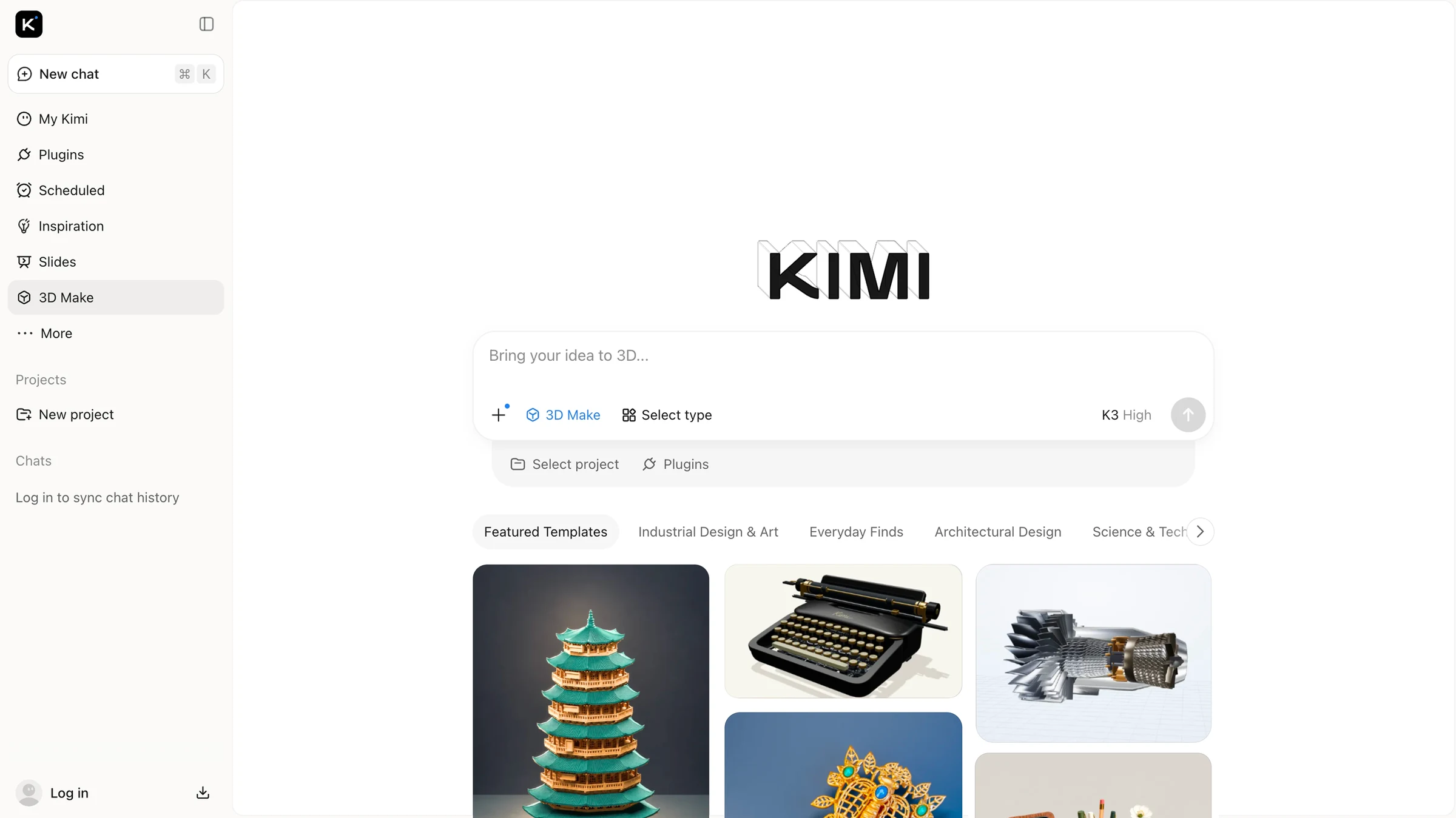
K3.1 Pro can directly write scripts to operate Blender, CAD software, and the Unity, Unreal, and Godot game engines. In official demos, it produced a complete 3D game and a desk lamp that can be 3D printed. 3D Make is now available on kimi.ai and in the App, allowing online preview and editing of 3D models, direct 3D printing after download, and export to video or Live Photo.
The finance demos look more like office work. The company provided an NVDA DCF/LBO model with linked statements and traceable formulas; there were also CATL investment committee materials and a quantum computing industry report, with source-level citations required.
Open Weights Are Great—But Don’t Expect to Run Them on a Personal Computer
Open weights means the model files are public: anyone can download them, run and fine-tune them on their own servers, and data does not have to pass through Moonshot AI. But a personal computer cannot run it: extrapolating from the 4-bit precision used by K3, merely storing 2.8 trillion parameters requires about 1.4TB of memory. The license terms have not yet been announced.
To make open weights possible, Moonshot AI says it removed cyber offense and defense-related data during training. With the same training pipeline but without removing that data, an internal exploit test solved 90.5% of the problems; after removal, it solved 81.0%. The company says its offensive capability still lags behind top closed-source models that have been publicly available for more than three months.
Pricing and Availability
Regular users can use it in Kimi Web and the App; the company does not state how much free users get. The enterprise edition is off by default and must be manually enabled by an administrator. API accounts must be topped up with at least $1 before use. The Highspeed version is 2 to 3 times faster, at $4 input and $20 output, the same price as Opus 5.5.
What the Comments Are Arguing About
On launch day, the comment section was already split into two camps. Some users said pricing matters more than benchmark scores, since the same budget can run twice as many Agent calls; others gave up immediately at the sight of 1.4TB of memory—running it on a personal computer is a nonstarter, so they will just call the API. Some focused on the real quality of the 1 million-token context: fitting content in is one thing, but whether numbers in financial reports can be found and calculated correctly and consistently—ideally with citations back to the source text—is another. In coding scenarios, the real test is whether long context can accurately locate relevant files without missing constraints.
Some users also complained that plan quotas are consumed quickly and that real-world experience falls short of benchmark scores. Such feedback currently lacks systematic evaluation and can only be taken as reference. A good-looking parameter leaderboard matters less than getting one complete workflow to run end to end.
K3.1 Pro puts open weights and low pricing on the table together, applying pressure to closed-source models. But whether to switch your main model is not about leaderboards; it is about whether long tasks can be completed in one pass and whether token consumption is sustainable. After the weights are released before November 4, whether the community can push inference costs down another notch is the next variable.
Official blog: https://kimi.ai/blog/kimi-k3-1-pro
API docs: https://platform.kimi.ai/docs/guide/kimi-k3-1-pro-quickstart
Original tweet: https://x.com/Kimi_Moonshot/status/2113680701770068067
发布时间: 2026-10-24 17:43