The GPU Depreciation Schedule Needs a Rewrite: A100 Is Five Years Old, and Rent Is Still Rising
In the rent data compiled by a16z, H200 is 143% above the 6-year depreciation line, and even the five-year-old A100 is 9% above it. Token demand rose sharply after April; GPU scarcity arrived before obsolescence.
A line drawn according to 6-year straight-line depreciation is being contradicted by GPU rents.
In its Charts of the Week on October 23, a16z posted rent data from Ornn Data: from January to October 2026, the 7-day average rent for all GPU models was higher than at the start of the year, including the A100, which has already been on the market for five years.

a16z gives the approximate year-to-date changes: H200 +160%, B200 +120%, RTX PRO 6000 +65%, H100 +35%. A100 is not listed among the increases, but it is also higher than at the start of the year.
If we use the standard 6-year straight-line depreciation as the baseline, the gaps are even larger: H200 +143%, B200 +111%, RTX PRO 6000 +73%, H100 +54%, A100 +9%. Most of the gaps opened up after April.

Alex Danco of a16z said that over the past 18 months, people's assumptions about GPU depreciation have been proven wrong. Moses Sternstein added a more direct point: GPU rents keep rising, token prices are falling, but consumption is increasing, creating a relative scarcity of GPUs. The old A100 was expected to be phased out quickly, but in reality it is still being rented, and at prices above what it should command under the depreciation schedule.
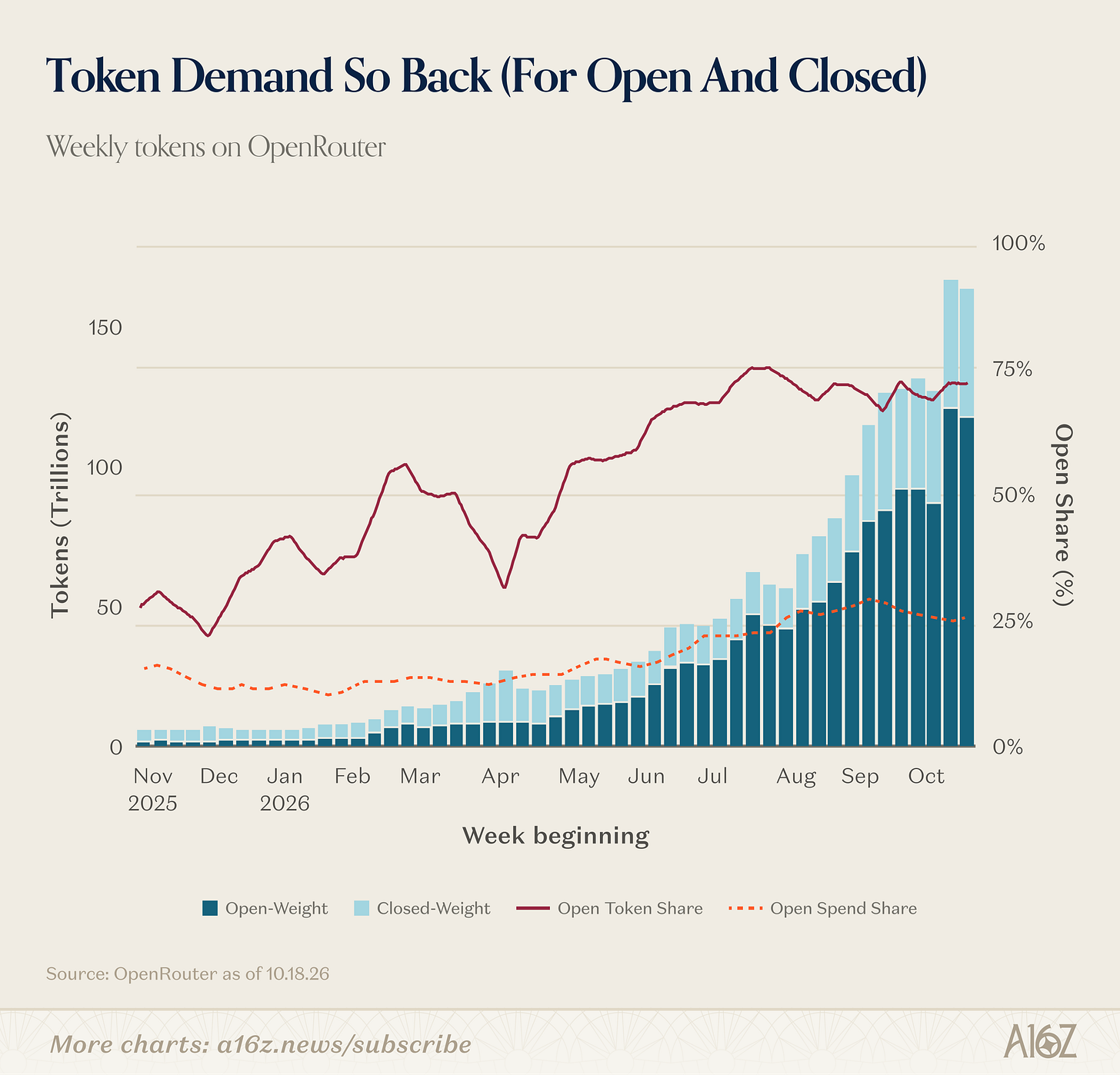
OpenRouter's token demand curve points in the same direction: it began to rise sharply in the spring, flattened briefly at the end of summer, and recently jumped another step. Demand did not stay only on new cards; inference and agentic usage have dragged older cards back into cash flow.
Depreciation models are used to treating GPUs as ordinary server assets that lose value over time. Actual rents are determined by token demand, inference consumption, and how quickly supply is absorbed. The A100 has the smallest increase, showing that not all cards are equally tight: newer cards are tighter, while older cards fill the gap.
Some netizens said in replies that 'the A100 refuses to die' is the real story. Others said that old hardware was never the constraint, and neither is old human data. The analogy is a bit harsh, but when applied to compute rental, the direction is not hard to understand.
Risks remain. If token demand slows, older card prices will loosen first. The market is still divided on whether this is a temporary gap or a long-term trend, and concerns about the post-2028 buildout have not disappeared.
Those who value using 6-year straight-line depreciation should at least rerun rents every quarter. The original a16z tweet and charts are in the a16z tweet.
发布时间: 2026-10-25 10:37