AI Can Do a Full Day's Work on Its Own, but Companies Still Won't Let It Change a Single Salesforce Record
The METR curve shows agent task duration roughly doubling every 7 months; in 2022 it was 30 seconds, and today it can cover a full workday. In a16z's long article, Databricks CEO Ali Ghodsi says AI doesn't have an intelligence problem; it has a context problem. For companies to use agents, they first need to give them a system of record they can read, write, and be evaluated against.
a16z put METR's curve into its latest article: since 2019, the length of tasks AI agents can complete independently has roughly doubled every seven months. In 2022, ChatGPT could handle coding tasks that take a human about 30 seconds; today's frontier agents can cover a full workday for a skilled engineer. The chart data runs through May 8, 2026.

In the same article, Databricks CEO Ali Ghodsi offered a rather blunt footnote: most companies still won't let AI reliably update records in Salesforce.
His judgment is short: AI doesn't have an intelligence problem. It has a context problem.
That sentence deserves unpacking. For an agent to do work inside a company, it needs to know four things: which data is real, what that data means, whether it has permission to touch it, and whether the result counts as good once the work is done. These four things usually live in databases, dashboards, policy documents, and the heads of experienced employees. A sales VP knows the biggest deal is stuck because the key contact is quietly interviewing elsewhere; they also know that a certain salesperson's 90% actually means 50%. That information is not in Salesforce fields, and no matter how well an agent can write code, it cannot read it.
Doubling Every Seven Months, Stuck on One Record
Databricks' technical trajectory looks like four layers stacked over nearly two decades. In 2009, Ali was at Berkeley watching internet companies use big data to predict clicks, purchases, and views. Hadoop distributed computation across cheap servers, but every round of computation had to write results back to disk, which made iterative machine-learning workloads very slow. Matei Zaharia wrote Spark, keeping frequently used data in memory and speeding up iterative workloads by as much as tenfold. In 2013, Ali, Matei, and several researchers founded Databricks, packaging cluster management, scaling, and security into an enterprise platform.
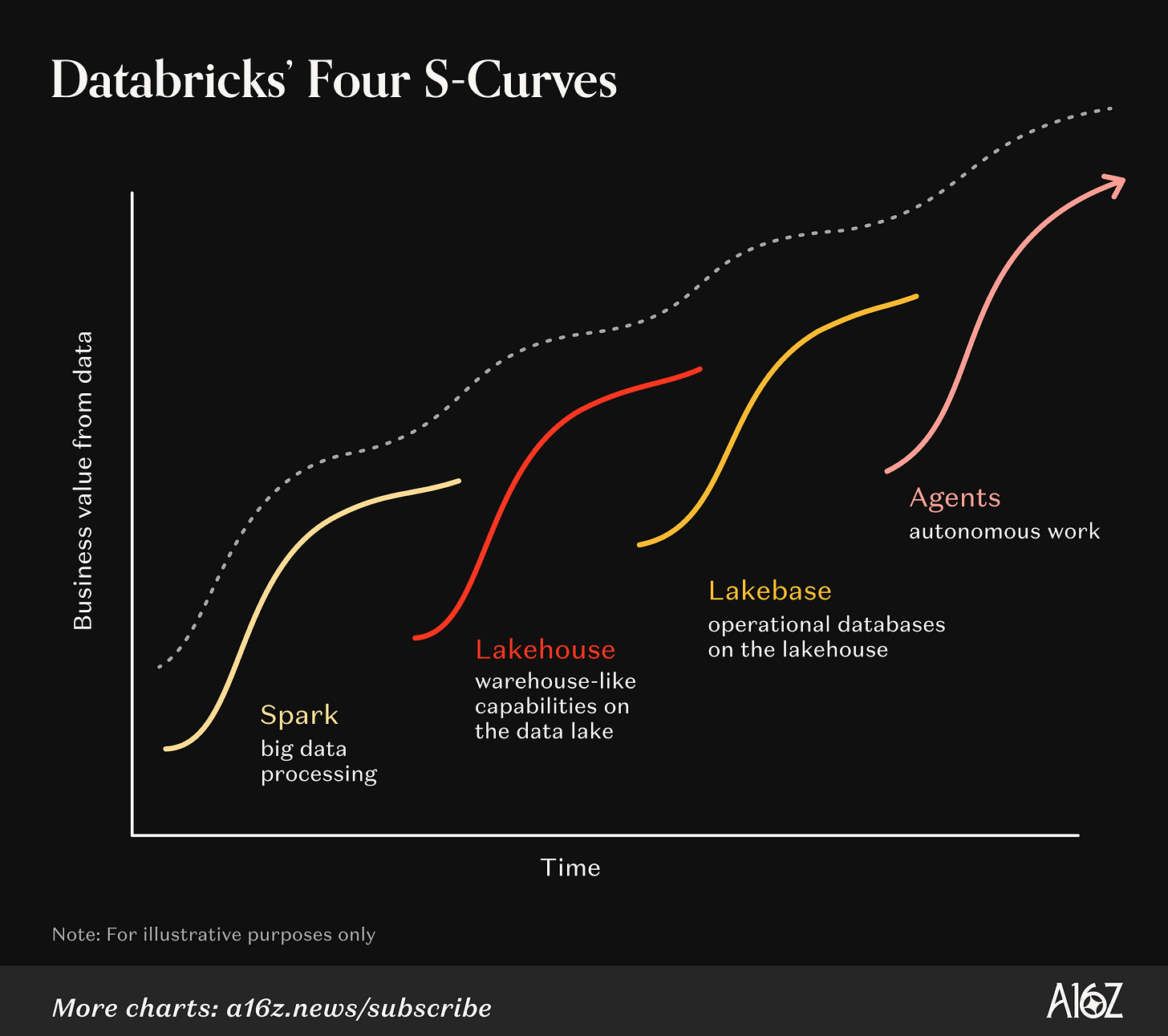
The next two steps are closer to today's agents. The 2020 Lakehouse combined the cheap storage of data lakes with the reliability and query performance of data warehouses. After acquiring Neon in 2025, Databricks launched Lakebase, separating storage and compute for operational databases so that databases can branch in seconds like code. An agent can open an isolated branch for experiments and throw it away when done. The article says that today Databricks sees more agent queries than human ones, with more than 17 million databases started by agents every day; the company has annualized revenue of more than $7 billion, up 80% year over year, at a $190 billion valuation. Lakehouse annualized revenue exceeds $1.5 billion, and Lakebase exceeds $100 million.
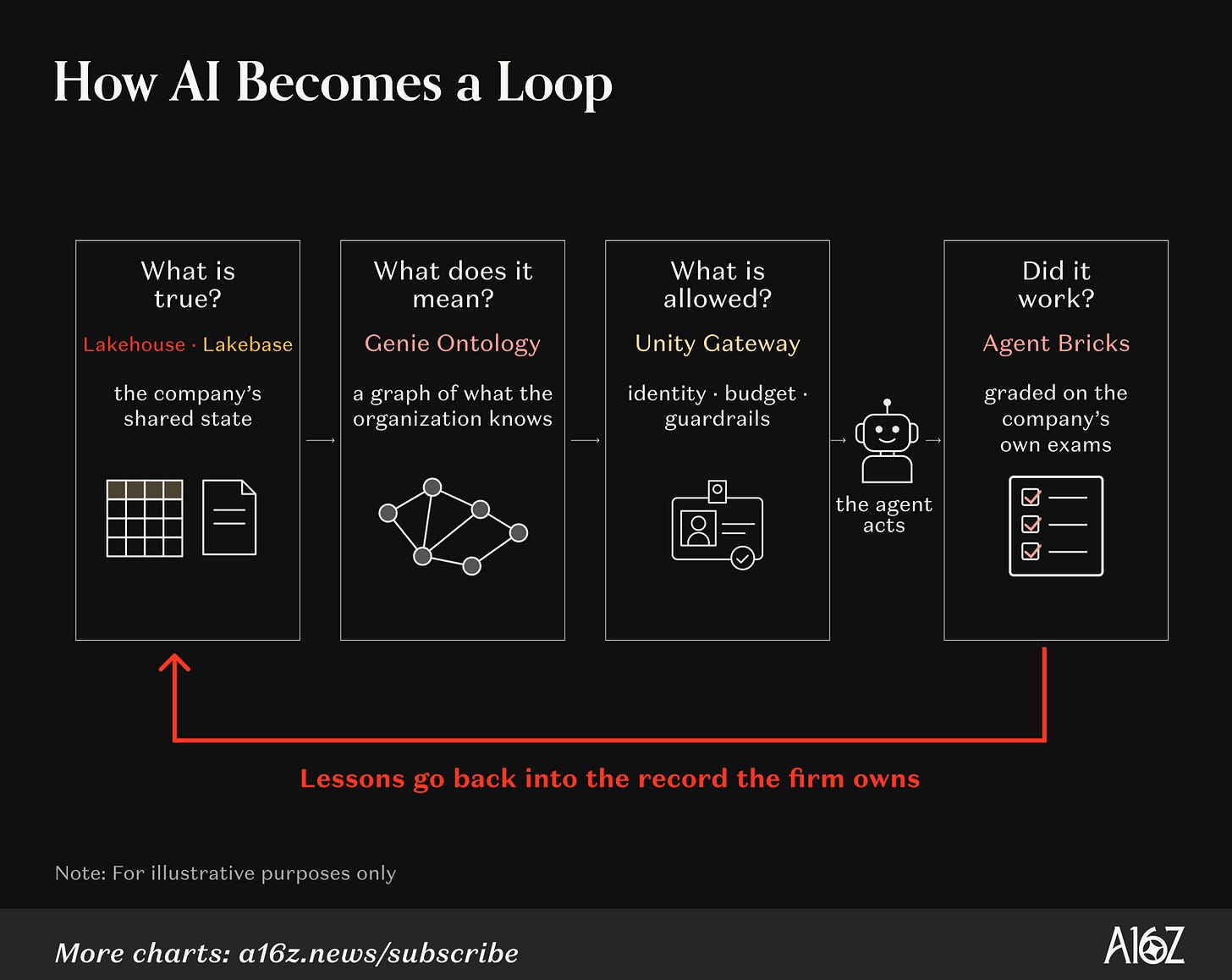
Ali calls the answer a system of record for agents, or SORA. The term can easily sound like marketing, but broken down it is very concrete. Before an agent writes a record, the system has to tell it: who this record belongs to, which customers, contracts, and goals it relates to, which past changes caused problems, who has authority to approve it, and what standard will be used to accept it after the change.
SORA Has to Answer Four Questions
The article breaks SORA into four questions. What is true is held as state by Lakehouse and Lakebase. What it means: Genie Ontology continuously builds an organizational knowledge graph, and OntoRank ranks knowledge by signals such as creator, scope of use, and update time. In Databricks' tests, connecting an agent to the company ontology raised answer accuracy from about 50% to 84.5%. What is allowed: Unity Gateway gives every model, agent, and AI tool an identity, budget, and guardrails, and logs what data they touched and how much they spent. Whether it works: Genie and Agent Bricks let business teams and engineering teams each build agents and each write their own exams, defining acceptable outcomes and unacceptable mistakes, then optimizing against company standards.
The article pulls the lens back to the company itself. In 1937, Ronald Coase asked: if markets can coordinate through prices, why do companies still exist? The answer comes down to transaction costs: finding people, negotiating, and monitoring all cost money. Herbert Simon later added a layer: shared computer records make decentralized decisions safer; a ticket agent doesn't need to call every colleague—just look up records, sell tickets, and record changes. The database era extended this principle to the whole company, and the agent era will compress coordination costs another round.
X replies included a user adding: an agent can complete an eight-hour software task, and still no one lets it near a Salesforce field. Another user said people treat agents like interns, but they should be treated as database users. Both point to the same thing: the capability curve and the acceptance gate are not the same line. An agent being able to run all day does not mean a company dares to hand over write permissions. Context goes stale, permissions leak across boundaries, and errors accumulate until they explode at the end of the process.
Jack Dorsey wrote this year about going from hierarchy to intelligence, saying a system can maintain a continuously updated business model and use the model to coordinate work. Ali agrees with the direction but separates org structure from information flow. Twenty years ago, to know what was happening in the company, you could only ask people up and down a tree; now Genie can answer most questions that come up in meetings. Management still has to develop people, judge priorities, and notice who is unhappy; it's just that the information-routing part will be taken over by agents.
Companies Have to Own Their Own Loop
The most memorable competitive example in the article is two banks renting the same frontier model for credit decisions. The first bank sends prompts, receives answers, and records the final decisions. The second records which facts produced the answers, where humans overrode them, which decisions performed well later, which failed, and then adjusts policy. A year later, when a better model arrives, the second bank inherits definitions, permissions, evaluation cases, customer history, and exceptions it has already encountered. The first bank still inherits the same prompt.
Satya Nadella calls this human capital and token capital; the loop becomes the company's new IP. Jensen Huang says every company's business data is a gold mine. Databricks is betting that data and loops stay in systems the company controls. Models can change, vendors can change, but what the company learns must not disappear along with a contract.
Work itself is also changing. The article's judgment is that future jobs may not be everyone an engineer, but closer to everyone a manager. Engineers are already managing coding agents: scoping problems, splitting tasks, delegating in parallel, reviewing PRs, approving some, sending some back. Scientists at Novo Nordisk use Genie to ask questions of obesity data; financial analysts at Rivian generated the revenue dashboard the CFO wanted; supply-chain analysts generated an inventory-tracking app. Execution becomes cheaper, while the need for judgment rises.
The ending returns to that Salesforce record. A user said half of Salesforce records are already wrong before an agent touches them. That joke isn't funny; it explains why write permissions are hard to open up. For an agent to be trustworthy, the system of record must first be true. Once records can answer what is real, what it means, who allows it, and whether it works, agents will be more than demos that can write code for a day—they will be employees who can take on work inside the company.
Original links: a16z article and tweet.
发布时间: 2026-10-28 20:48