NVIDIA Takes Motion Generation to 15,000 Frames per Second, but Your GPU Isn't a 5090
2 ms latency, 15,000 FPS, 350,000 motion clips—NVIDIA MotionBricks' numbers look great. But between the lab's 5090 and the machine in your living room still running at 60 fps lies a whole hardware generation gap. What's more worth watching is the robotics part.
NVIDIA has released MotionBricks, a motion generation model. Official numbers: 15,000 FPS on an RTX 5090, 2 ms latency.
Let's break that number down. One frame in a 60 fps game is 16.7 ms, and 2 ms accounts for 12% of that. Someone on X did the math directly: 15,000 frames is 250 times the demand for 60 fps, so in theory a single 5090 could drive 250 characters at once.
It sounds like game NPCs can finally say goodbye to looping walk animations.
But someone poured cold water on it in the comments: 2 ms is a lab number; in a real game the same GPU also has to do rendering, and most players' machines are far from a 5090. That's fair. 15,000 FPS is the upper limit of capability, not the frame rate delivered to you.
More interesting is another reply: "NPCs at 15,000 frames per second, and their faces go straight into the wall." Motion generation is solved, but perception and decision-making haven't caught up. No matter how fast the generation is, if the NPC doesn't know there's a wall ahead, it will still clip through it.
What's really worth watching isn't games.
MotionBricks was trained on 350,000 motion clips from the BONES-SEED dataset, which consists of real human motion-capture footage. The official demo includes an unedited 2-minute-40-second UE5 demo: navigation, going up and down stairs, picking up a sword, sitting on a chair, and jumping over a bench, all generated by a neural network end to end. No foot locking, no animation blending, no collision-detection post-processing. This description comes from the project homepage's own wording.
It also integrates with GR00T Whole-Body Control, becoming part of NVIDIA's motion generation layer for humanoid robots. Pretrained models include SOMA and Unitree G1, packaged in ONNX, with SafeTensors on Hugging Face. The code is open-sourced at NVlabs/motionbricks, with an interactive demo, Smart Primitive editor, and scene editor.
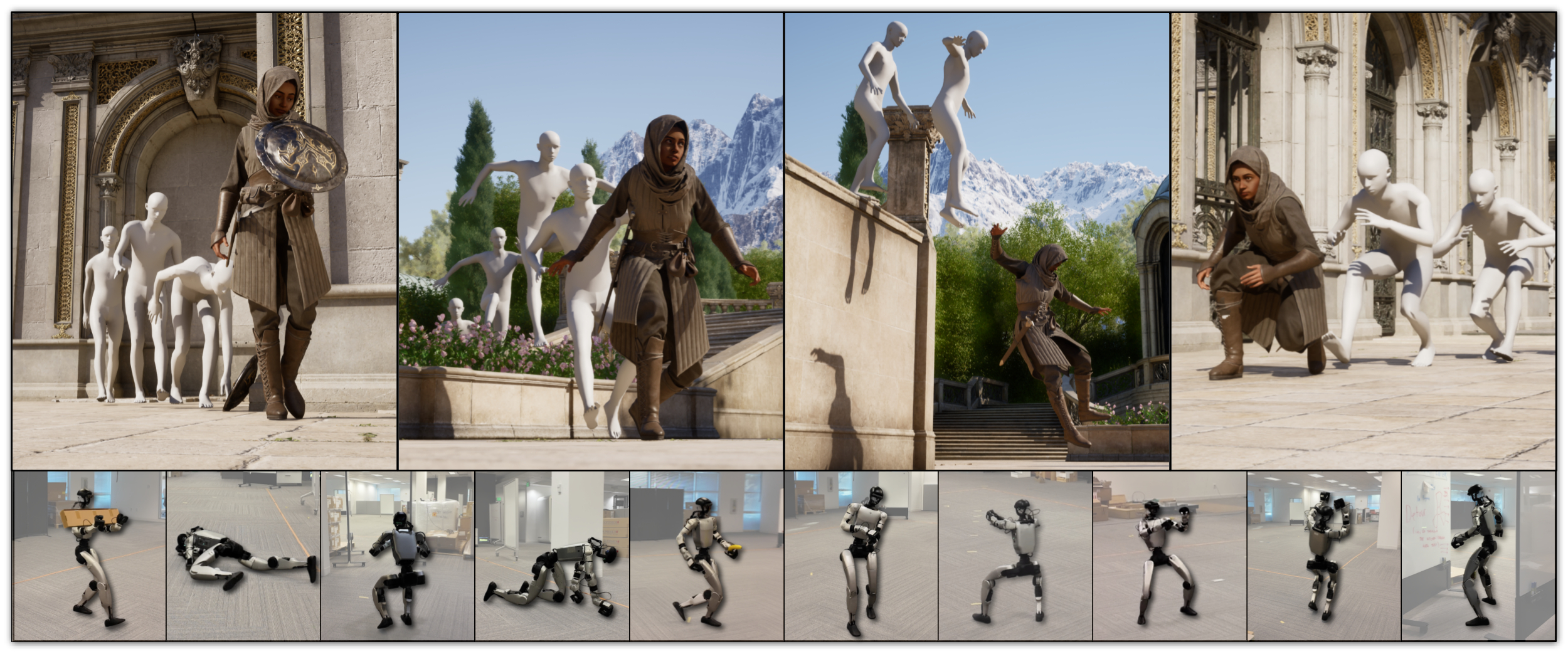
One point is worth noting: two years ago, this kind of thing was still proprietary motion-matching technology kept under wraps inside big companies. Now the paper is on arXiv, the weights are on Hugging Face, and they've even given you the ONNX exporter. It's a SIGGRAPH 2026 paper, and the code is released directly.
Back to that 2 ms. It's real, but it's a 2 ms on a single card, pure inference, without considering the rendering pipeline. There's still a gap before "every NPC has its own motion brain." But the gap is shrinking. It isn't shrinking by waiting for everyone's GPU to become a 5090; it's shrinking by this technology becoming a default component in the engine, so you don't even notice it running.
By that day, the NPC wall-collision problem will still be there—it'll just collide much more smoothly than before.
发布时间: 2026-10-29 09:50