The More Multi-Agent Systems Learn, the Messier They Get—The Problem May Be That No One Owns the Failure
Amazon and UC San Diego's EMMA treats multi-agent configuration as episodic memory and changes only one place after failure. It beats the strongest baseline by up to 32.5% on three benchmarks and uses 17% to 38% fewer training executions. The comments fixate on another question: what if the attribution is wrong?
When a multi-agent system fails and the model is left to fix it itself, a common problem is that where to change and how much to change depend entirely on the model's feel. The change may make things better, or it may scramble routing, prompts, and skills into a mess.
EMMA, a paper from Amazon and UC San Diego, aims to narrow this gap. It treats the configuration of a multi-agent system as structured episodic memory; after a failure, it first assigns responsibility, then changes only one place.
A bit of background first. Deploying LLM agents in specialized domains requires fine-grained processes and knowledge. Parameter training is expensive and not interpretable. Manually designing agent systems shifts the cost to experts. Episodic memory updates at the context level, but single-agent adaptation struggles to mitigate cross-task interference, which is even more pronounced in complex tasks such as multi-application navigation and data-pool analysis. Multi-agent evolution can mitigate this, but existing methods define update rules unclearly and rely on the backbone model to decide where and how much to change. Learning follows the backbone's structural preferences; some backbones keep accumulating skills, while others keep generating agents.
EMMA's system has three parts, all run by the same LLM. A controller plans each task and executes it step by step, selecting a sub-agent and skill at each step. Sub-agents start from a generalist; each specialist inherits the generalist prompt and adds its own role method. Skills are short programs, such as algorithms or pitfall checklists. EMMA treats the controller's routing memory, agent prompts, and skills as episodic memory and improves from failures. After a failure, a reflector determines which of the three has the right to repair it and proposes only one edit there. Backbone-independent guards ensure that each accepted edit is scoped, incremental, and bounded.
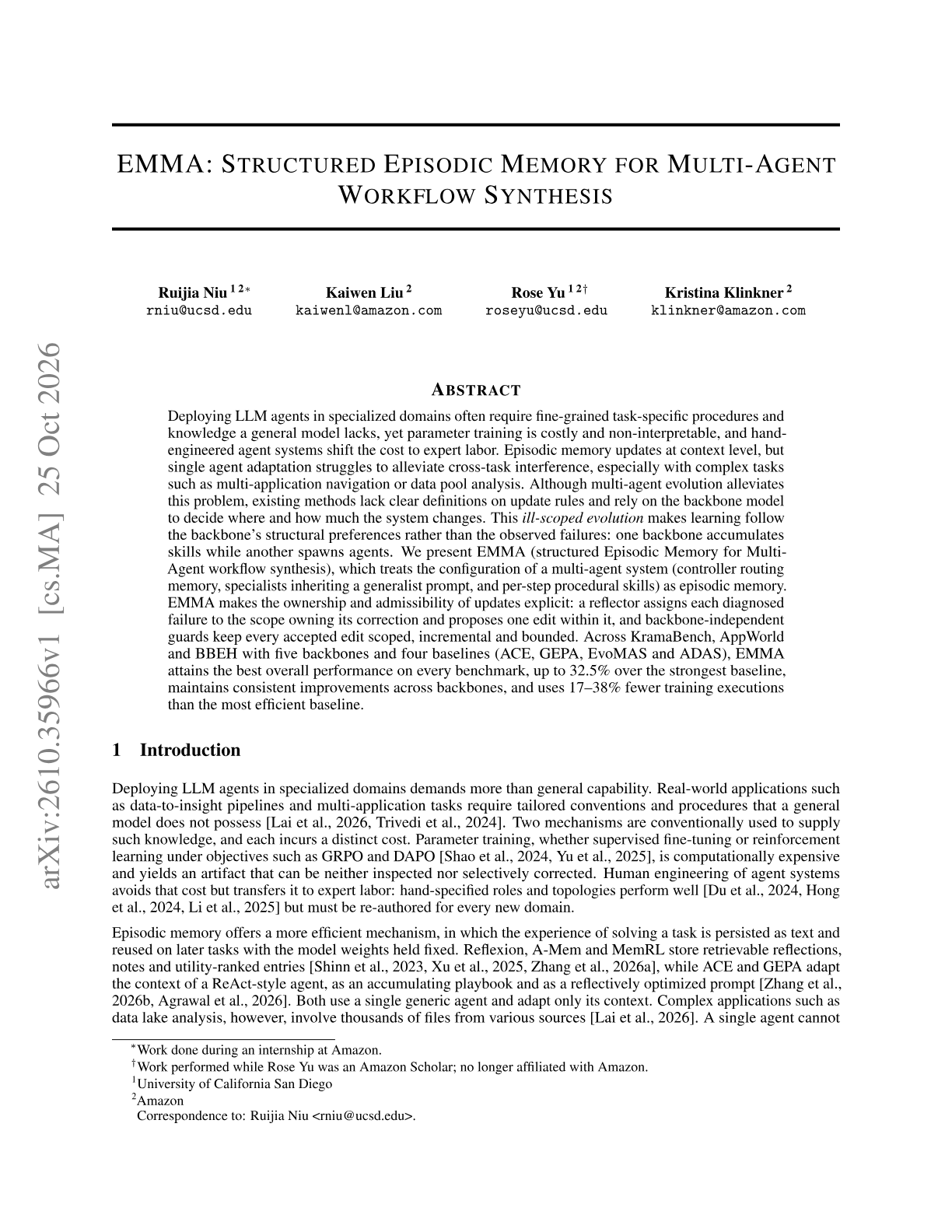
Results are compared across five backbones and four baselines: ACE, GEPA, EvoMAS, and ADAS. EMMA is overall best on KramaBench, AppWorld, and BBEH, surpassing the strongest baseline by up to 32.5%, with consistent improvements across backbones. It uses 17% to 38% fewer training executions than the most efficient baseline.

X user SiEdge said that having the reflector determine whether a repair belongs to routing, prompts, or skills is what makes this method clever. Xiaoman's comment was more direct: attributing first and then acting is equivalent to assigning responsibility to the agent. She followed up by asking how high the misattribution rate is.
This follow-up is not trivial. Euan Cox worries that the reflector will always find someone responsible. Some failures are bad inputs, not problems with routing or skills. Making edits for these failures would quietly make the system worse. He is curious whether the guards allow the system to decide that nothing needs to be fixed.
Another easily overlooked point is forgetting. Tinker said that episodic memory turns one-off fixes into reusable things, but the hard part is deciding what to forget. A memory packed with expired episodes is worse than a blank one. Krrish mentioned that his agents shared a Notion database as memory, and until he had them start deleting old notes, most of it had been noise.
Self-improvement can also regress. plankton said that his first 'improved' X writing skill lost 16 to 3 in a blind evaluation against the open-source original. Only small changes based on the original won. The guards appear to be an important part.
When multiple agents share work, the memory problem is more complex. Alex Khinevich said that when they investigated Claude Code and A2A, each tool kept its own logs, with no sharing. An episode should record who acted, on whose behalf they acted, and under what authority they acted—not just what happened.
EMMA's value is not in the word 'memory' but in narrowing update authority. The real cost of a memory system is maintenance, not storage. Being able to decide not to change may be more important than being able to change. The public description does not elaborate on the attribution error rate, nor does it say what proportion of the time the guards allow no repair. These two numbers may determine whether it can be deployed more than the 32.5% improvement does.
Paper: https://arxiv.org/abs/2610.35966
Chat with Paper: https://academy.dair.ai/papers/emma-structured-episodic-memory-for-multi-agent-workflow-synthesis-2610.35966
发布时间: 2026-10-29 00:37