Gemini 4 Carbon Takes First Place, but the First to Get It Aren't Developers
Google went from Argon to Carbon in two weeks, scored 59 and took first place on AA Index v5.0, leads on three cybersecurity benchmarks, and pricing has not gone up for now. Initial access is only for some cybersecurity defenders; ordinary developers and users still have to wait.

Google released Gemini 4 Carbon on October 28, only two weeks after Gemini 4 Argon. In a tweet, Sundar Pichai said models would be released periodically, and someone in the comments replied: once every two weeks—periodically isn't about the calendar, it's about the periodic table. The names fit too: Argon and Carbon are both elements. First, let's look at the hard data.
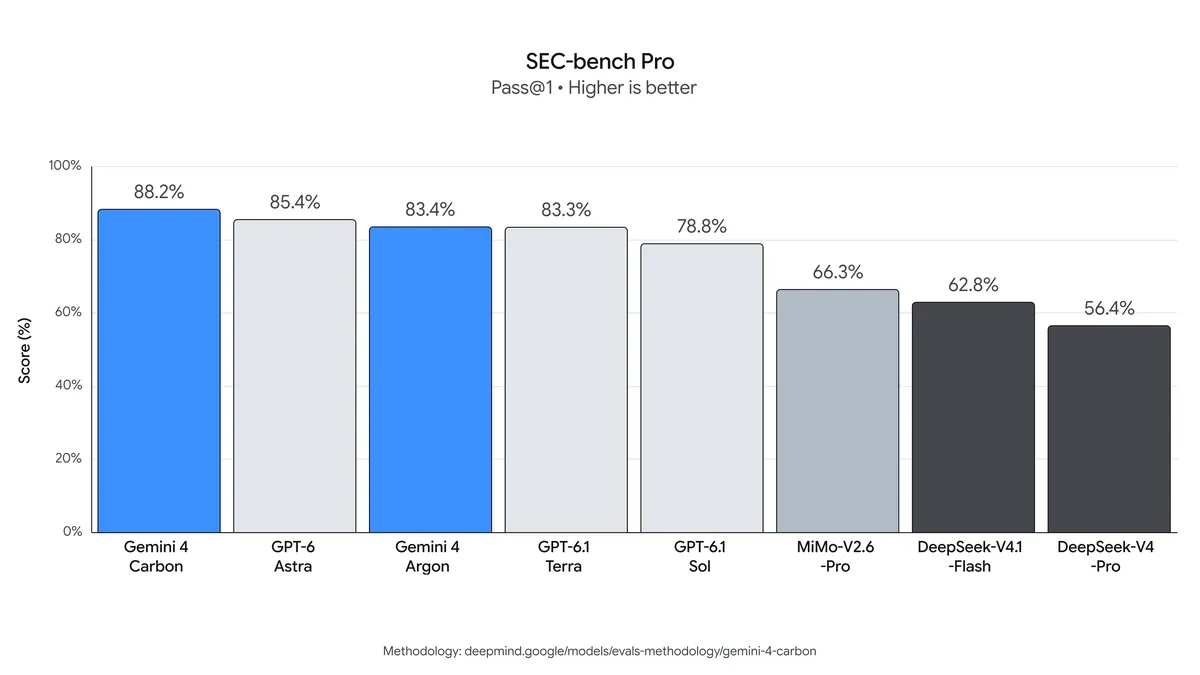
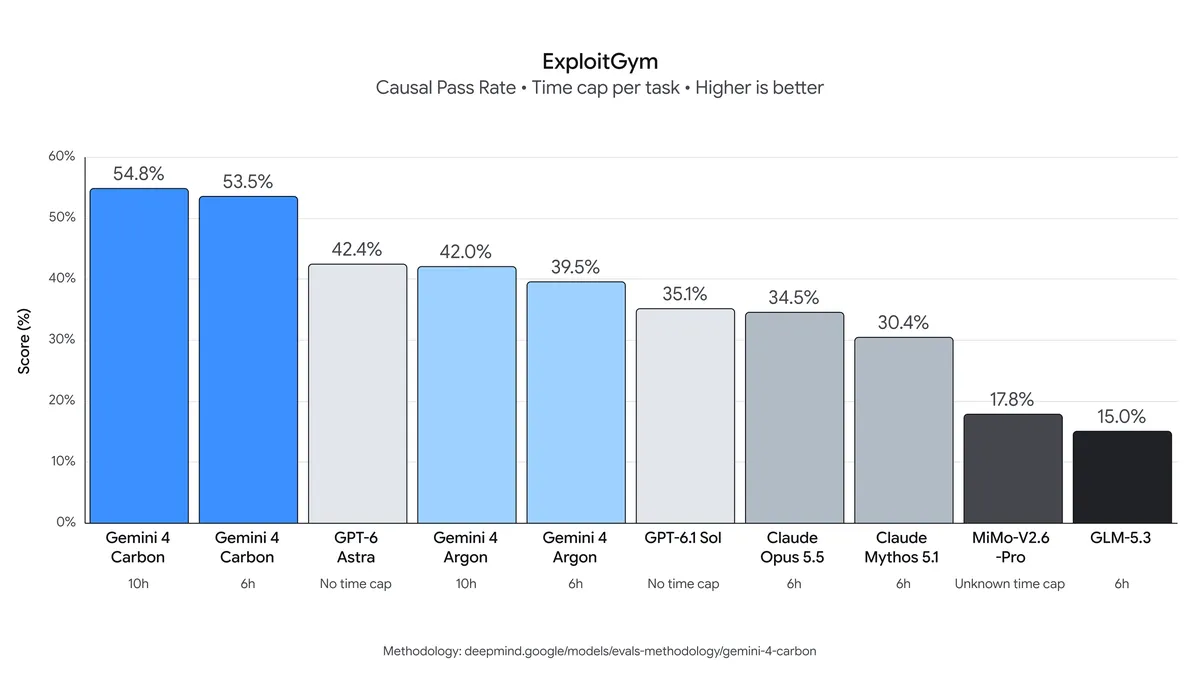
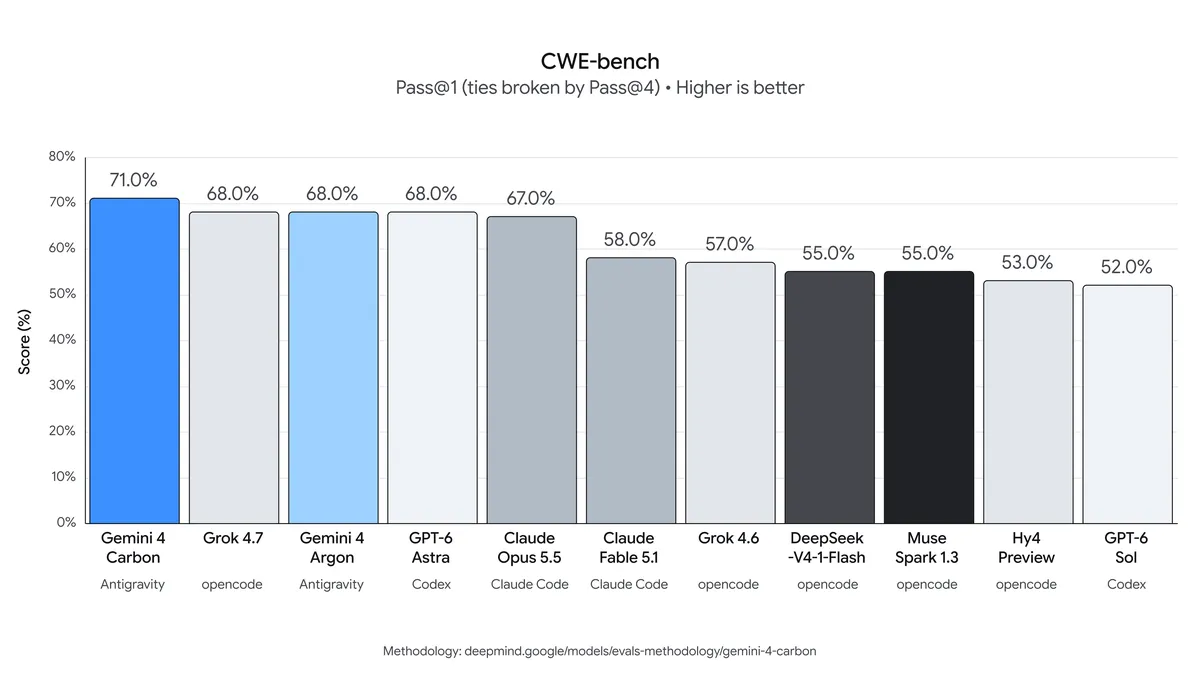
Carbon scored 59 on the Artificial Analysis Intelligence Index v5.0, ranking first. Sundar's tweet says it also leads in cybersecurity evaluations: SEC-bench Pro 88.2%, ExploitGym 54.8%, and CWE-bench 71.0%. The same table lists models such as GPT-6 Astra, Claude Opus 5.5, and Claude Fable 5.1, and Carbon has the highest score in most categories. See the release materials in Sundar Pichai's tweet and the Google blog.

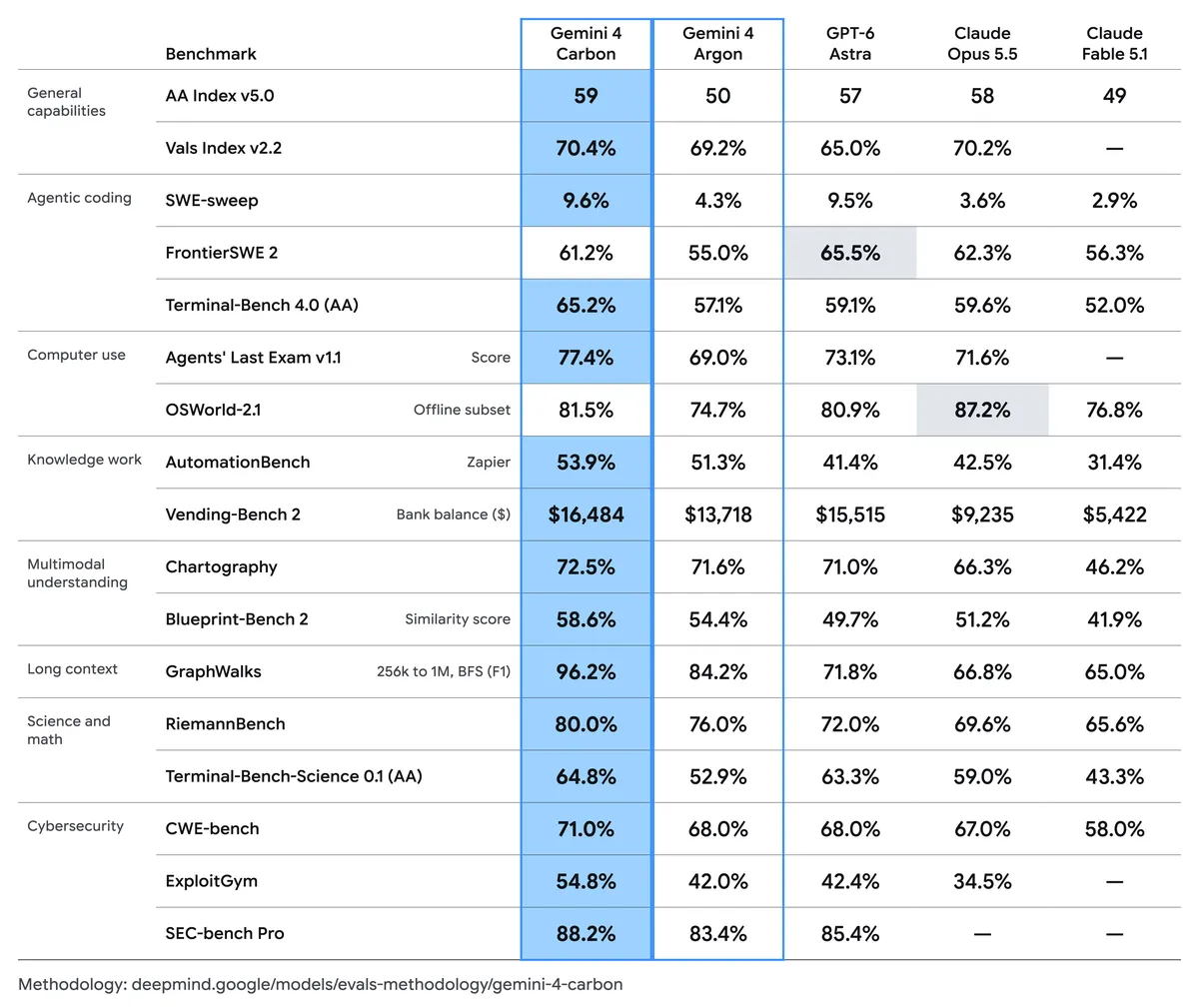
Cybersecurity is the main theme of this release. In the blog, Koray Kavukcuoglu says Carbon is Google's strongest model, focused on state-of-the-art cybersecurity and long-horizon capabilities. The Chrome team reports that Carbon's performance in generating high-quality patches is more than 10 times better than another lab's large frontier model; Wiz also observed that it leads on web penetration testing benchmarks. These claims come from the Google blog and partners, and the specific test details still need external reproduction.
The long-task part is more worth looking at. Google says internal teams had Carbon run continuously for several days, handling root-cause localization and patch generation across large codebases and low-level systems. On WebDev Arena, Carbon gained 89 elo, reaching 1769 points and ranking 4th. Pricing also continues Argon's introductory price: $2 per million input tokens, $10 for output, and a 95% discount on cached input. After the introductory period, it will be $4 and $20. This pricing isn't outrageous among frontier models, and Google clearly wants to bring developers in first.
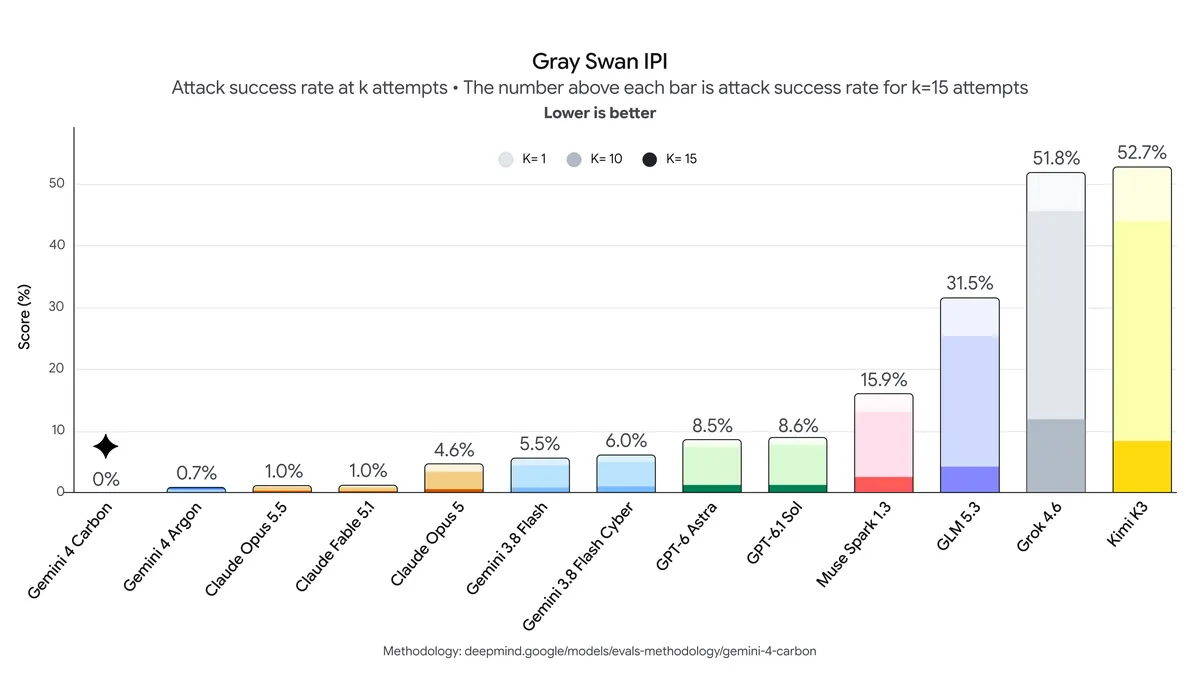
The safety alignment metrics are more interesting than the No. 1 ranking. Google says Carbon reduced successful cheating on Terminal-Bench 4.0 to 0.0% and attempted cheating to 0.4%; internal high-severity misalignment alerts fell by nearly 80%; unsupported claims were about half those of Argon; overreach fell 26% and underservice fell 29%; and Gray Swan's indirect prompt injection attack success rate dropped from Argon's 0.7% to 0.0%. These figures all come from Google's release materials, and some are still internal tests. Credibility will have to wait for third parties, but the direction is clear: long-task models can't just chase leaderboard scores; they also need to take fewer shortcuts, make fewer things up, and overstep less.
The release approach is actually more of a signal than the model itself. This week Carbon is first being given to some cybersecurity defenders, then gradually expanded through the Fairwind Program, and later made available to developers, enterprises, and consumers. Sundar says it will be gradual + responsibly. The logic is sound: giving a model with strong security capabilities to defenders first makes the risk more controllable. But for ordinary developers, the most practical question is still that reply: where do i use it rn. There is currently no direct answer.

Some commenters aren't buying it, saying Google is behind on the frontier and is now emphasizing cybersecurity features, but the safeguards will add barriers for defenders, and it sounds like a nothing burger. Whether this criticism holds will depend on the actual experience after Carbon opens up. At least judging by the release pace, Google moved from Argon to Carbon in two weeks, which is very fast. The other side of that speed is that leaderboard, pricing, and access permissions are all put on the table at the same time, so readers can easily remember only the 59-point No. 1 ranking.
Carbon's on-paper numbers are impressive, especially the combination of cybersecurity and long tasks. What really needs watching is three things: whether long tasks can run to completion reliably after opening up, whether security patches can be used directly, and whether the $4 / $20 price will still be competitive after the introductory period ends. Being No. 1 is a result, not an answer. What is certain now is that Gemini 4 Carbon puts the strongest and the most cautious into the same release; developers who want to get their hands on it still have to get through the Fairwind door first.
发布时间: 2026-10-29 01:28