Gemini 4 Carbon Tops the Rankings, but Ordinary Developers Still Have to Wait
Google releases Gemini 4 Carbon, moving from Argon to a new model within two weeks; it scores 59 on the Intelligence Index to rank first, leads cybersecurity benchmarks, and is initially opened to trusted defenders.
Google has released Gemini 4 Carbon. On October 28, Sundar Pichai announced this new frontier model, two weeks after the release of Gemini 4 Argon. When Elon Musk reposted it, he wrote only “Impressive” (original post).

The key information Sundar gave was very focused. Carbon scores 59 on the Artificial Analysis Intelligence Index v5.0, ranking first. It continues the cadence from Argon, with a two-week gap, as Google aims to prove its speed in shipping frontier models.
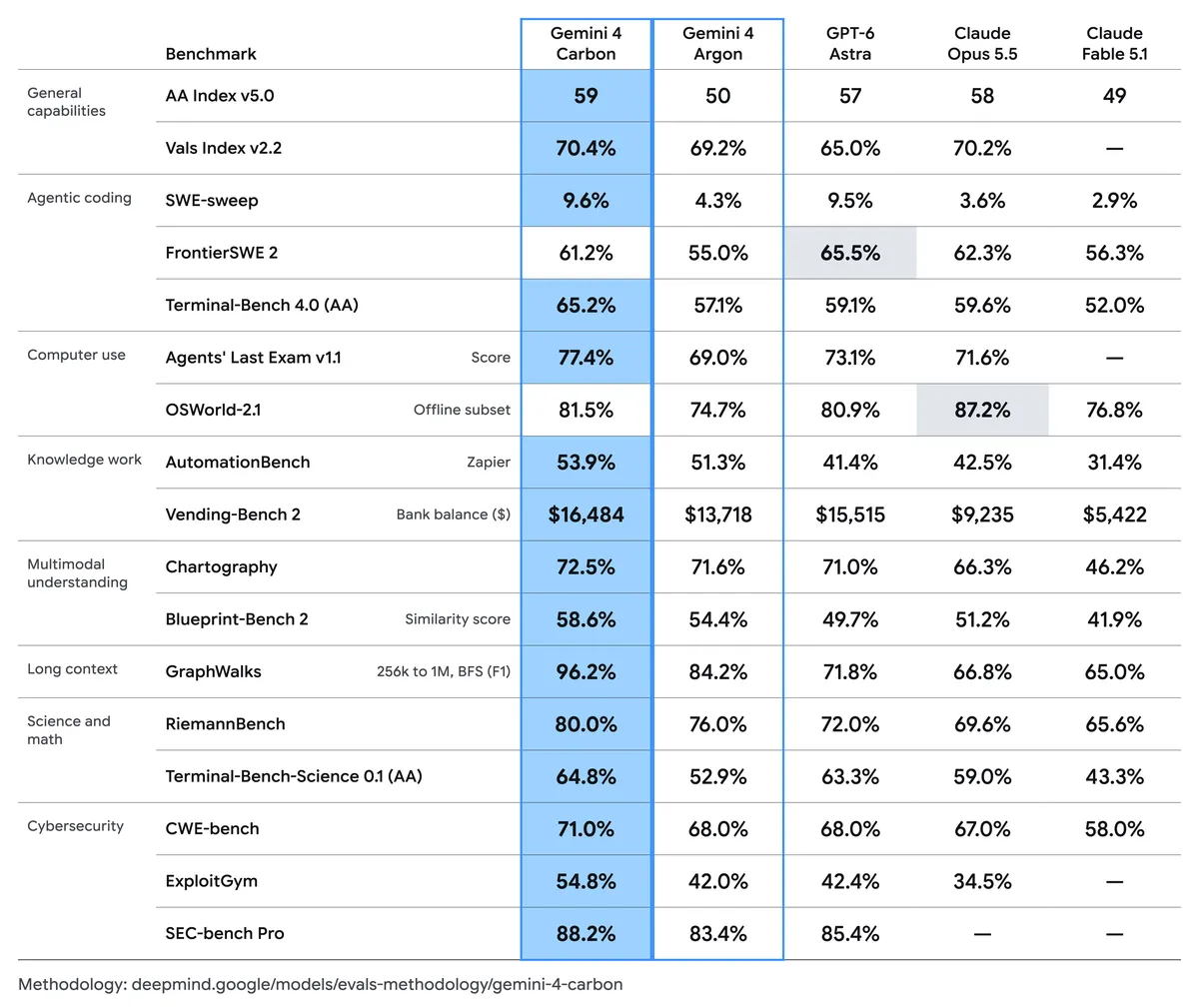
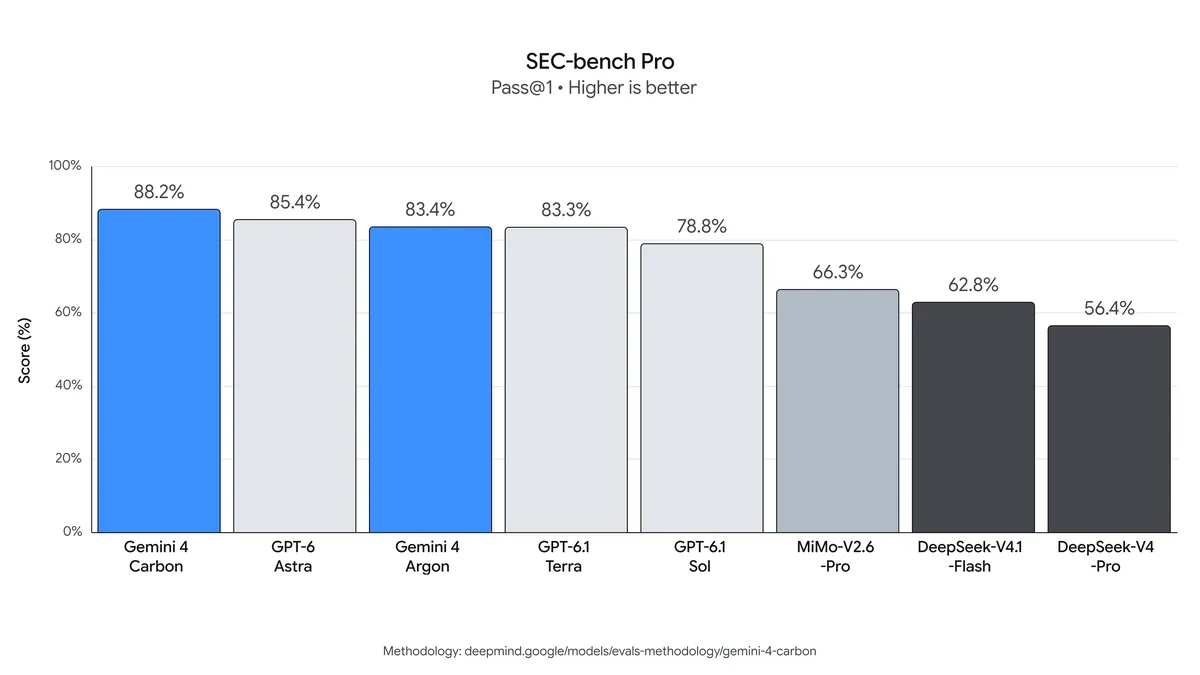
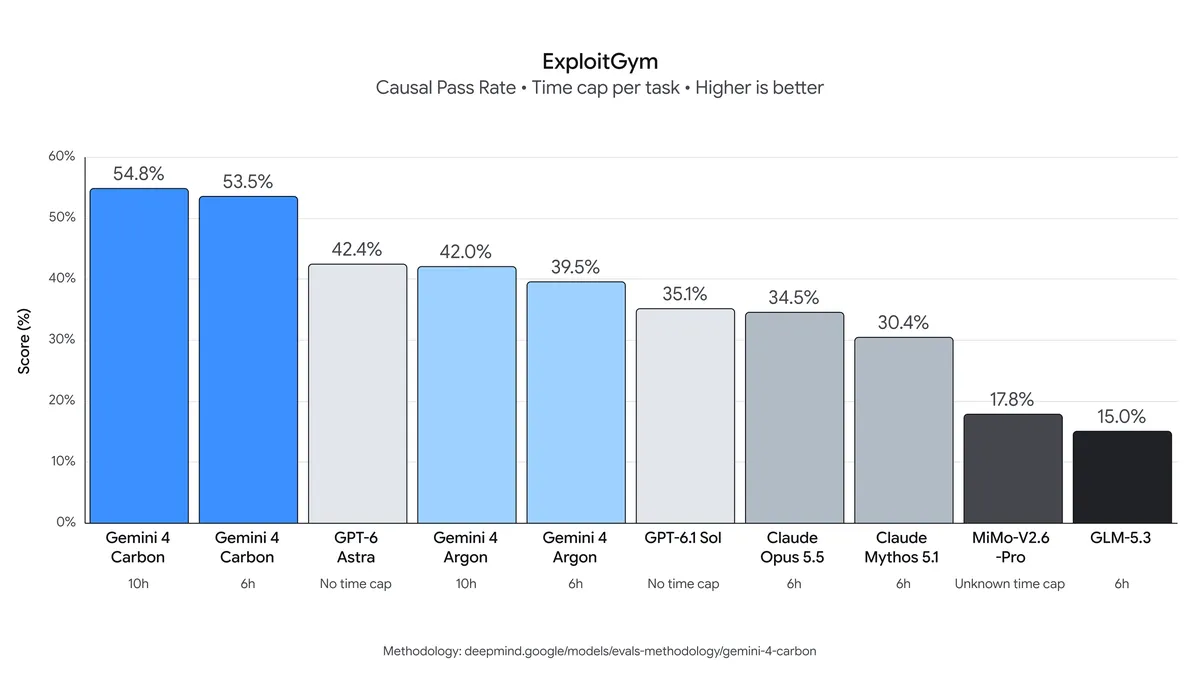
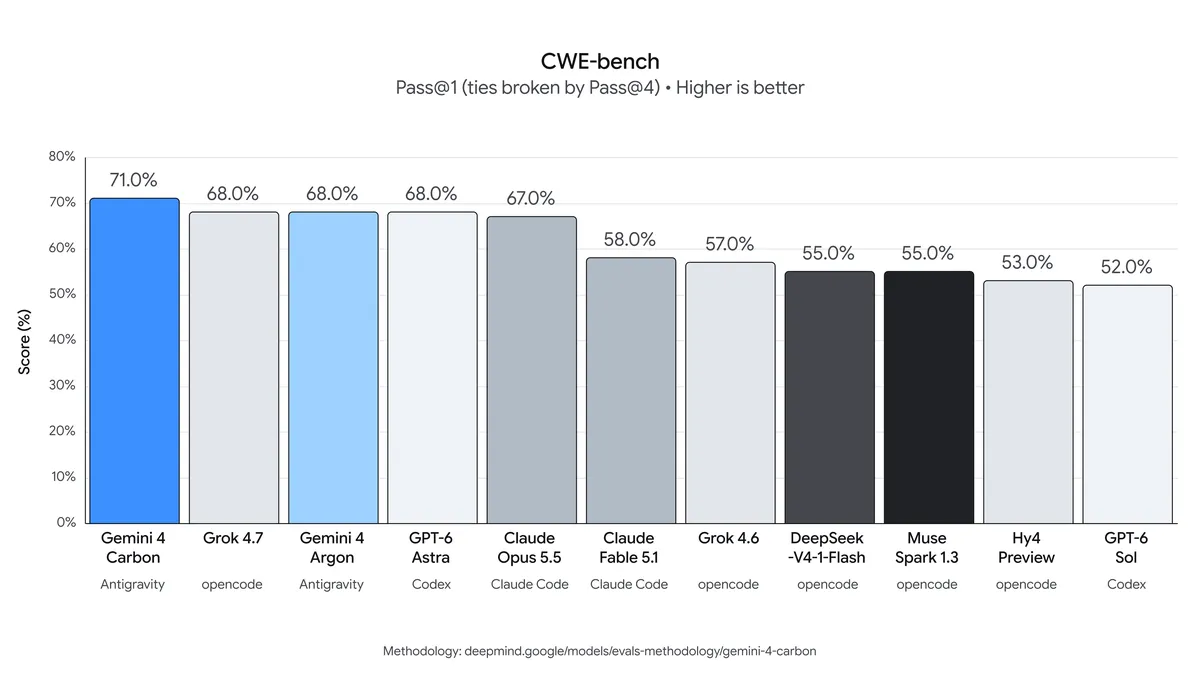
This release is not focused on general chat. The blog is authored by Google DeepMind SVP Koray Kavukcuoglu, and the title directly highlights cybersecurity and long-horizon capabilities. Carbon scores 88.2% on SEC-bench Pro, where the task is to find real vulnerabilities; 54.8% on ExploitGym, which is used to determine whether a vulnerability is exploitable; and 71.0% on CWE-bench, which fixes verified issues down to the root cause. The three metrics cover discovery, validation, and remediation.
There is also concrete progress on long-horizon tasks. The blog says internal teams have seen Carbon run continuously for several days, work through dead ends, and handle multi-step engineering problems in large codebases and low-level systems. On WebDev Arena, Carbon gains 89 elo to reach 1768, ranking 4th. The Chrome team says that when generating high-quality patches, Carbon is more than 10 times better than a large frontier model from another lab. Wiz says it leads on a web penetration-testing benchmark.
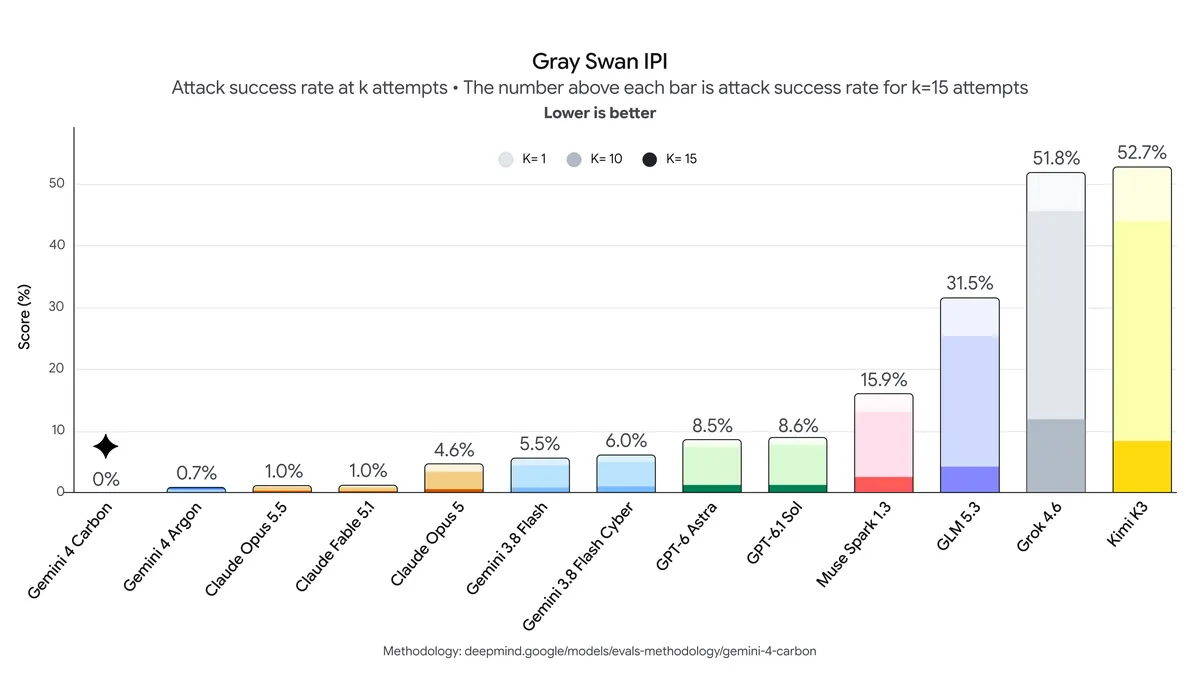
Safety alignment provided quite a few numbers. On Terminal-Bench 4.0, the cheating success rate is 0.0%, and attempted cheating drops to 0.4%. In an internal real-time coding environment, high-severity misalignment alerts fell by nearly 80%. Unsupported claims decreased by about half compared with Argon. Overintervention fell 26%, and underservice fell 29%. On the Gray Swan indirect prompt injection benchmark, the attack success rate is 0.0%, compared with 0.7% for Argon.
Pricing has not jumped. During the introductory period, it is the same as Argon: $2 per million input tokens and $10 for output, with cached input discounted by 95% off the input price. After the introductory period, input is $4 and output is $20. The rollout is very cautious. This week it is first being given to a subset of trusted cyber defenders, after which partnerships will expand through the Fairwind Program; Google also participated in the U.S. government’s voluntary pre-release testing. Developers, enterprises, and consumers will have to wait for product-level access.
The reaction on X was more direct than the release. Jax Wu said, “Argon was only two weeks ago, and Carbon is already first? Wait, what.” Brad Watton joked that the so-called periodic release apparently refers to the periodic table, not the calendar. ⱤɆ₳ₗ ฿Ɇ₦ posted a clip from Gladiator with the subtitle “Most impressive.”
One detail is worth noting. Carbon’s strongest areas lean toward offense/defense and engineering remediation, yet Google is first handing it to cyber defenders rather than rolling it out to ordinary users first. The speed race continues, but access is being tightened. For now, ordinary developers can only wait for Fairwind to expand and for product-level access. The original blog post is here.
发布时间: 2026-10-29 02:28