Are Agents Really Going to Consume 1000x Tokens? Someone Just Cut Per-Task Usage by 45%
Particle-1, post-trained on DeepSeek V4.1 Flash, uses about 45% fewer tokens on average across four software engineering benchmarks, cutting per-task cost by 34.4% to 51.6%. The debate is not about model leaderboards, but about the bill once agents scale.
In a tweet, Aaron Levie did the math on agents: future agents will consume 1000x the tokens they do today. The reasoning is not complicated: agents will need to run inside workflows, process data, write software, handle enterprise security, and do many jobs that are not automated today.
Just as this judgment came out, Suhail announced his new company Particle and its first model, Particle-1. It did not set out to climb a bigger leaderboard; instead, it targeted token efficiency. Particle-1 is post-trained on DeepSeek V4.1 Flash 1017. According to the official results, it uses about 45% fewer tokens on average, keeps task accuracy within the base model's confidence interval, and completes tasks faster.

Particle positions itself as an inference layer for open-weight models. In his tweet, Suhail said intelligence is becoming one of the world's most important resources, but the infrastructure to produce it remains expensive and centralized. At the same time, the quality gap between frontier models and open-weight models is narrowing. What Particle wants to do is make the cost of intelligence approach zero as system efficiency improves.

Let's look at the numbers for software engineering first. Particle-1 was tested on four benchmarks: Terminal-Bench 2.1, ReactBench, ADE Bench, and DeepSWE 1.1. Compared with its predecessor DeepSeek V4.1 Flash, it uses 28.4% to 52.2% fewer output tokens and cuts average per-task cost by 34.4% to 51.6%. pass@1 does not fall noticeably behind.
On DeepSWE 1.1, for example, Particle-1 outputs an average of 59,580 tokens per task, versus 83,246 for DeepSeek V4.1 Flash and 98,155 for GLM 5.3 Flash. Per-task costs are $0.2211, $0.3368, and $0.6523 respectively. Accuracies are 72.57%, 71.15%, and 66.82%. In this dataset, saving money and completing tasks faster are one and the same.
General capabilities have not been sacrificed much, either. On GPQA Diamond, Particle-1 scores 90.40% versus 90.91% for the base model; Tau Airlines is 86.00% versus 88.00%; MMLU is 86.08% versus 85.98%; and BabyVision with tools is 89.18% versus 89.60%. These numbers show it did not cut reasoning capability just to save tokens.
The training method is not particularly mysterious, but the details are worth a look for technical readers. Particle uses Cascade RL for staged post-training; the training stack is based on RadixArk's open-source Miles, with asynchronous training and separation of rollout and trainer nodes. A rank-64 LoRA adapter is attached to the model, covering experts in all layers; trainable parameters are about 1.25% of the model's parameter count. Policy updates use GSPO, the learning rate stays at 5e-5, and advantages are not normalized by group standard deviation. Suhail says the long-term goal is continuous post-training—rapidly patching improvements into models like shipping software.
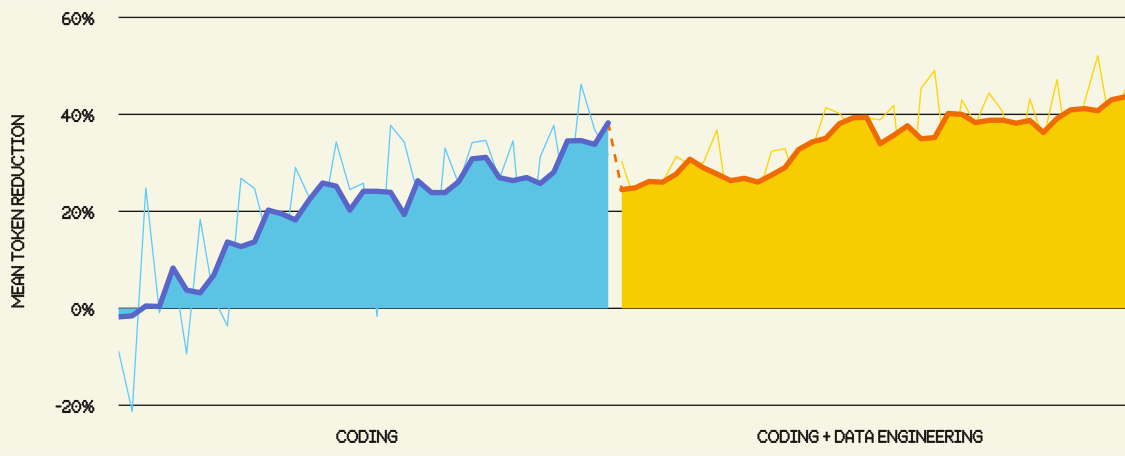
The saved tokens mainly come from the reasoning process. On Terminal-Bench 2.1, ReactBench, and ADE, about 90% of token savings come from reasoning tokens. On DeepSWE 1.1, tool-call text also contributes about 30%. The behavioral changes are concrete: fewer loops around the same action, stopping when the task is done, less repeated checking and long confirmation, fewer rounds of trial and error and patching, and more focused exploration and validation.
In a Git deployment task, Particle-1 outputs 15,892 tokens versus 47,006 for the base model, 66.2% fewer. Both successfully verified the branch deployment, but Particle-1 wrote much less reasoning for deployment checks and completion confirmation; its final two confirmation calls dropped from 11,445 tokens to 1,765.
In another calendar scheduling task, both models used four model calls and six commands, and both got the final result right. Particle-1's savings came from shorter reasoning: about 94% of token savings occurred after the correct file had already been written, with the completion and confirmation portion dropping from 5,193 tokens to 1,078.
There are early signals outside code, too. Particle tried Particle-1 on Harvey LAB's contract review task; at standard adapter strength, output tokens were 24.6% lower than the base model, and all eight reports passed strict checks. At 2x and 4x adapter strength, tokens could be saved further, but one or two reports missed one criterion. At 8x, output was 78.7% lower, and only three reports passed. Compressing redundant analysis can also compress away useful qualifications.
The comments were not one-sided. One reply said 1000x tokens only works if per-token cost falls at the same time; otherwise it is just a bigger bill no one will approve. Someone asked whether this token savings could be reproduced on Opus-class models. Others argued that many agent steps do not need frontier models at all, and a local 27B model is already enough. Another comment focused on pricing: when agents run checks by the hour, per-seat subscriptions will look increasingly unreasonable.
These doubts are more interesting than the launch numbers. Once agents scale, per-task token count will become the real price tag. Model leaderboards tell you who is smarter; token efficiency tells you who can keep running over the long term. Particle-1 starts with software engineering, but its bet is clear: if agents really do consume 1000x tokens, saving tokens is not a minor optimization but a prerequisite for scaling.
发布时间: 2026-10-29 05:37