Particle-1 Didn't Cut Unit Price; It Cut Costs by Using 45% Fewer Tokens
Suhail's new company Particle has released its first model, Particle-1, post-trained on DeepSeek V4.1 Flash. Across four software engineering benchmarks, output tokens are 28.4% to 52.2% lower, costs are 34.4% to 51.6% lower, and accuracy remains comparable. Pricing is the same as the base model; the savings come from the model stopping earlier.
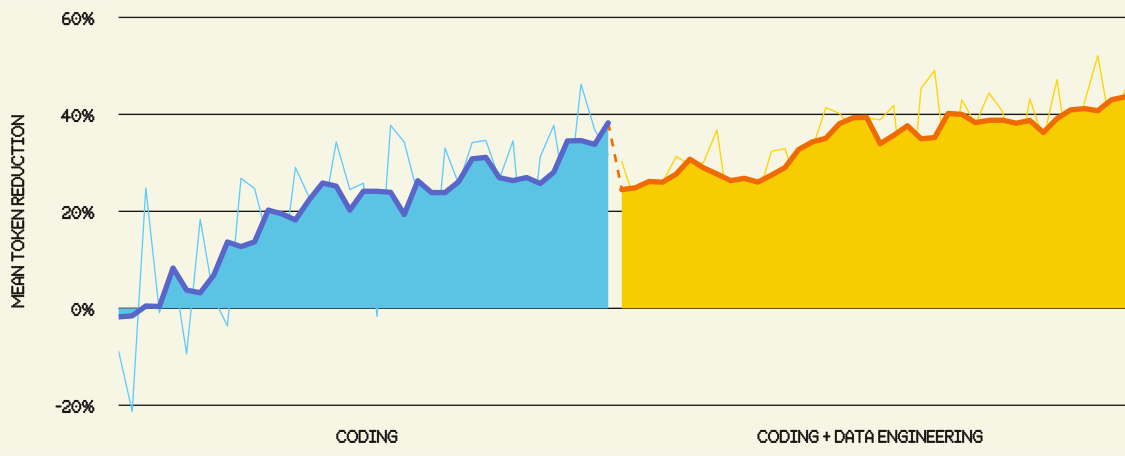
Suhail's new company Particle has released its first model, Particle-1. It focuses on token efficiency. The official website puts it plainly: Particle wants to be the inference layer for open-weight models—fast, cheap, and reliable. Particle-1 is post-trained on DeepSeek V4.1 Flash 1017, and the company says it uses about 45% fewer tokens on average across a variety of tasks while maintaining comparable accuracy.

Tokens are the smallest billing unit for what a model reads and writes. Reasoning, tool calls, and final confirmations all burn tokens. For developers, fewer tokens mean lower bills; for end users, fewer tokens also mean tasks finish sooner. That is exactly the point Particle is targeting. Particle chose to post-train on DeepSeek V4.1 Flash, pushing the model toward less reasoning, earlier stopping, and less rework.
Looking at the data from the four benchmarks together makes it clearer. DeepSWE 1.1, Terminal-Bench 2.1, ReactBench, and ADE Bench all center on software engineering and data analysis tasks. Particle-1's output tokens are 59.6k, 24.8k, 41.3k, and 9.6k, respectively. DeepSeek V4.1 Flash is at 84.2k, 39.4k, 67.5k, and 20.2k. GLM 5.3 Flash is at 98.2k, 67.5k, 148.1k, and 21.6k. The largest gap is on ReactBench, where Particle-1 uses about 72% fewer output tokens than GLM 5.3 Flash.

The official summary is: across the four benchmarks, output tokens are 28.4% to 52.2% lower, average cost per task is 34.4% to 51.6% lower, and pass@1 falls within the base model's confidence interval. Taking DeepSWE 1.1 as an example, Particle-1 costs $0.2211 per task, DeepSeek V4.1 Flash costs $0.3368, and GLM 5.3 Flash costs $0.6523. Average output tokens are 59,580 vs. 83,246 vs. 98,155. Accuracy is 72.57% vs. 71.15% vs. 66.82%. Here is the counterintuitive point: Particle-1's unit price is not lower than DeepSeek V4.1 Flash's. The official footnote says both are $0.30 per million uncached input tokens, $0.006 for cached input, and $1.20 for output. The savings come from using fewer tokens. The unit price has not changed. That distinction matters. With the model price war having reached today's stage, the room for simply cutting unit prices is shrinking; using post-training to drive down tokens per task is another path.
The training method is not complicated, but it is dense with details. Particle splits post-training into consecutive stages: following the Cascade RL idea, it first trains on coding, then on coding plus data engineering. Internally, it uses Datamaker to synthesize tasks, organizes tasks in Harbor format, hands them to the Terminus 2 agent for execution, and every task has a way to verify results. The training stack is built on RadixArk's open-source RL framework Miles, with distributed asynchronous training and rollouts and trainer separated across nodes. The team modified the SGLang rollout engine and the Megatron training engine to reduce the discrepancy between trainer and inference. A rank-64 LoRA adapter is attached to the model, covering experts in all layers, with trainable parameters equal to about 1.25% of the model's parameter count. Policy updates use GSPO, with a fixed learning rate of 5e-5, and following Dr. GRPO, advantages are not normalized by group standard deviation.
Where the tokens are saved: the company breaks it down into four categories: less reasoning for the same action; less repeated checking after a task is complete; fewer rounds of trial-and-error fixes; and more focused exploration and verification. On Terminal-Bench 2.1, ReactBench, and ADE, reasoning tokens account for about 90% of the savings. On DeepSWE 1.1, tool-call text also contributes about 30%. This explains an easily overlooked point: token efficiency affects not only the bill but also task latency. If the model writes fewer rounds of confirmation, users wait a little less.
Evidence for generalization is still early. Particle used Harvey LAB's contract review task as an example: read four legal documents, check whether arbitration clauses comply with the arbitration institution's rules, and write a Word report marking deviations, severity, and recommendations. Under the standard 1x adapter, Particle-1 uses 24.6% fewer output tokens than the base model, and all 8 reports pass inspection; the base model's accuracy is 62.5%. Increasing adapter strength to 2x and 4x reduces tokens by another 47.8% and 60.2%, but 1 to 2 reports each miss one criterion. At 8x, output is 78.7% lower, and only 3 reports pass strict inspection. This result is quite interesting: compressing tokens too far also compresses away useful qualifications. Contract review is only one task, with 8 rollouts, and cannot be treated as a general conclusion, but it highlights the boundaries of token efficiency.

The product is already available. Particle-1 is offered through the Particle API, and the website says it supports zero data retention and is hosted in the United States. Developers can use an API key to connect it to their own harness or agent workflow. Documentation is at docs.particle.ai, and the model page also lists DeepSeek V4.1 Flash and GLM 5.3 Flash. Particle's careers page is looking for post-training research engineers, inference performance engineers, product engineering, and sales, based in San Francisco. In a tweet, Suhail said the goal is to make intelligence as accessible and abundant as electricity. That is a big claim, but Particle-1 at least offers a verifiable small wedge: burning fewer tokens per task.
In the comments, some people focused on the brand, and some marveled at the release cadence. Linus said 2027 will be a year of turning heads every day. Jon Cheney replied that release notes are already hard to keep up with, let alone integrating them all into work; he has already started picking just one new thing a week to seriously integrate into real work. That reaction is more concrete than any slogan. Model releases are becoming denser and denser, and what is truly scarce is the patience to integrate one new thing into a workflow.
Those who want to try it can go directly to particle.ai to get an API key; the blog has the full evaluation and training details. Link: https://particle.ai/blog/introducing-particle-1
发布时间: 2026-10-29 04:34