Gemini 4 Carbon Took First Place, and the Comments Immediately Ask: Can We Use It This Time?
Google went from Argon to Carbon in two weeks. AA Index 59 ranks first, leading cybersecurity benchmarks. The release goes to defenders first, and pricing stays the same as Argon. The comments' disagreement over benchmarks and usability is more worth watching than the leaderboard.
On October 28, Google released Gemini 4 Carbon. It was two weeks after Gemini 4 Argon. Sundar Pichai announced it on X, and Koray Kavukcuoglu provided details on the Google blog. Carbon claims to be the strongest, with a focus on cybersecurity and long-horizon tasks.

Leaderboard: AA Index 59 ranks first
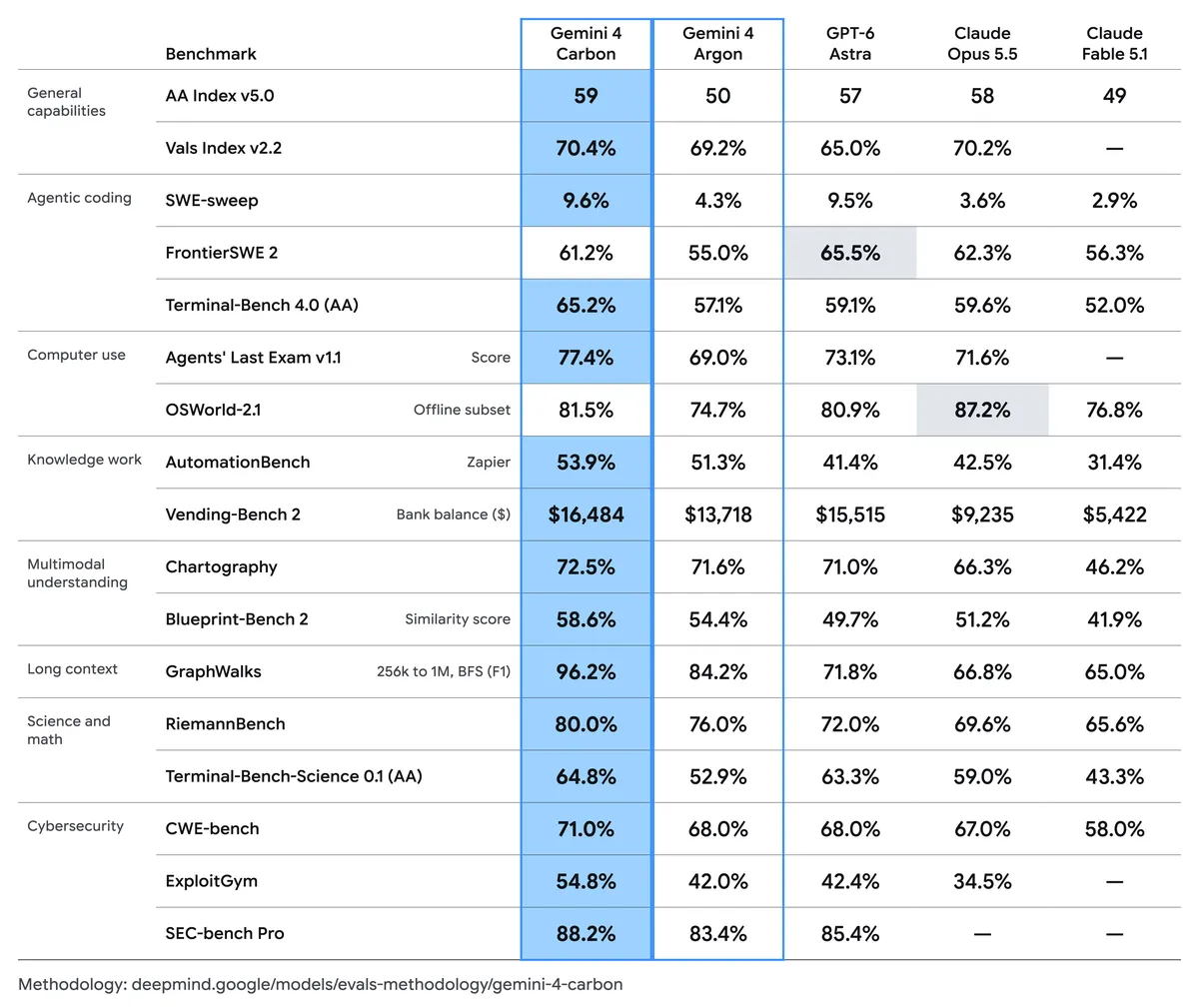
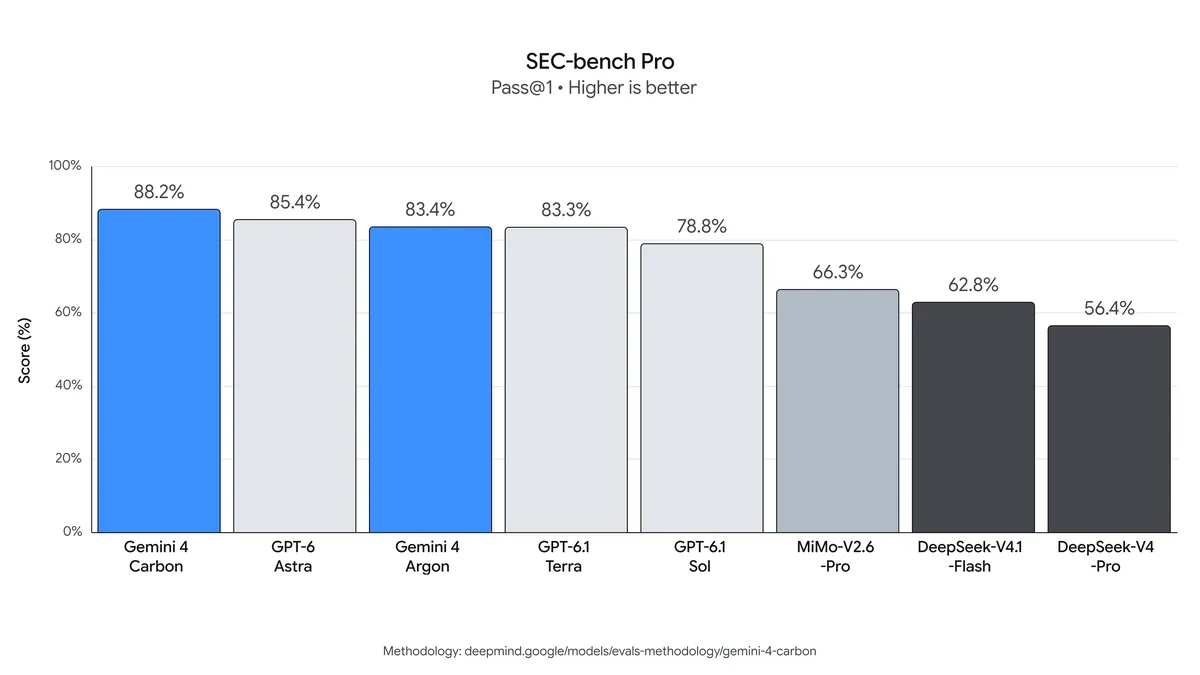
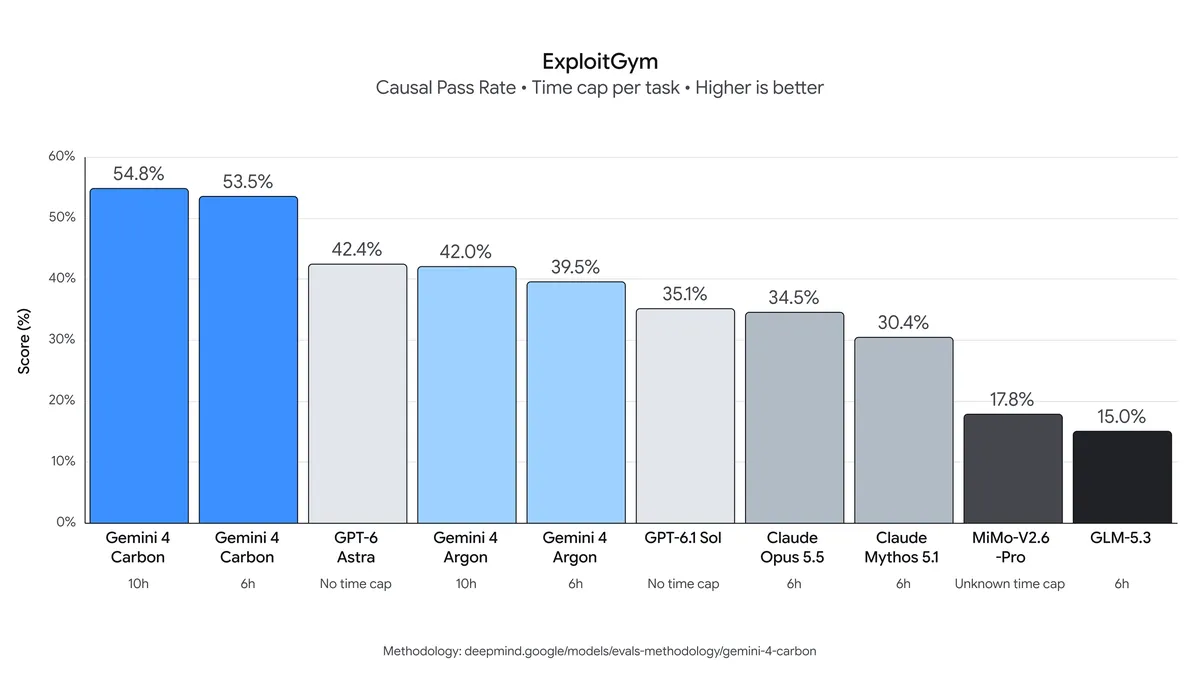
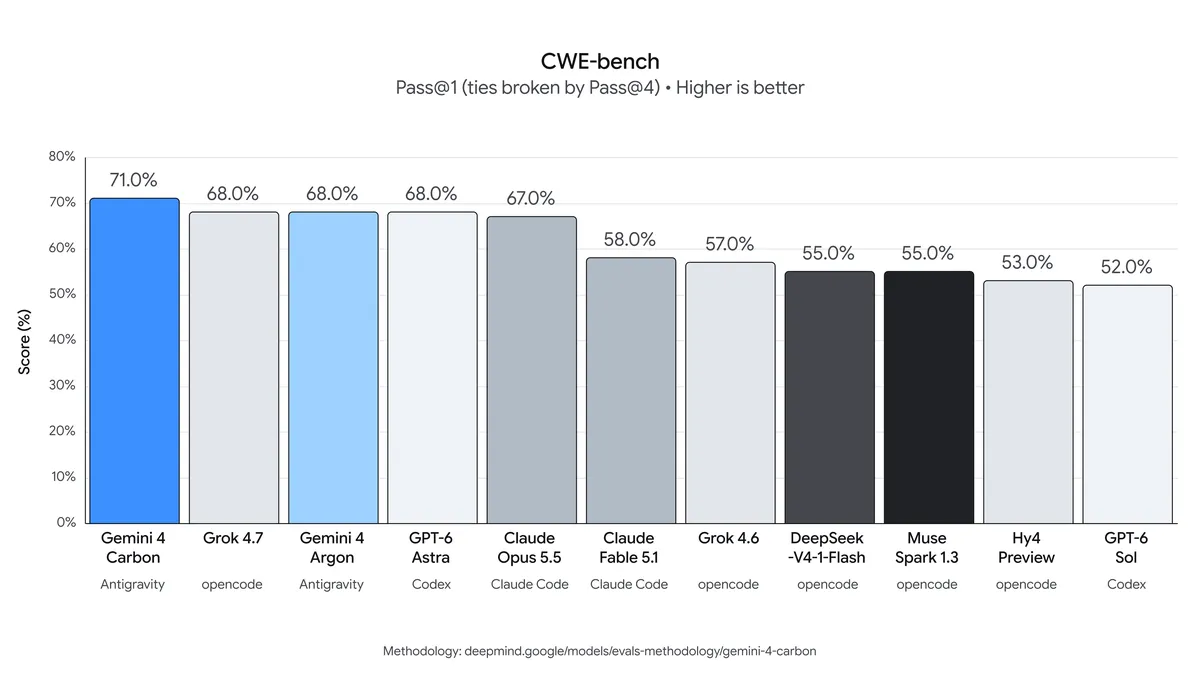
Carbon scored 59 on the Artificial Analysis Intelligence Index v5.0, ranking first. The safety benchmarks given in the blog: SEC-bench Pro 88.2%, used to find vulnerabilities; ExploitGym 54.8%, used to verify exploitability; CWE-bench 71.0%, used to patch root causes. On WebDev Arena, Carbon improved by 89 elo to 1768 points, ranking 4th.
The table also lists Gemini 4 Argon, GPT-6 Astra, Claude Opus 5.5, and Claude Fable 5.1. The data source is cited as deepmind.google/models/evals-methodology/gemini-4-carbon.
Long-horizon tasks: internal teams run it for days
Carbon targets continuously running agent workflows. Google internal teams ran it continuously for several days, handling subtle bugs in large codebases and low-level systems, including root-cause localization and patching.
The Chrome team reported that Carbon generated high-quality patches more than 10x better than a large frontier model from another lab. Wiz said Carbon leads on a web penetration testing benchmark. Both are partner claims in the Google blog; independent reproduction will wait for more teams to get the model.
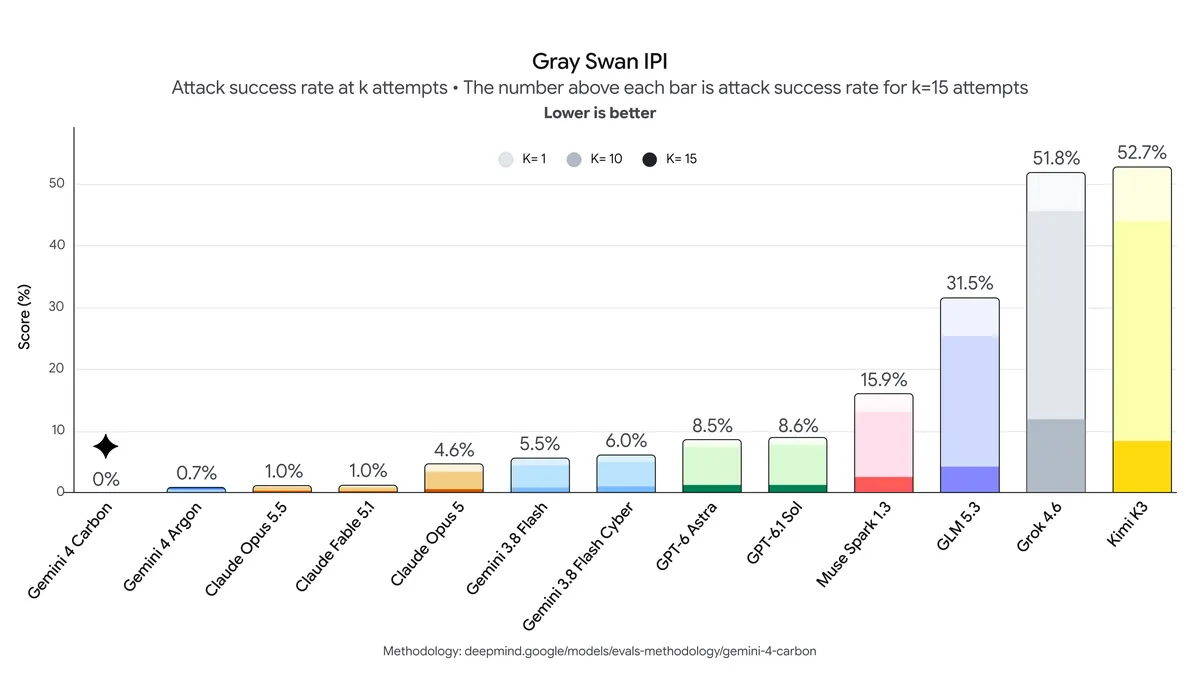
Safety: 0.0% attack success rate on Gray Swan IPI
Carbon continues to use Argon's multilayered safety stack, including model training, real-time abuse defenses, prompt injection resistance, and chain-of-thought monitoring. Internal data given in the blog: Terminal-Bench 4.0 cheat success 0.0%, cheat attempts 0.4%; internal high-severity misalignment alerts fell by nearly 80%; unsupported claims were about 2x lower than with Argon; overreach fell by 26%, and under-service fell by 29%.
On the Gray Swan indirect prompt injection benchmark, Argon's attack success rate was 0.7%, and Carbon's was 0.0%.
Release strategy: cybersecurity defenders first
Carbon will not be opened to everyone right away. Google is first giving it to a subset of cyber defenders, then expanding to trusted partners through the Fairwind Program, and only after that will it enter developer, enterprise, and consumer products. The blog also mentions that Google participated in the U.S. government's voluntary pre-release model testing process.
Pricing follows Argon's introductory price: $2 per million input tokens, $10 per million output tokens, and cached input at 5% of the input price. The blog notes that after the introductory period, pricing becomes $4 per million input tokens and $20 per million output tokens.
Comments: between high benchmarks and users willing to use it lies product experience
Under the launch tweet, doubts focused on usability. A user named Michael M said that unless Google substantially lowers the hallucination rate, he is not interested no matter how high the benchmarks are. Tin asked whether Carbon will actually be usable or is just for leaderboard farming, and said he does not remember using a good Google model since 2.5 Pro. Another user, DataReaper69, came up with Google's next name: Bromine.
A reply posted a silent reaction video with no text explanation.
Google's release cadence has turned frontier models into software version numbers. Shipping cybersecurity first shows that Carbon's capability package is not suitable for being dropped directly into a general chat entry point. Being No. 1 on the leaderboard can prove that training and evaluation have advanced, but everyday usability will have to be answered by the product experience. The doubts in the comments are not new, but this time they hit the point: the scores are out; next, we look at what the first batch of defenders says after using it.
Reference links: Original Google blog post, Sundar Pichai's launch tweet, GeminiApp repost.
发布时间: 2026-10-29 04:38