Two Weeks from Argon to Carbon: Google Takes Another First, but Commenters Are Asking When They Can Use It
Gemini 4 Carbon scored 59 on the AA Intelligence Index v5.0 to take first place, and it also leads on cybersecurity benchmarks. On launch day, however, the community was mostly discussing rollout pace and hallucination rates.
On October 28, Sundar Pichai announced Gemini 4 Carbon on X. It came two weeks after the release of Gemini 4 Argon. In a blog post, Google DeepMind SVP Koray Kavukcuoglu wrote that Carbon is 'our strongest model,' with a focus on cybersecurity and long-horizon tasks.

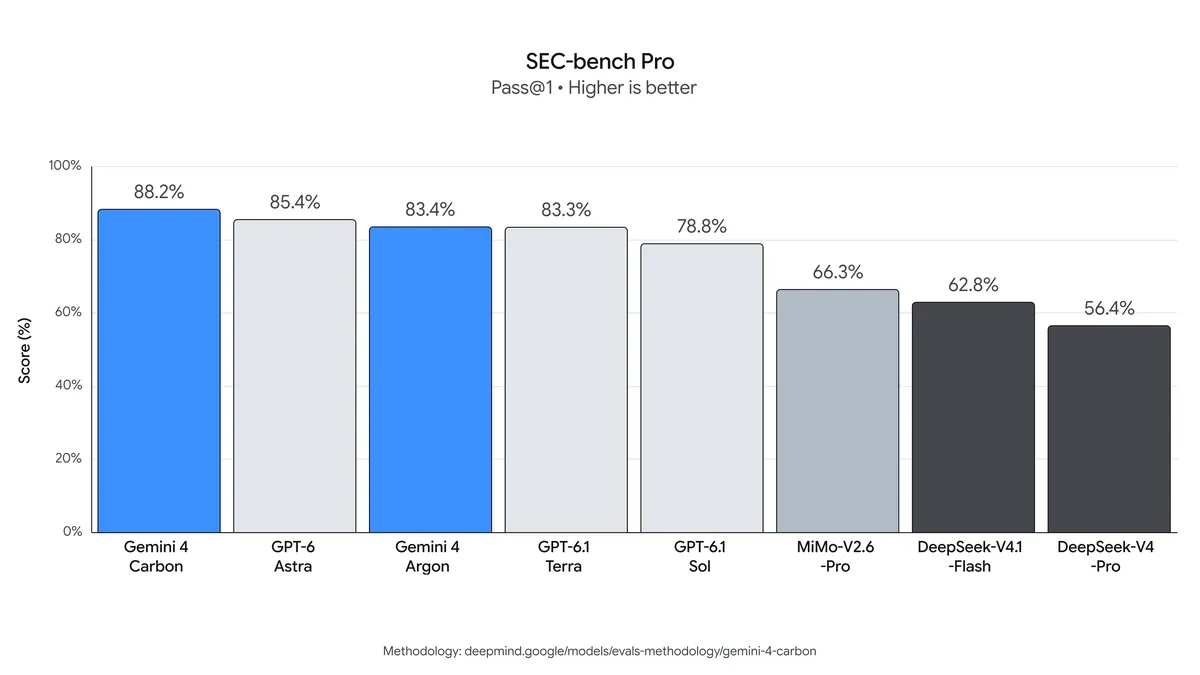
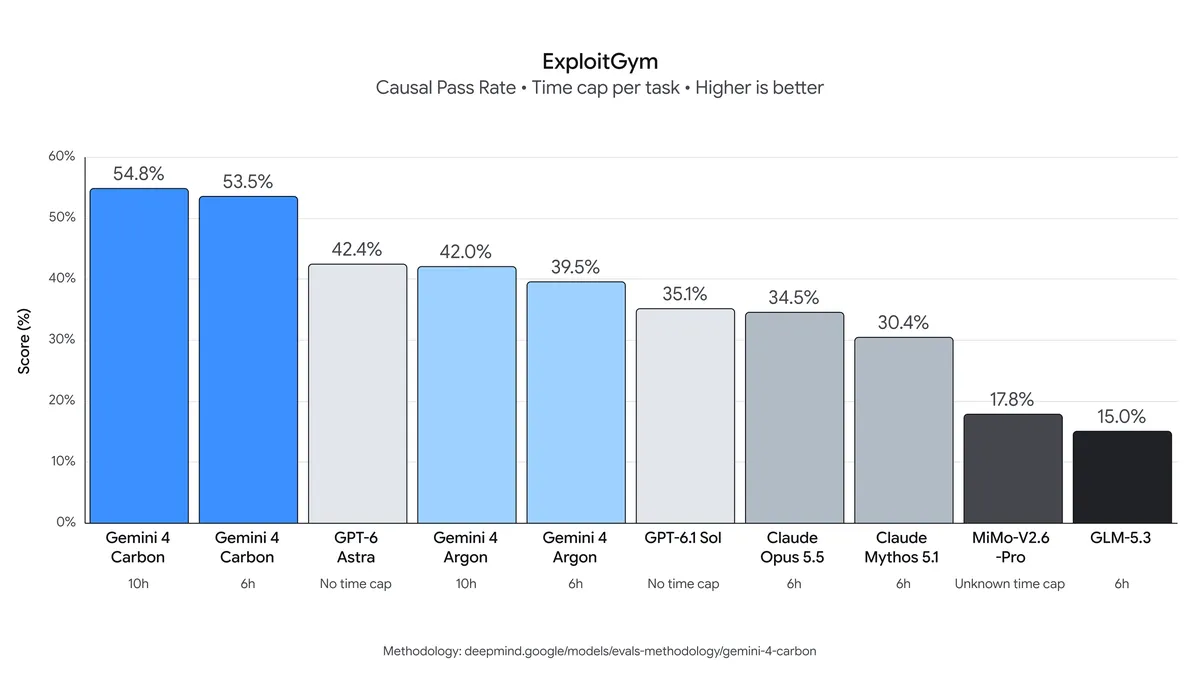
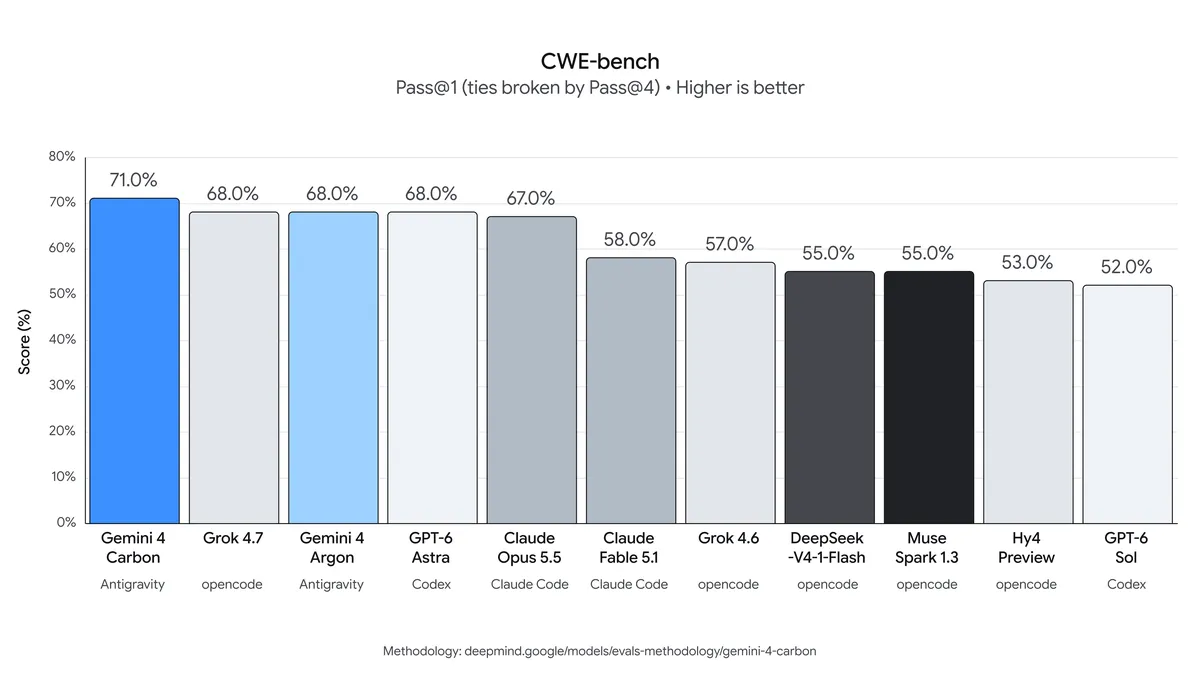
First, the hard metrics. Carbon scored 59 on the Artificial Analysis Intelligence Index v5.0, ranking first. This leaderboard is a composite capability score, not a single-subject exam. On cybersecurity, there are three results: SEC-bench Pro vulnerability finding 88.2%, ExploitGym exploitability validation 54.8%, and CWE-bench patching 71.0%. On WebDev Arena, Carbon is 89 Elo points above Argon and ranks No. 4 with 1,768 points. Pricing follows Argon's introductory price: $2 per million input tokens, $10 for output, and cached input is 95% off. After the introductory period, prices return to $4 and $20.

The table in Sundar's tweet compares Carbon with Argon, GPT-6 Astra, Claude Opus 5.5, and Claude Fable 5.1. The numbers are dense, and Carbon leads on AA Index, SEC-bench Pro, ExploitGym, and CWE-bench. The blog also includes another summary table.
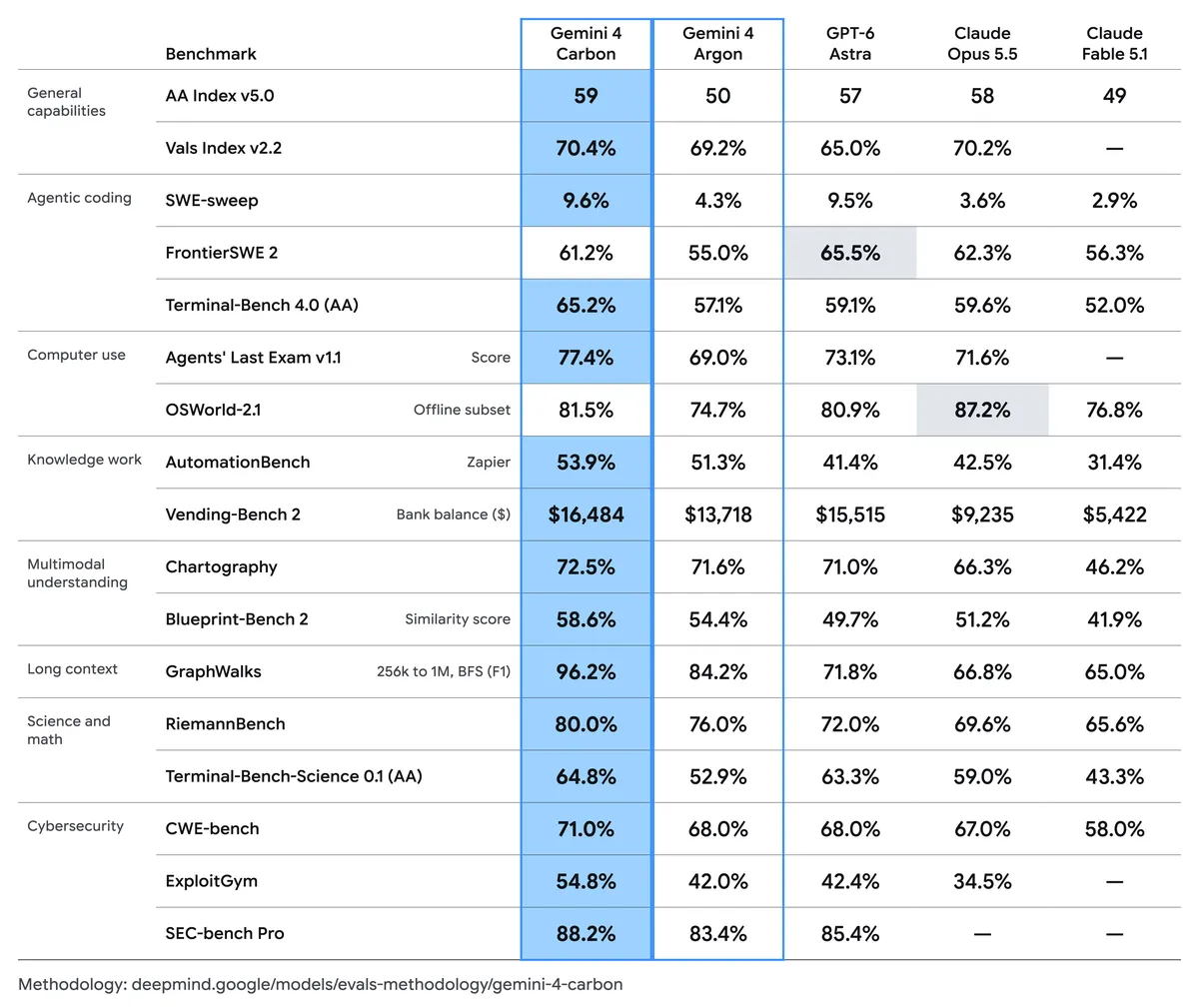
For long-horizon tasks, Google says internal teams had Carbon run continuously for several days on multi-step engineering problems such as root-cause localization and patching in large codebases. The Chrome team reported that Carbon generated high-quality patches more than 10 times better than another lab's large frontier model. Wiz also observed that it leads on web penetration testing benchmarks. These are claims from Google and its partners; the actual experience will have to wait until it is opened up.
On cybersecurity, the blog includes three charts. For finding vulnerabilities, SEC-bench Pro: Carbon 88.2%. For validating risk, ExploitGym: Carbon 54.8%. For patching, CWE-bench: Carbon 71.0%.
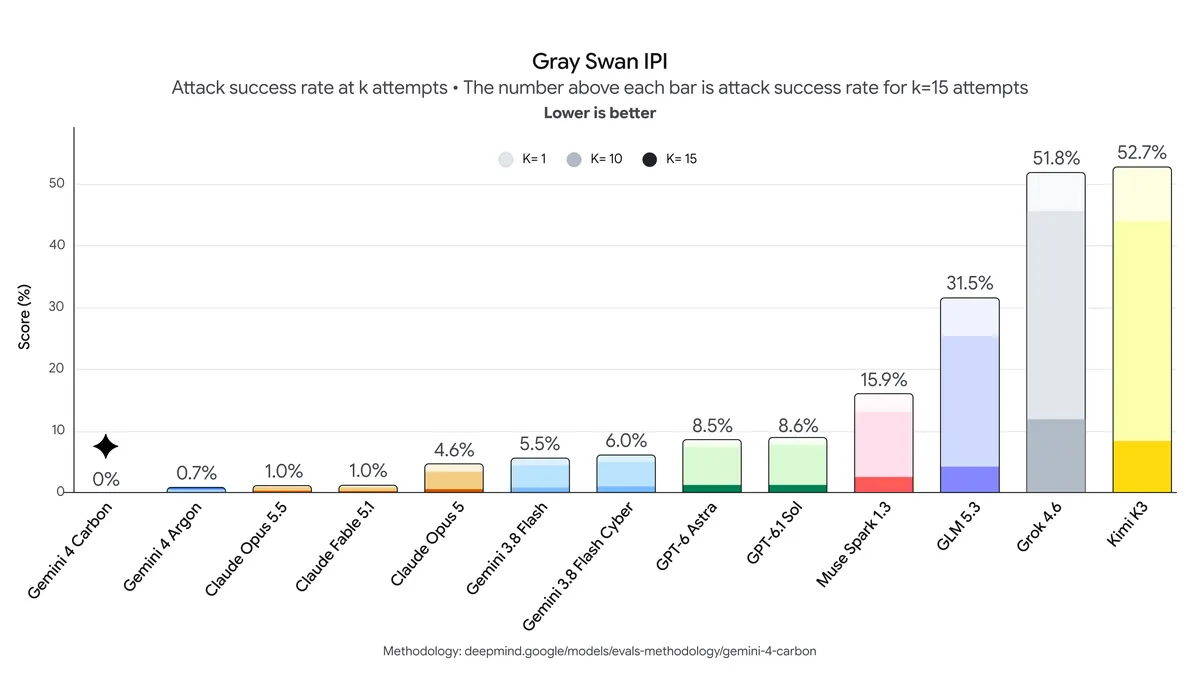
Safety alignment data was also provided. On Terminal-Bench 4.0, successful cheating dropped to 0.0%, with attempted cheating at 0.4%. Internal high-severity misalignment alerts fell by nearly 80%. Unsupported claims were about 2x fewer than Argon. Overreach dropped 26%, and under-service dropped 29%. On the Gray Swan indirect prompt injection benchmark, attack success rate was 0.0%, compared with 0.7% for Argon. These metrics come from Google's internal tests and external benchmarks; the launch blog post includes links to the methodology.
The rollout pace was the most controversial part on launch day. Carbon will first be available to a subset of cyber defenders starting this week. It will then expand to trusted partners through the Fairwind Program. Google says it is participating in the U.S. government's voluntary pre-release testing process for frontier models, and that developers, enterprises, and consumers will get access 'soon.' Price and availability are two different things.
The community reaction was direct. Under Sundar's tweet, Brad Watton wrote: Two weeks from Argon to Carbon. 'Periodically' clearly meant the table, not the calendar. The point was that 'periodic' referred to the table, not the calendar. Michael M said that unless Google significantly reduces the hallucination rate, he has no interest no matter how high the benchmark scores are. DAD The Builder offered a new interpretation of Carbon: by the time you get access, the model will already need carbon dating. Pietr said that if Argon's script repeats, by the time access arrives in a few months, a better model will already be out. These comments do not represent all users, but they show the gap between release pace and actual experience.
One user posted a reaction video with the caption: 'when you never expected Google to drop a model better than Argon that too soon.' In the video, the person sits at a dining table with a confused expression. Placed next to the No. 1 ranking, the reaction is quite accurate.
Carbon's name, price, and benchmarks are all clear. What is not clear is when ordinary developers and users will actually be able to use it. Google says 'soon,' and the comments are asking 'how long is soon?' The previous Argon rollout already caused some people to lose patience, and this time Carbon puts the same question back on the table.
Original blog post: https://blog.google/innovation-and-ai/models-and-research/gemini-models/introducing-gemini-4-carbon/
Sundar's tweet: https://x.com/sundarpichai/status/2115489219804352921
发布时间: 2026-10-29 06:32