A world model that runs on a single 4090: Tencent releases the code, weights, and evaluation set
Hy-Nomas is open source, supports multi-turn interaction with text and camera, enables low-VRAM inference on a single 4090, and 280 evaluation cases are released alongside it. The technical report's comparison with Genie 3 has both wins and losses.
Tencent Hunyuan has open-sourced Hy-Nomas, an interactive video world model. The code, weights, technical report, and evaluation set are all released together, and the web demo has no waitlist.
The official comparison video is titled Hy-Nomas vs Genie 4:
It addresses context preservation in continuous interaction. Ordinary video generation models give you one clip at a time; Hy-Nomas generates segment by segment, using KV cache to carry history between segments. Text can modify objects, style, scene, and actions over multiple turns, and camera trajectories can also be used as conditional input. The technical report abstract is quite specific: structured video captions paired with action-aware causal attention, descriptive context visible across segments, and action instructions confined to the time window in which they are supposed to occur. In the web demo, Nomas-PE first converts user instructions into structured prompts; offline inference reads a prepared prompt file directly.
The model backbone is an 8B diffusion model with 54 dual-stream MMDiT blocks. The text encoder uses the language-model portion of Qwen2.5-VL-7B-Instruct. Video uses DCAE-V's 32-channel latent, with 32x spatial compression and 4x temporal compression, and decoding uses a fine-tuned PixelUMM. Standard inference uses 8 denoising steps and outputs 720x1280 at 24fps. The standard configuration runs with 8-GPU sequence parallelism; there is also a low-VRAM configuration for a single RTX 4090: DiT weights and KV cache stored in INT8, decoder in FP8, CPU offload, and the GPU keeps at most 18 historical latent frames, with earlier history archived on the CPU.
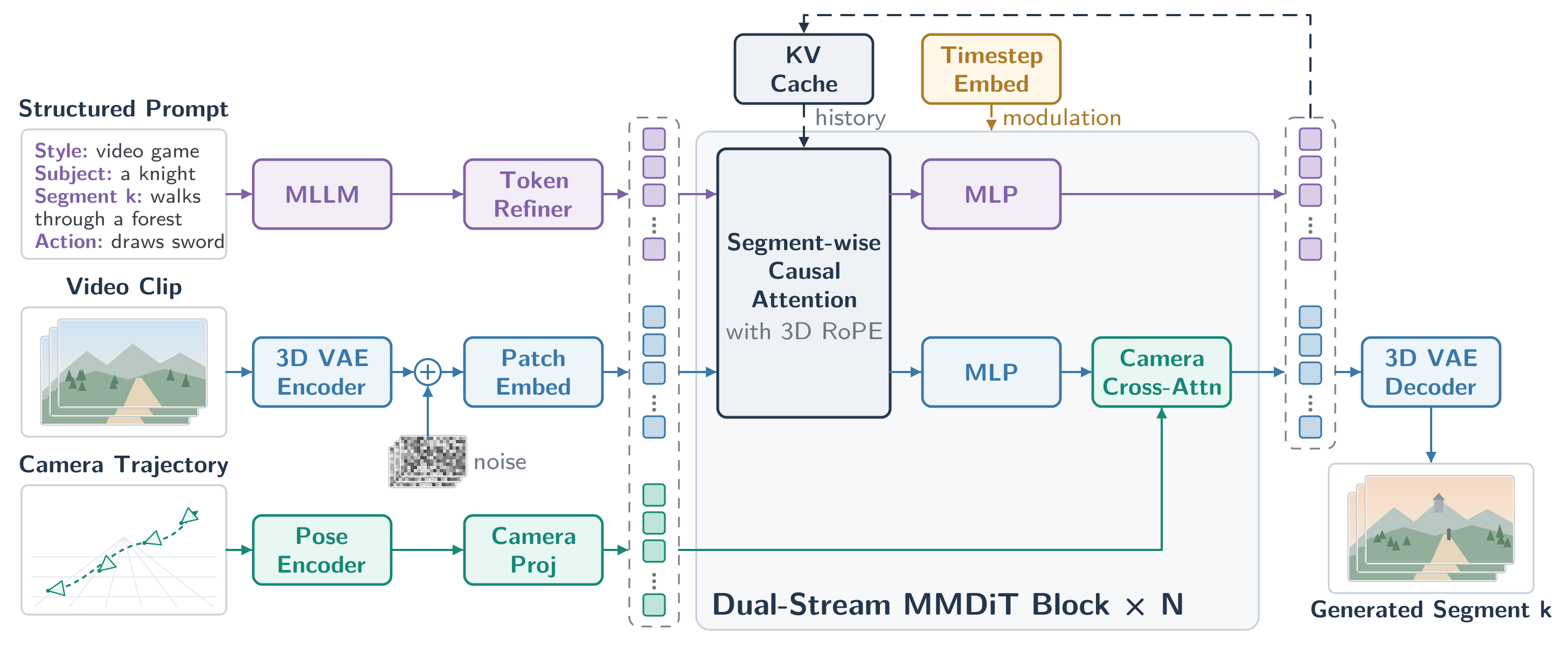
In a reply, a user summed up the single-card 4090 configuration in one sentence: DiT weights and KV cache stored in INT8, decoder runs in FP8, only 18 historical latent frames stay on the GPU, and the rest of the world history waits on the CPU. Still 8 steps, still 720x1280 at 24fps.

The bench is the more noteworthy part this time. Hy-Nomas-Bench contains 280 test cases divided into four groups: 60 multi-turn text, 100 camera navigation, 60 interleaved text and camera, and 60 spatial memory. Camera navigation covers 49 scenes, 8 basic camera actions, and 24 two-key combinations, with each action lasting 2 to 4 seconds, paired with a reverse return of equal duration. Spatial memory uses four sets of outbound-and-return paths to compare whether objects and scenes remain consistent when returning to the same camera pose. The dataset provides prompts, structured captions, interaction sequences, and reference camera trajectories. It provides evaluation inputs and geometry; scoring is another matter. There are many open-source world models, but few are willing to release their evaluation sets as well.
The human evaluation comparison from the technical report is also out. One user summarized: against Genie 3, Hy-Nomas has a 32% win rate and 14% loss rate on camera control over 100 trajectories; on spatial memory, a 13.3% win rate and 30% loss rate. This time the official team recreated Genie 4 examples and released a full comparison video, but the materials do not provide quantitative win/loss results against Genie 4. Someone replied hoping to run Genie 4's looped paths with the same pairwise test. That request is reasonable: video can show trends, but quantitative conclusions still depend on reproduction.

A user said in a reply that world memory in video models is the part that really matters. Hy-Nomas puts long-horizon generation and world memory among its main selling points, and the bench also has a dedicated spatial memory item.
Community integrations are already spreading: SGLang merged support; ComfyUI-Hy-Nomas supports chained video segments and WASD camera control; WanGP v18.81 added keyboard exploration and text-driven events; Reactor Runtime provides streaming serving and a browser demo. The Mashbox demo on Google TPU reports real-time 720p on a v6e-4 slice, using 0.933 seconds of compute per second of generated video, with no late frames over a 60-second run.
Rui Zhao built a GTA-style world with Hy-Nomas: driving, spreading wings, taking off, landing, dodging tank fire, and escaping, with keyboard control and text prompts switchable. The video is below.
Project page: https://hy-nomas.hy.tencent.com/ . Demo: https://hy-nomas.hy.tencent.com/demo . Code: https://github.com/Tencent-Hunyuan/Hy-Nomas . Weights: https://huggingface.co/tencent/Hy-Nomas . Technical report: https://arxiv.org/abs/2610.36729 . Bench: https://huggingface.co/datasets/tencent/Hy-Nomas-Bench .
The interesting part here is not another world-model demo. Beyond open weights, releasing the bench as well is what gives people an entry point for reproduction and comparison. The competitive focus for world models has also shifted from single-clip video quality to interactive controllability, long-term memory, and consistency. The single-card 4090 configuration lowers the barrier to experimentation, but the low-VRAM setup has CPU offload and transfer overhead, and the standard configuration is still 8 cards. The phrase 'no waitlist' still resonates in 2026, which shows people have been annoyed by waitlists for a long time.
发布时间: 2026-10-30 03:36