Equivalent Intelligence Gets 10x Cheaper Every 4 to 6 Months—So Why Hasn't the Bill Gone Down?
Mert Gulsun said a line twice on ThursdAI: every 4 to 6 months, the same intelligence gets 10x cheaper. For the first time, more than half of the Artificial Analysis Index v5 score comes from private questions, and cost has to be calculated per task. Yet the per-task cost of frontier models is still rising.
Mert Gulsun was asked to say a line twice in the ThursdAI clip. Alex Volkov's original wording was that he didn't want this line to get buried: every 4 to 6 months, the same level of intelligence gets 10x cheaper. This is the judgment Artificial Analysis gives for its entire index. The comparison is equal intelligence, not equal models.
The interesting part of this tweet is the second half. Frontier models like Fables and Astras are seeing their cost per task go up. The same chart shows two lines moving in opposite directions: at the bottom, old intelligence is rapidly getting cheaper; at the top, the new frontier keeps raising prices. For developers, the purchasing question comes down to the task level: which tasks must chase the newest models, and which tasks can just wait two quarters.
AA has just released Intelligence Index v5. Mert says this is the first time more than 50% of the index score comes from private held-out tasks—problems the labs cannot see during training. Four categories at 25% each: knowledge work, coding, general intelligence, and science. From v4.3 to v5, there are two new evals, three upgrades, and three retirements. AA also launched a Progress Index, drawing questions from 36 evals and backtesting models since November 2022 with the same set of questions to produce a cleaner progress curve.
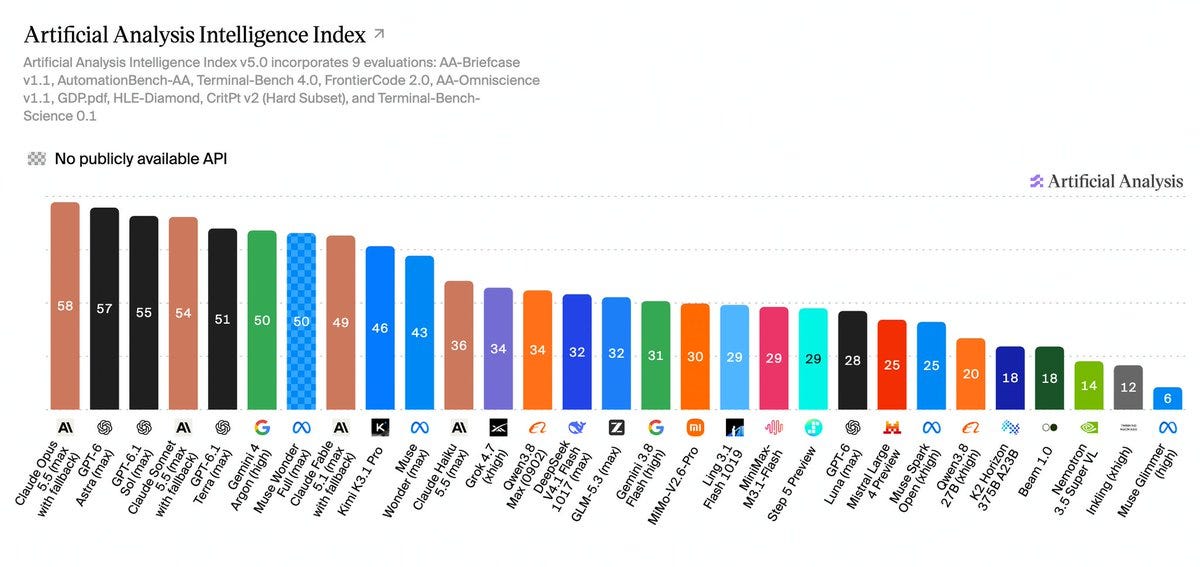
AA has consistently pushed cost per task, not just per-token pricing. Mert explains it plainly in the clip: users don't care how many tokens, subagents, or retries the system used behind the scenes; they only care about the speed, intelligence, and total cost of getting the job done. This framing is closer to the real bill, because a model with cheap tokens can burn the savings back through long-chain reasoning.
One commenter added in a reply that waiting has also become a strategy. The previous generation of brains is good enough for most work, and you pay for frontier models only when cheaper models actually fail. Yurii Filipchuk asked whether the rise in cost per task is because tasks are getting longer or because tokens are getting more expensive. In the clip, Mert only lays out the phenomenon: the other end of the cost curve is moving up, and Fables and Astras are at that end. Whether it is longer tasks or more expensive tokens still needs to be unpacked by AA.
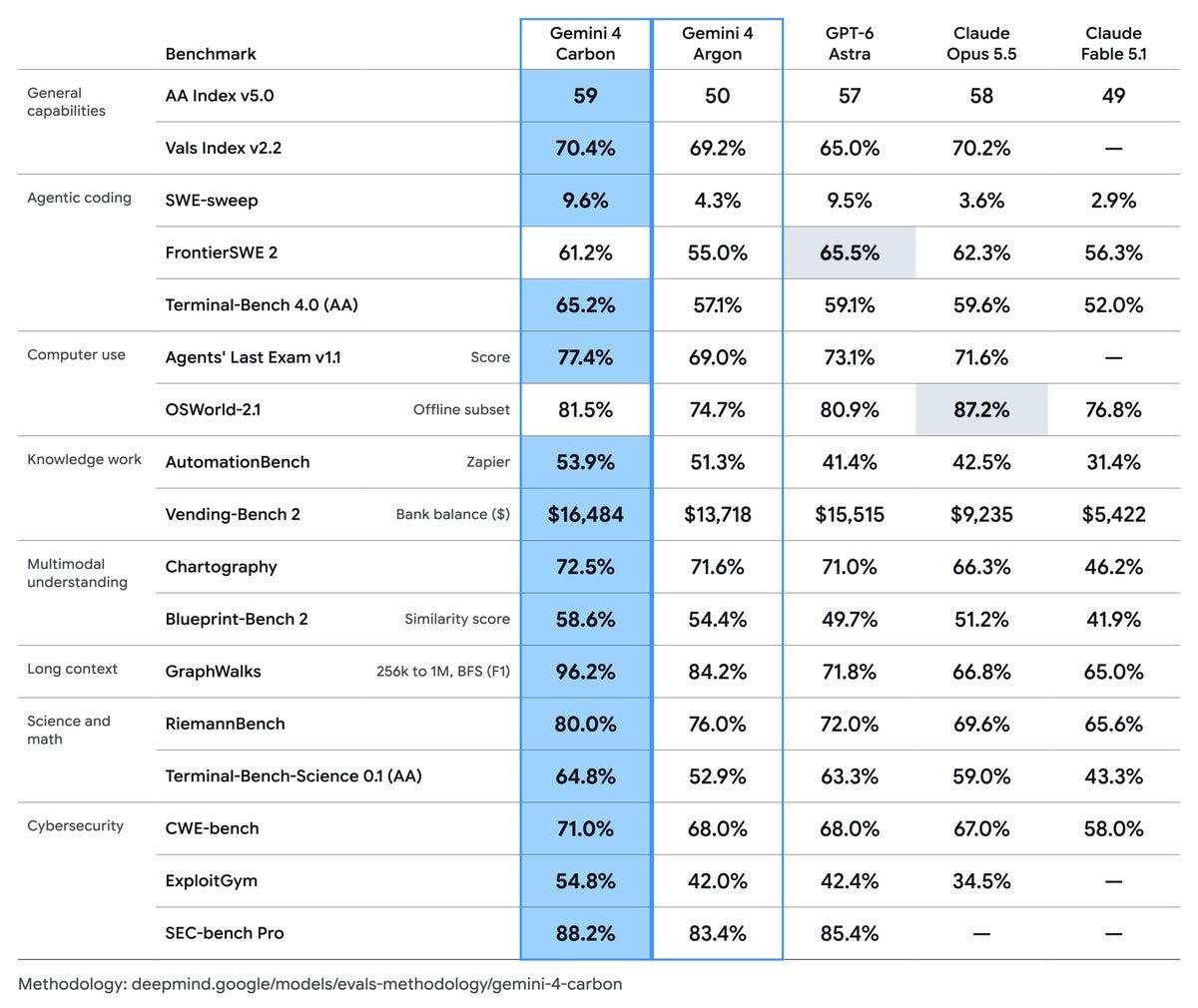
In the same week, Gemini 4 Carbon scored 59 on AA Index v5, taking first place, one point ahead of Claude Opus 5.5, first in Text Arena, and second in Agent Arena. Launch pricing is $2 per million input tokens and $10 per million output tokens, including a 50% launch discount. Mert mentioned that DeepMind has long placed bets on science; AlphaFold is an older example, and as evals now shift toward science, that accumulated advantage is starting to show. Whether a one-point gap is significant was also put to Mert in the clip.
Put the time scales side by side: model rankings change by the week, the cost of equal intelligence drops 10x every 4 to 6 months, and company procurement and migration move on an annual cycle. The mismatch is right there. Reassessing your model mix once a quarter may be more practical than chasing every release. The full clip is on YouTube, and the show notes are on ThursdAI. The views come from Alex Volkov's tweet, an interview with Mert Gulsun and Artificial Analysis, and replies from Iris Qingrou and Yurii Filipchuk.
发布时间: 2026-11-02 06:32