In 90 Minutes, an Anthropic Engineer Breaks Down the Agent's Brain and Hands
The course video comes from X; the topic is Claude Managed Agents with Opus 5.5. Over 90 minutes, research agents, scheduled tasks, evals, and multi-customer runs are all broken down. First look at why the brain and hands should be separated, then at the engineering pitfalls that are easy to miss.
Someone on X shared a 90-minute course, presented by an Anthropic engineer, titled Section 01 Claude Managed Agents with Opus 5.5. The video comes from an AI Engineer World's Fair session, and the speaker is Anatoli Kopadze. The original tweet said these 90 minutes can replace $500 Agent tutorials online. Whether that's worth it is another matter, but the course's timeline is laid out very practically.
<video title='Anthropic 工程师在 AI Engineer World's Fair 讲 Claude Managed Agents with Opus 5.5' controls height='1080' width='1920' poster='https://wink.run/image?url=https%3A%2F%2Fpbs.twimg.com%2Famplify_video_thumb%2F2116189932616138752%2Fimg%2F_ge7LGh-jm1owcEr.jpg' src='https://video.twimg.com/amplify_video/2116189932616138752/vid/avc1/1920x1080/c2bgAcsUax0ZWZO7.mp4?tag=29'>
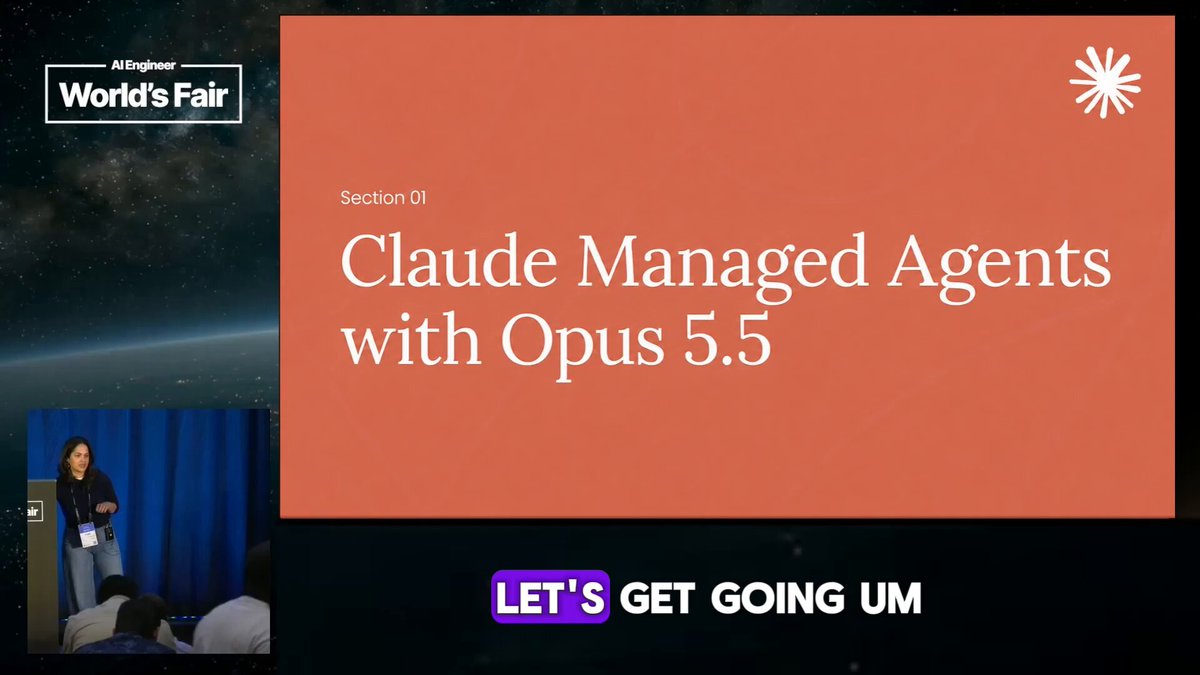
Timeline:
- 00:00 Why the brain and hands should be separated
- 07:45 The architecture behind Claude Managed Agents
- 23:40 Building a research agent step by step
- 54:00 Agents that run on a schedule, and 'dreaming' between tasks
- 1:10:23 Evals, CI/CD, and running agents for multiple customers at the same time
Of these five sections, the first is the easiest to skip. Many DIY agents plug tools directly into the reasoning loop from the start. They can run in the short term, but when problems appear later, it's hard to diagnose: did the model make a wrong judgment, did the tool call go wrong, or did the orchestration layer fail to catch it? The course separates planning, tool calling, and evaluation into independent stages. Some commenters said that this way, when something goes wrong, you can pinpoint the specific stage.
Another commenter pointed out a further benefit: once the brain and execution layer are separated, even if the model changes, tool orchestration and workflows can still be reused. This may not cover every scenario, but the direction is worth checking against your own system.
The research agent section at 23:40 is worth pulling out and watching on its own. One commenter summarized: define the retrieval scope and validation criteria first, so that when the agent goes off track, there is evidence you can check. This idea isn't new, but placed within a 90-minute live breakdown, it's clearer than reading a blog post alone.
At 54:00, it covers agents that run on a schedule, and 'dreaming' between tasks. For people doing scheduled research tasks, one commenter gave a more specific suggestion: keep the previous results, report only additions and changes, and attach the original sources. Rewriting a complete report every day actually makes it harder to see what exactly is new this time.
The last section moves into evals, CI/CD, and running agents for multiple customers. Here is an engineering detail that's easy to miss: if scheduled multi-customer tasks aren't bound to a tenant identity, callback results may be attributed to the wrong owner. Someone in the replies also asked whether the Claude API is mandatory. Boundary questions like these are worth noting as you watch.
If you have a development background, you can compare it with your own agent workflow: are the brain and hands mixed together, and are evals tacked on only at the end? Non-technical readers can treat these 90 minutes as an architecture primer: behind an agent there isn't just a chat box and a few tools, but also orchestration, permissions, evals, and a runtime environment.
Anatoli Kopadze's original tweet: https://x.com/anatolikopadze/status/2116191759231246768
adon's share: https://x.com/F5Adon/status/2117021112500437426
Save it first, and find a full block of time to watch it.
发布时间: 2026-11-03 00:43