Sequoia Capital: AI Companies Will No Longer Sell Software—They’ll Sell Work Outcomes
Sequoia Capital has wrapped up AI Ascent, with more than 150 AI practitioners in attendance. Core thesis: AI opens up a $10 trillion services market; 2026 belongs to agents; the moat is customer relationships, not models. Sequoia gave a counterintuitive answer to where the moat actually lies.
Sequoia Capital just brought more than 150 people in AI together at the AI Ascent summit. Demis Hassabis, Andrej Karpathy, Greg Brockman, Boris Cherny of Anthropic, Dmitri Dolgov of Waymo, and Jim Fan of Nvidia were all there. Sequoia’s Pat Grady, Sonya Huang, and Constantine Buhler took turns on stage to lay out a framework for where AI is heading.

The core thesis in one sentence: AI opens up the services market, which is an order of magnitude larger than software.
Over the fifteen years of cloud computing, the total addressable market for software grew from roughly $350 billion to $650 billion, with cloud capturing about $400 billion of it. AI adds a new layer underneath. Sequoia estimates that roughly $10 trillion of the services market can now be reached by machines. The number may not be precise—$5 trillion or $50 trillion are both possible—but the order of magnitude is clear. U.S. legal services alone, one industry in one country, is a $400 billion market, the same size as the global software industry.
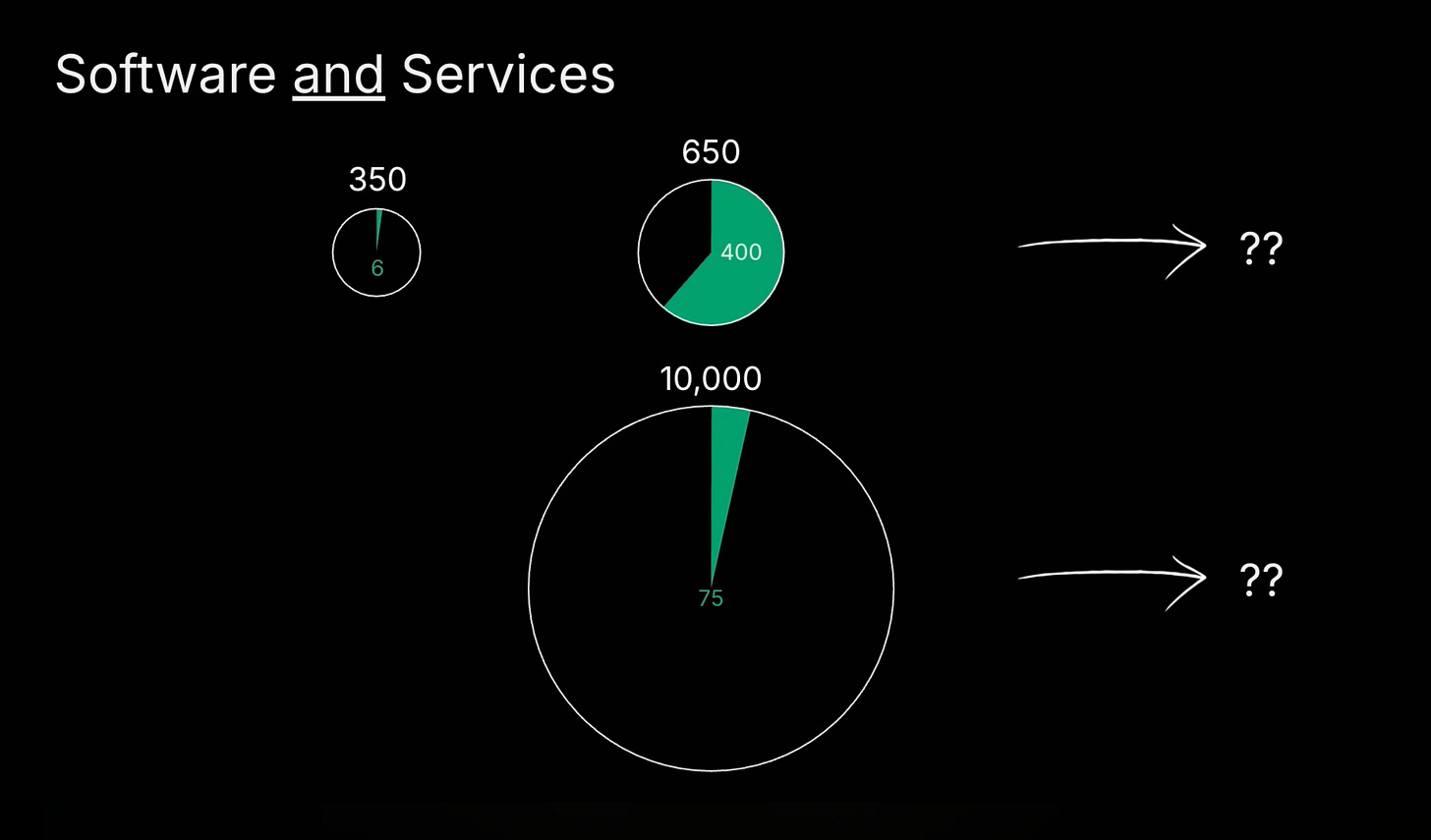
This wave is also faster. In each technology wave, companies reach $1 billion in revenue at an increasingly dense pace. Cloud took more than a decade; AI companies may get there in a few years.
Pat Grady drew a distinction between AI and the internet. The internet changed how information is distributed—it was a communications revolution. AI changes how information is processed—it is a computing revolution. The latter has deeper impact.
He also offered a set of metaphors: over the past few years, AI has been a “faster horse,” improving knowledge-worker productivity by 10% to 40%. Useful, but the shape of work did not change. This current generation is a “car,” delivering 10x to 40x efficiency gains and reorganizing workflows and organizations themselves.
Sequoia’s definition of AGI is very commercial: a system that can be sent out to do work, recover by itself when it fails, and keep going until the task is complete is enough. Philosophical debates can be set aside.
The race has already begun in the services economy. Software companies used to sell systems of record; AI companies sell outcomes. In the past, you gave a lawyer a set of tools; now you do the lawyer’s work directly. This is the view from Sequoia partner Julian’s article, which Sonya Huang specifically cited in her talk.
The moat has changed too. Grady said that in a computing revolution, capabilities change faster than customers do. Technical founders instinctively chase the latest models, but the foundation at the model layer is the least stable. Today’s breakthrough is tomorrow’s baseline. The real moat is customer intimacy, workflow integration, and accumulated trust. Product still matters, but customer stickiness compounds through each wave of technology turnover.
Another easily underestimated thing is affordance—borrowing a term from design, it refers to how an object itself suggests how to use it. A hammer has high affordance; its shape announces its function. Raw model capabilities have very low affordance. Claude Code’s terminal interface is powerful, but ordinary employees inside enterprises do not know what to do with it. The opportunity at the application layer is to package underlying capabilities into intuitive interfaces so customers get results with minimal effort.
There is also a structural opportunity: the diffusion gap. Frontier models improve every week, while enterprises take months or even years to absorb changes. The wider the gap grows, the more room there is at the application layer. Sequoia believes the core task of the application layer is to fill this gap—to turn frontier capabilities into deployed business value.
Sonya Huang declared 2026 the year of agents. 2022 to 2024 was the chat interface; 2024 to 2025 was reasoning models; 2026 belongs to agents. From systems that respond to prompts to systems that pursue goals.
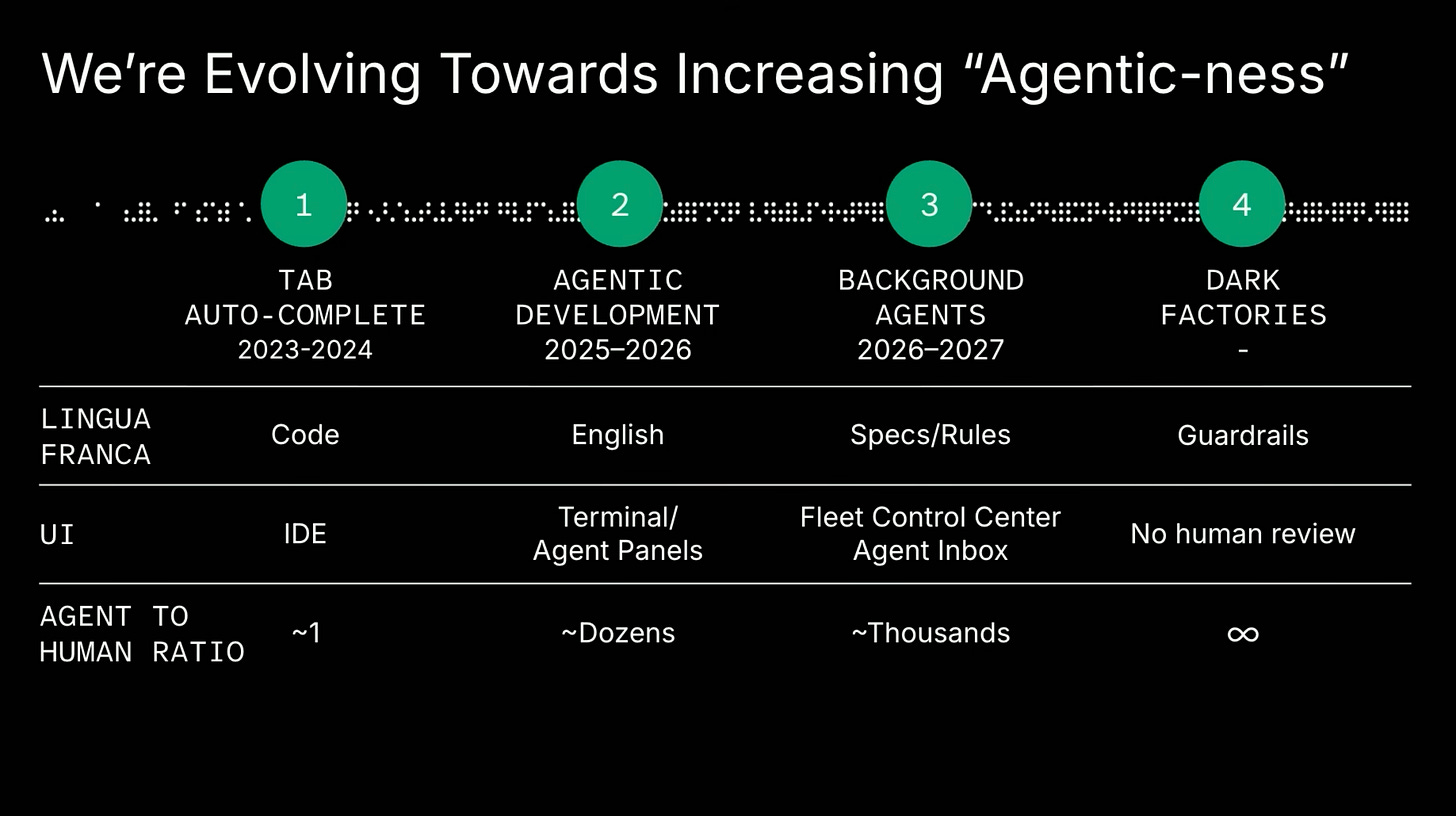
Agents need three things: reasoning and planning, the ability to act (call APIs, run code, search the web, write files), and iteration across long time horizons. Only all three together produce agency.
Agentness is a spectrum. In 2023 it was tab completion in an editor—useful, but not transformative. Then came the development model where a human directs an agent or coordinates a small team of agents. Further out are background asynchronous agents that run for long periods without human supervision and generate sub-agents themselves. The frontier is the dark factory: a pipeline with human review completely removed. Huang said dark factories sound unreal, but they are already appearing in production in narrow domains such as cybersecurity. The same path repeats in every field: assistant, managed intern, self-managed intern, trusted autonomous worker.
Her most important conclusion is that “services are the new software.” In healthcare, agents can analyze genomes, recommend interventions, prescribe drugs, and find clinical trials. In law, they can negotiate contracts, do litigation work, and resolve disputes. In science, they are solving Erdős-level math problems and proposing new superconductors. In personal life, they take over email, calendars, accounts, and tax filing. Economic activity that used to be captured by professional-services firms is being absorbed into the application layer.
Constantine Buhler added another perspective. He divided work into two categories: physical work moves matter; cognitive work moves ideas. The Industrial Revolution handed more than 99% of physical labor to machines. The cognitive revolution is now happening, with a similar trajectory but at greater scale and speed.
He told several stories.
In the mid-19th century, aluminum was more expensive than gold; the aluminum cap atop the Washington Monument was exhibited at Tiffany. After the electrolytic process was invented, aluminum became disposable cutlery and candy wrappers. Buhler’s metaphor: aluminum is intelligence; electrolysis is AI. Professional capabilities that used to take decades to acquire are becoming callable on demand and disposable after use.
In 2006, NASA used evolutionary algorithms to design a satellite antenna. A human-designed symmetrical geometric shape was beaten by a twisted, asymmetrical structure. Buhler believes that as AI takes over the design of chips, vehicles, buildings, and software, the outputs will increasingly look like alien artifacts, and centuries of human aesthetic intuition may no longer apply.
The steam engine was improved for nearly a century entirely through trial and error. Only after thermodynamics was systematized by Carnot in the early 1800s did the field gain a rigorous foundation. Buhler says AI is now also in a trial-and-error phase: systems work, but why they work is not clear. He expects that within 20 years there will be a basic science of intelligence, as rigorous as thermodynamics, and it will enter high-school textbooks.
When photography emerged, many said painting was finished. Instead, painting turned toward Impressionism, Expressionism, and Cubism, no longer asking what the eye sees but beginning to ask what the heart and soul see. Buhler expects that after machines take over the literal execution of cognitive work, human creation and interpretation will turn toward what machines cannot replicate.
He closed by quoting Protagoras: man is the measure of all things. Meaning nothing has value in itself—aluminum, art, intelligence are all the same. Value is conferred by human experience and meaning. AI can do work, and AI will do work, but only human relationships and human attention provide the reason to do that work.
Guillermo Flor concluded the article: three forces define this cycle—the technology foundation shifts every week, the addressable market is roughly 10x larger than previous platform shifts, and the playbook is different from the precedents of cloud and mobile.
Original link: Sequoia AI Ascent 2026: The future of AI
发布时间: 2026-11-03 18:35