After Installing This AI News Plugin, Information Overload Hasn't Eased at All
Longjing (longjing) puts Qiaomu AI News into DeepSeek Harness, bringing domestic and international AI news together in one place. Installation is not complicated; the controversy is over translation and filtering. The tool can save time finding sources, but it cannot save you judgment.
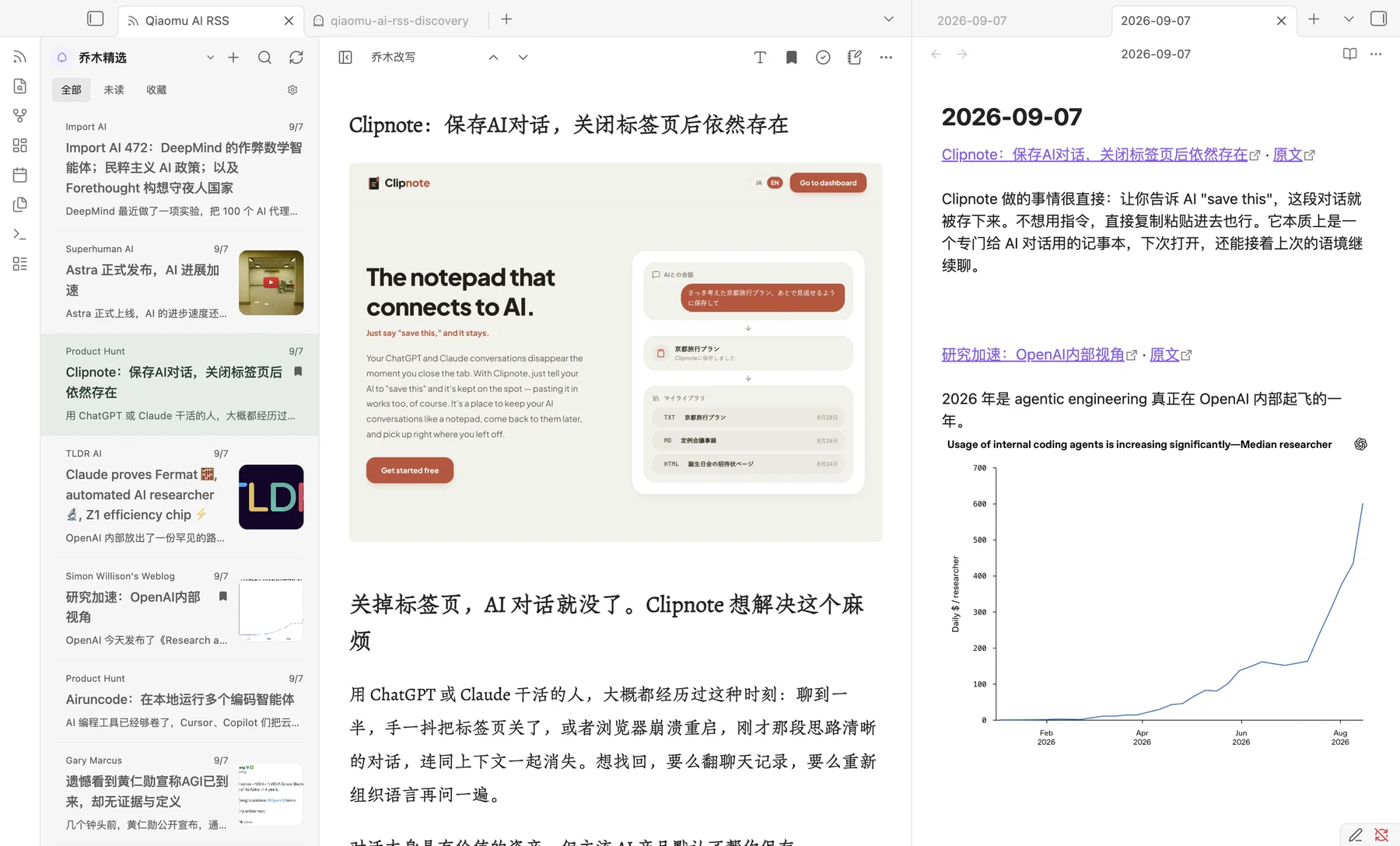
After installing DeepSeek Harness, the first thing to install is Qiaomu AI News. In Longjing (longjing)'s screenshot, the left navigation has plugins, automation tasks, and Qiaomu RSS, while the right side lists Product Hunt's NEXUPIRA, everyday GitHub operations, and neural network articles. AI news is laid directly into the AI workspace, saving the trouble of switching back and forth between browser tabs.

The pain point is very specific: you want to learn more about AI, but you don't know which information sources to follow day to day. There is too much fragmented information every day to keep up with. Qiaomu AI News gathers more than ten AI newsletters, well-known domestic and international AI podcasts, and excellent Chinese public accounts into one reading list. English content is converted into Chinese, with three versions provided: original text, Chinese translation, and Qiaomu rewrite. You can read it on the web by opening rss.qiaomu.ai. For the Obsidian plugin, search for Qiaomu AI RSS in the official plugin library; it requires version 1.13.0 or above. The DeepSeek Harness plugin is a community plugin and is not officially maintained. It also works in the Floatboat workspace.

Installation is not complicated, but the steps need to be clear. DeepSeek Harness users should first install Harness, then download the v0.9.1 .tgz installation package and the SHA256SUMS checksum file and put them in the same folder. In the terminal, verify first, then run dsh plugin --profile desktop add. v0.9.1 supports 0.2.1-rc.2 and rc.3; the release notes say the verified environment is rc.3. Ordinary reading does not require a model key; AI companion reading requires configuring the host model. Obsidian users should go to the third-party plugin browse page, search for Qiaomu AI RSS, install and enable it, and click the RSS icon in the sidebar. The web version requires no installation; just open it and read. Data across the three versions is independent, and subscriptions, read status, and favorites do not sync automatically. Personal subscriptions can be imported and exported with OPML.

The product page states it clearly: less information overload, more deep reading. In the actual interface, the article list is on the left and the Chinese rewritten body is on the right, and you can switch between original, translation, and rewrite. You can also excerpt articles into Obsidian's today's daily note, or take an article into Harness to ask follow-up questions. Podcast entries let you listen to audio, and YouTube video entries display an embedded player. Some subscriptions only have summaries; when full text and translation are unavailable, there is a clear notice and you can jump to the original. For AI rewrites, it is recommended to read them against the original.
The controversy is over translation. TYzzt says that English podcasts being directly converted into Chinese is the biggest draw. Xingxing is the opposite, saying that turning everything English into Chinese is a turnoff, that newsletters lose all their flavor when translated into Chinese, and that technical terms are often translated incorrectly; they asked whether there is a toggle to view the original. Xiangyang Qiaomu replied that the original text is available, and original links are also provided. Suoha Wangye asked whether it is raw machine translation or human-reviewed; if a podcast transcript gets one word wrong, the meaning goes astray. That concern is not unfounded. The product offers three versions, but translation quality depends on the source and the content already available in the service; not every article has full text, translation, and a podcast transcript. Laying out the choices is more honest than pushing a Chinese version.
The bigger controversy is over filtering. Marvin says that after aggregation, event deduplication is still needed; if ten bloggers share the same update, keeping one original source is enough. Once reading volume comes down, there is time to try things that are truly relevant. ZaneChu is more direct, saying this is useless and merely adds noise; you might get annoyed after two days and maybe even uninstall DeepSeek Harness along with it. ByteLee says installing the tool is only the beginning; Qiaomu's daily updates rely on his information-filtering criteria, and even if you read following him for half a year, you may not replicate that judgment. Shiwu says that if an information aggregation product can clearly explain why each piece of content was selected, that is more convincing than simply listing sources. These comments are more worth reading than the product introduction. Tools solve source discovery; judgment still has to grow on your own. xinhedudu mentions a practical value: shortening the time needed to find good content and avoiding ads and junk posts. Ryan_UnStuck is already asking what the subscription list is, which shows users want to see specific filtering results, not just aggregation capability.
The installation question is also interesting. A netizen asked how to install it, and Longjing (longjing) replied: just throw the image to DeepSeek Harness and let it help install; if you don't know how to install Harness, go to the official website in Qiaomu's original post and follow the steps. This answer is very practical, and it also exposes a reality: AI tools installing AI tools still has a barrier, just in a different place.
After installing it, don't start by subscribing to a long list. Keep a few sources you will truly read, treat translation as an aid, and treat the original as the source text. Tools can shorten the time spent finding content, but they cannot save you judgment. The solution to information overload is not aggregation; it is deletion. Delete subscriptions, delete noise, and delete those sources you can't finish but are afraid to unsubscribe from.
发布时间: 2026-11-04 02:38