Enterprise AI spending hits $176.8 billion a year, with 69% going to three companies
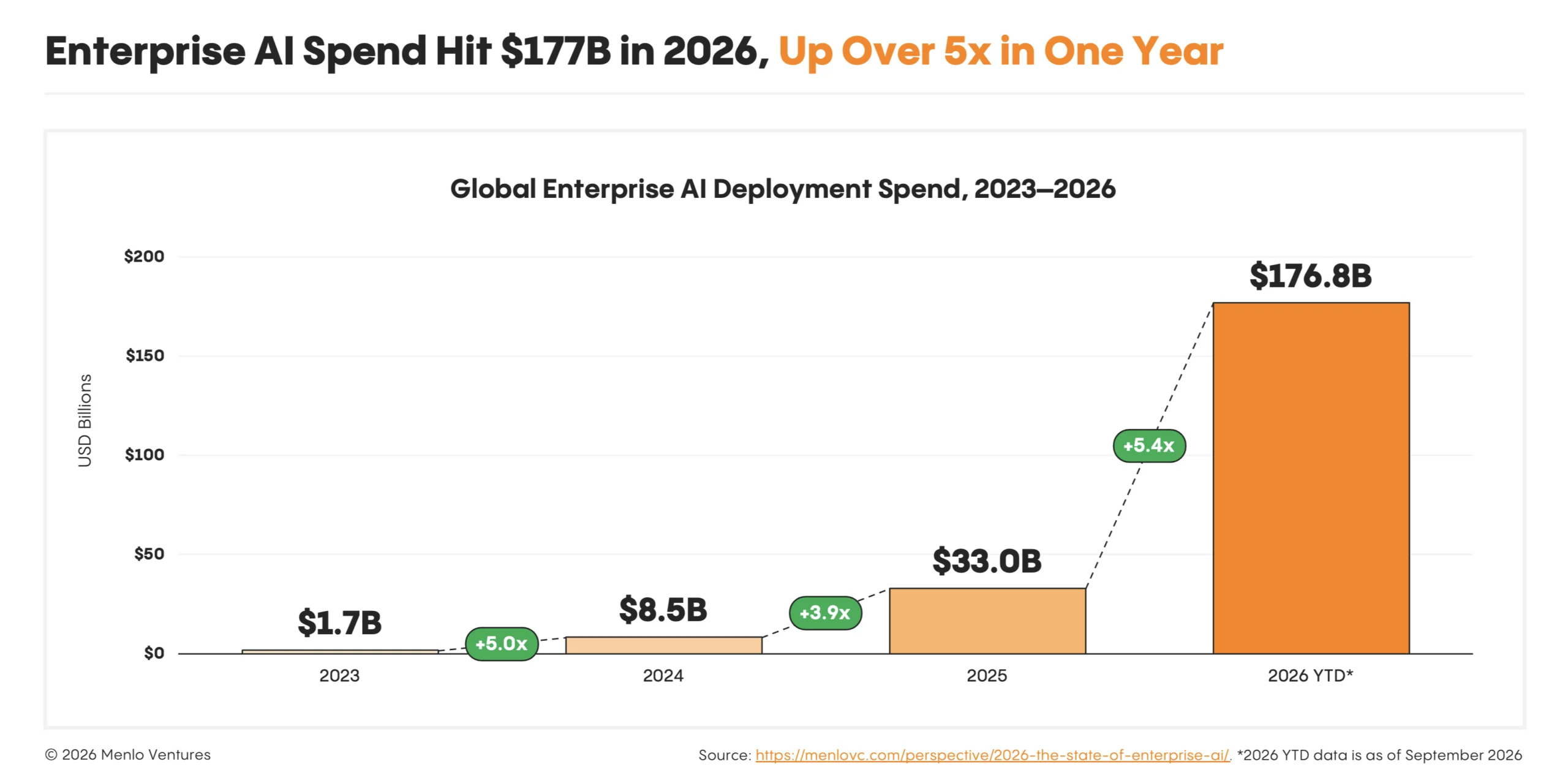
Menlo Ventures' fourth enterprise AI report is out. Enterprise deployment spending rose from $33 billion to $176.8 billion in a year, and Anthropic and OpenAI took 86% of LLM API spending. The bills are rising fast, but bills do not equal workload: the bulk of agent tokens are cache re-reads. Open source is approaching one-fifth of usage but accounts for only 4% of the bill.
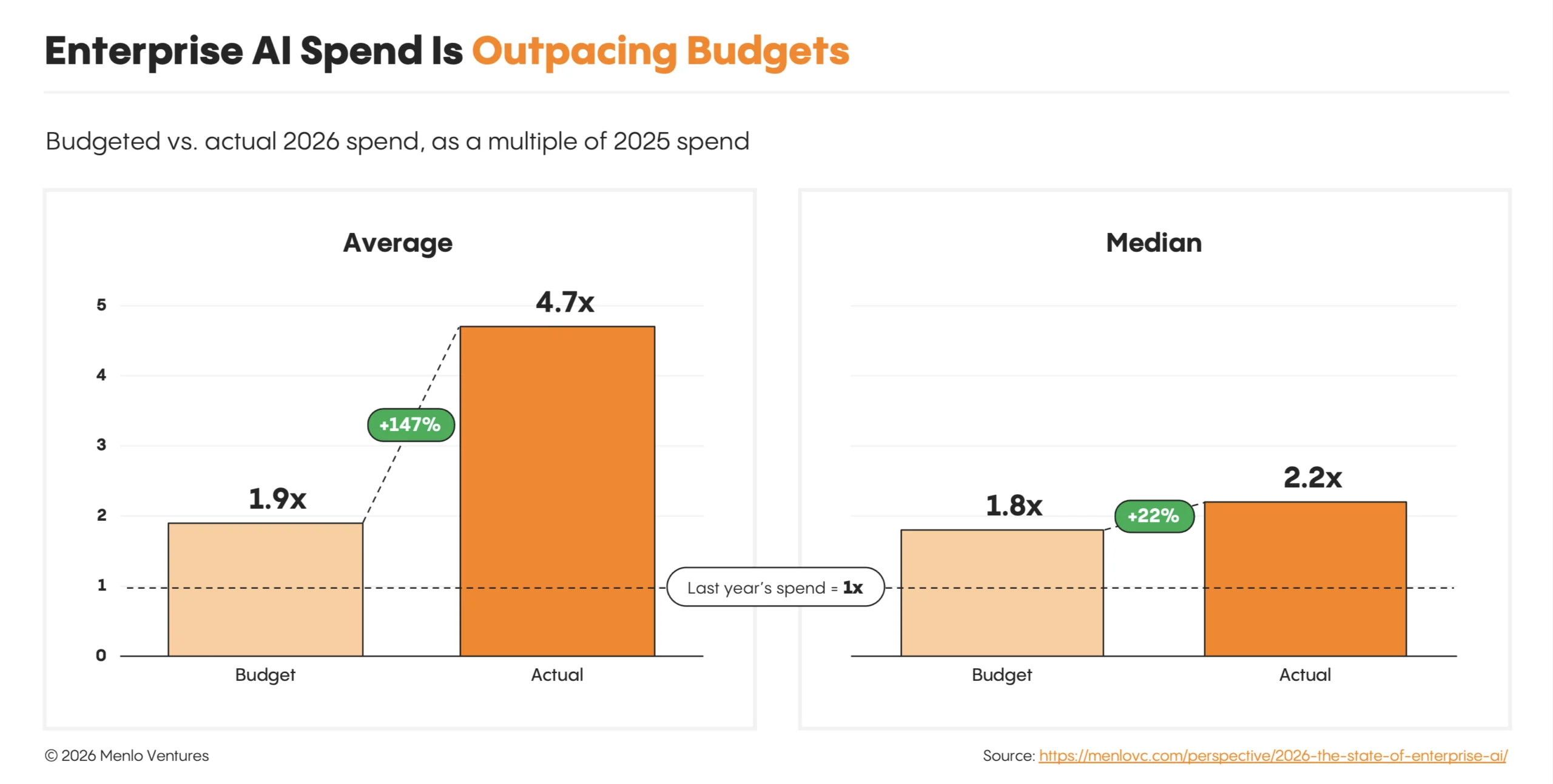
Three years ago, when Menlo Ventures first measured enterprise AI spending, the number was $2.5 billion. By September this year, it had become $176.8 billion. A year ago it was still $33 billion.
This report is Menlo Ventures' fourth annual 'State of Enterprise AI,' surveying nearly 400 U.S. enterprise decision-makers, covering more than $4 billion in AI spending, and co-authored by Tim Tully, Joff Redfern, Deedy Das, and Derek Xiao.
On X, Deedy Das summarized three numbers: spending rose 5.4x last year to $177 billion, mostly from existing buyers increasing their commitments; 69% of the money went to three frontier labs (Anthropic, OpenAI, Google), up from 50% a year earlier; and within LLM API spending, 86% went to Anthropic (55%) and OpenAI (31%).

First, where did the money go?
Anthropic's share of enterprise LLM API spending rose from 40% to 55%, OpenAI from 27% to 31%, and Google fell from 21% to 9%. Together the three accounted for $122.7 billion, or 69% of all deployment spending, 2.3x the combined total of all other players.
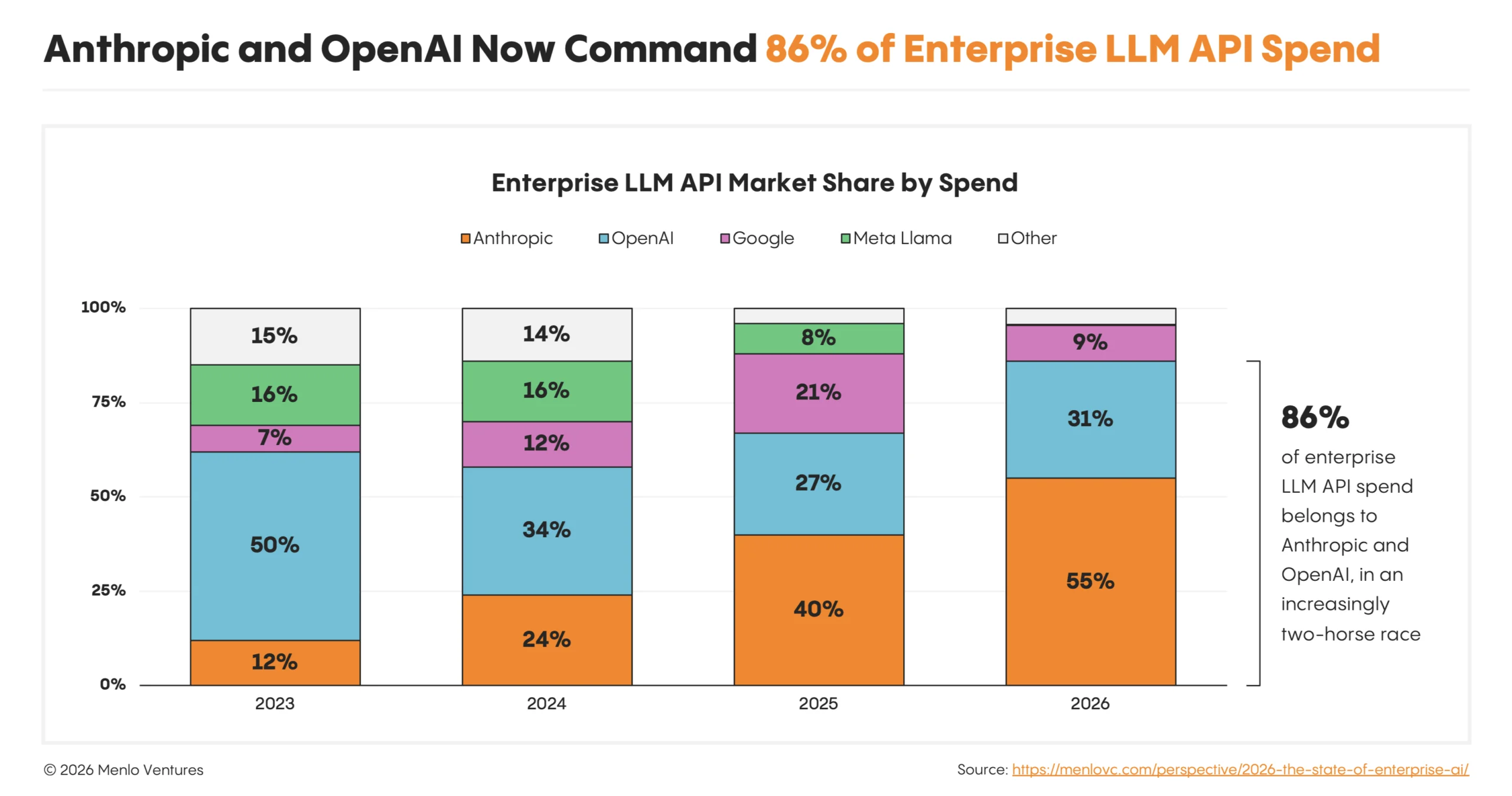
A year ago, Anthropic and OpenAI together accounted for 67%; now they account for 86%. Google's story is more worth watching: Gemini 3 Pro pushed Google back to the frontier in November 2025, but after that it did not keep up with the two companies' flagships, and API spending increasingly shifted toward the cheaper Flash. Near-frontier models such as xAI's Grok 4.7, Kimi K3, DeepSeek V4, and GLM-5.3 cost only a fraction and together account for less than 5% of LLM API spending.
One commenter wrote in reply: OpenAI baked the pie, and Anthropic is eating it.

But there is an easily overlooked issue here. How much money was spent and how much work was done are not the same thing.
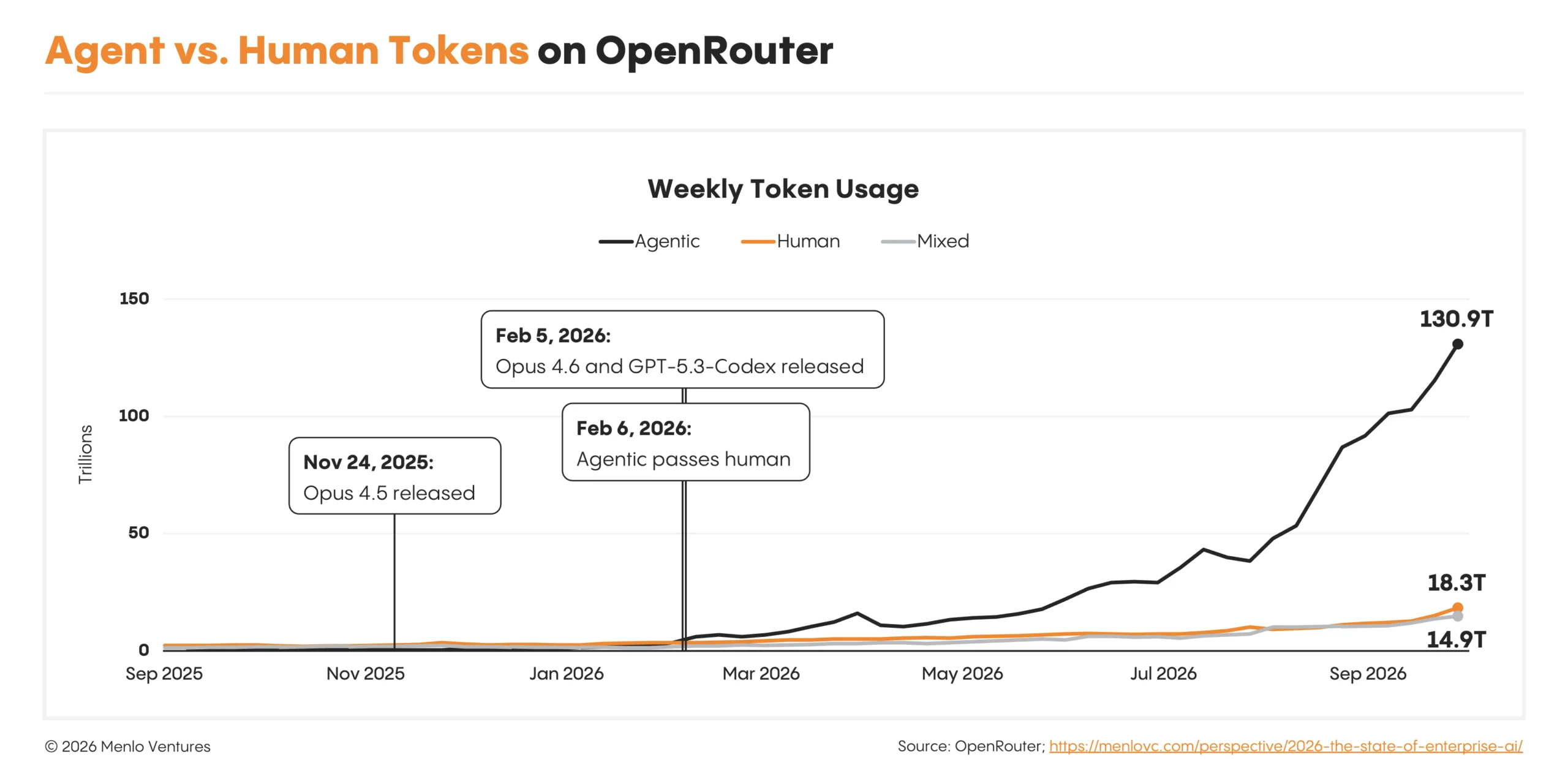
John Rood pointed out in a reply: 5.4x is a billing number, not a workload number. In an agent's request queue, most requests are the same context being resent repeatedly; spending rises with context length while output does not change. The 69% going to three companies only shows where tokens went, not how much work was actually completed.
Solar Nomad gave a concrete case: an agent setup running on a Mac mini used 3.17B tokens in seven days, 99.99% of them using Anthropic models, of which 95.9% were cache reads. The token count looks scary, but the bulk is re-read context. The report does mention that in agent sessions cache reads can account for more than 95%; Opus 5.5's cache read price is $0.20 per million tokens, fresh input is $4, and output is $20. Assuming a mix of 3% fresh input and 2% output, an agent session costs about $0.70 per million tokens.
The $177 billion bill reflects the invocation density of agents, not entirely the workload produced.
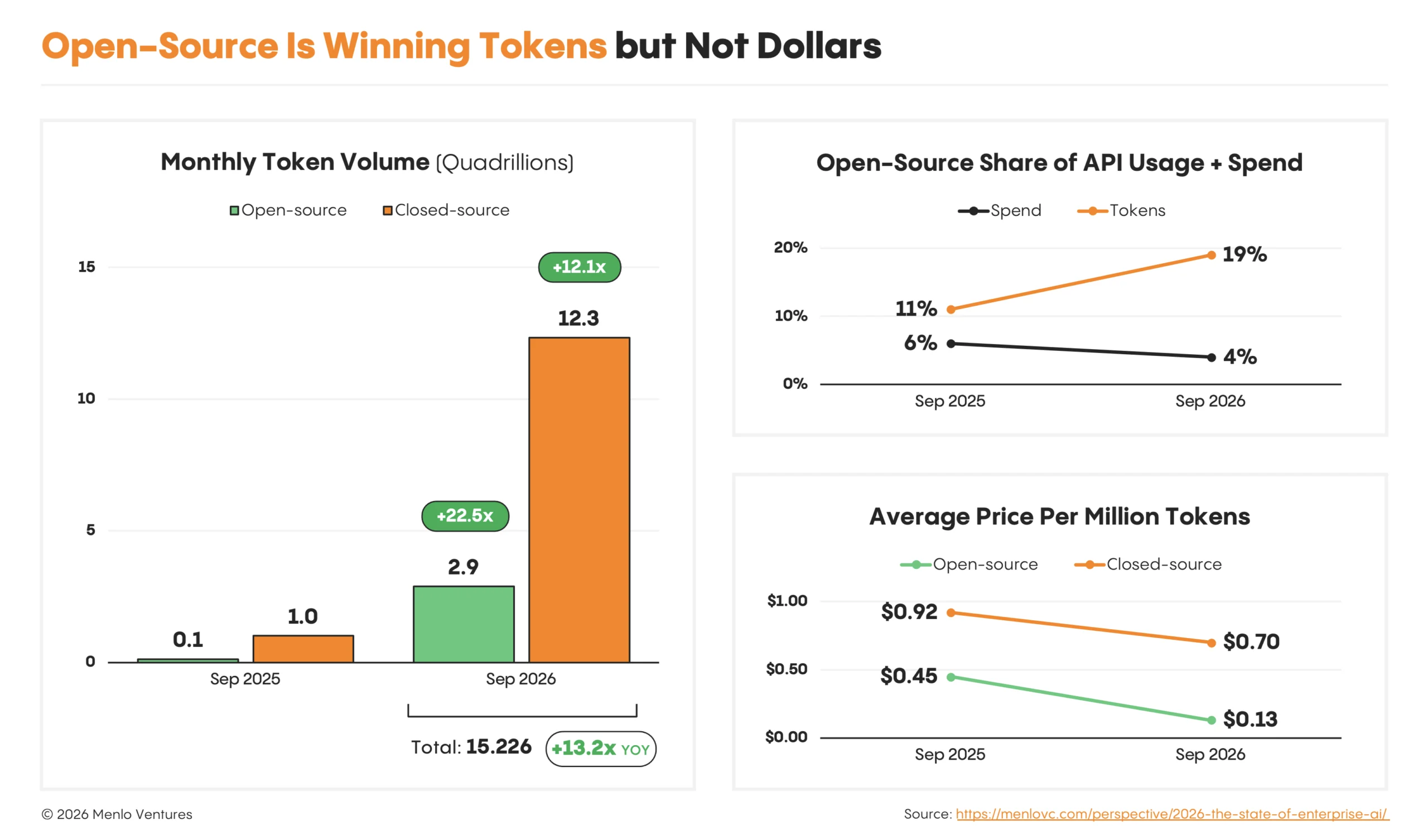
Another data point has a similar flavor. Open-source model usage has risen, but the bill has barely moved. Open source accounts for 19% of tokens and 4% of spending, versus 11% and 6% a year ago. The reason is simple: the average price of open-source tokens fell 3.3x over the year, to $0.13 per million, while the blended average price of closed-source models is $0.70. Usage rose 22.5x, but prices fell even faster.
One commenter's summary: cheap usage does not show up on the spending table, and the top three's spending share looks larger than the work they actually do.
Now, where did the money come from?
55% of incremental AI spending is new budget, not shifted from software budgets or headcount budgets. 22% comes from software budgets, of which 13% stays with incumbent vendors (for example, Office to Copilot), and only 9% (about $12.6 billion) goes to AI-native vendors. Menlo's report says it did not see enterprises replacing core systems such as Salesforce CRM, Workday HRIS, or Oracle NetSuite with AI. AI is expanding the software market while slightly slowing the growth rate of traditional SaaS.
This conclusion is the opposite of the SaaSpocalypse panic earlier this year. At the time, the market feared AI would eat traditional software, triggering a selloff.
Finally, where spending lands.
Of the $7.73 billion application market, coding is $3.4 billion and enterprise chatbots are $2.5 billion; together they account for 76%. Healthcare, as the largest vertical industry, ranks third with only $370 million. The report's explanation is that money flows to the kinds of work where agents can run: there is an operable connected environment, complete context, and verifiable results. Coding has all three most fully: the compiler checks whether it builds, and tests check whether behavior is correct.
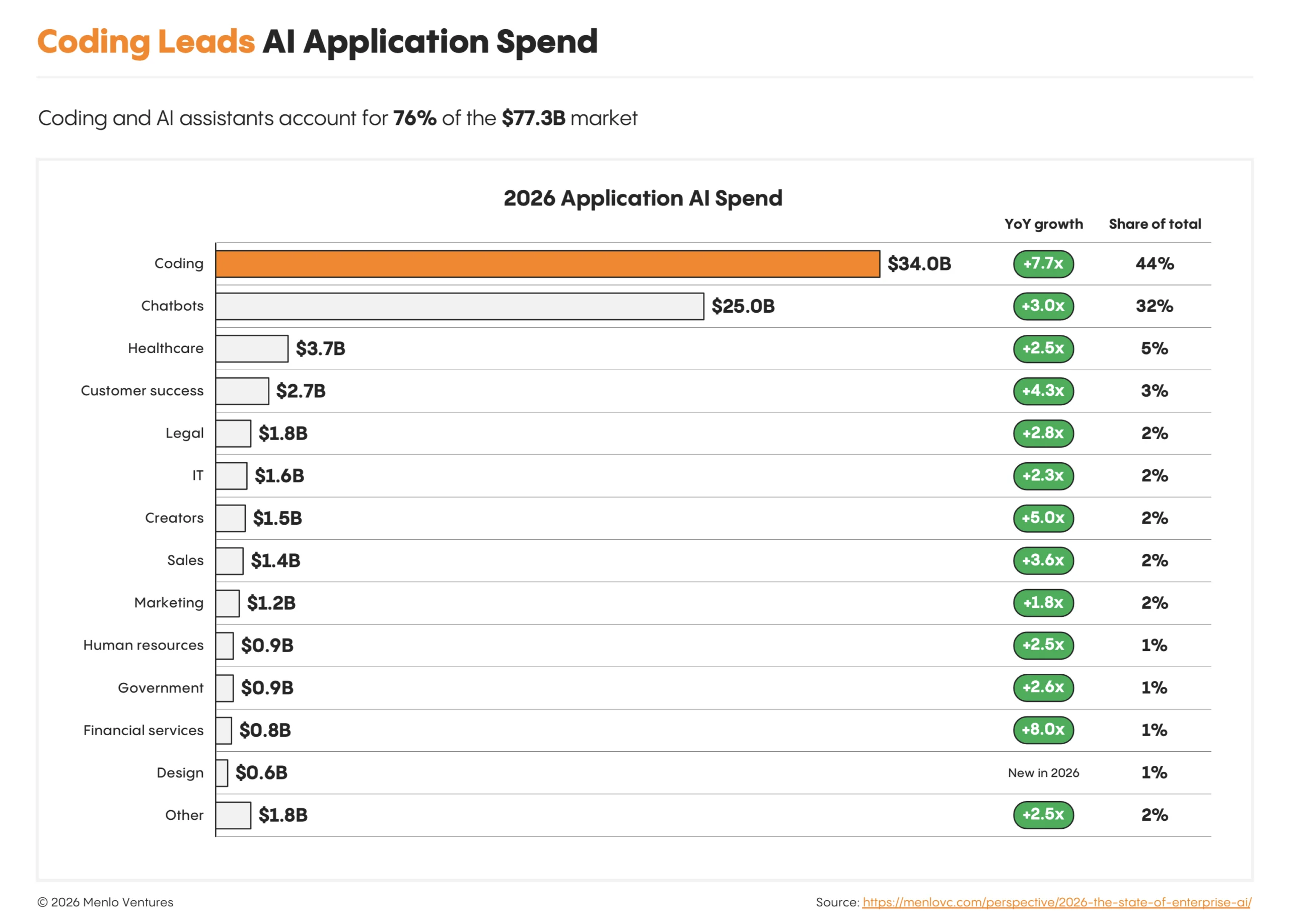
Anthropic's Claude Code and OpenAI's Codex together account for $24 billion, or 70% of the coding market; a year ago this number was still around $1 billion. The rest of the market also grew 2.9x to $10.1 billion, with independent vendors such as Cursor, Cognition, Factory, and Lovable taking share.
Agents are penetrating even faster at the infrastructure layer. 74% of builders use agents to manage workflows, up from 27% in 2025. Code sandbox adoption went from 11% to 40%, search from 5% to 30%, and browser infrastructure from 4% to 14%. Databases are still the system agents touch most, used by 91% of AI applications, and the form is shifting from long-lived persistence to creation and disposal per task.
Deedy Das wrote at the end of the tweet: three years ago, in the first report, enterprise AI spending was $2.5 billion.
5.4x in one year, 100x in three years. The bill is still rising; how much work these dollars bought back is another question.
发布时间: 2026-11-05 01:32