Most of the Work AI Does on the Production Line Isn't Writing—It's Choosing
Nace AI has open-sourced four decision models, the largest being 27B. A single forward pass gives each option a probability and returns a result in 183 milliseconds. In the training recipe, RLAF earns 2 more index points than pure SFT.
AI running in production spends most of its time not writing.
Which group a ticket should be routed to, which button an agent should click next, whether this piece of material can answer the user's question—all of these are multiple-choice questions. The prevailing approach now is to have a large model think it through, then parse the answer out of the output. It's slow, expensive, and asking the same input twice can give different answers.
Nace AI's Drex Technical Report describes another path: given a piece of context, a question, and a set of options, the model does a single forward pass and returns a probability for each option. It doesn't generate text, and it won't answer outside the options you provide.
How exactly decision models are trained and how they perform—these are among the first reports to explain it fairly thoroughly.

Four Models, One Recipe
Drex is a family of four open-source models:
- Drex DLM: 8B
- Drex v1.5: 9B
- Drex v2.0: 35B total parameters, 3B active
- Drex Max: 27B, multimodal
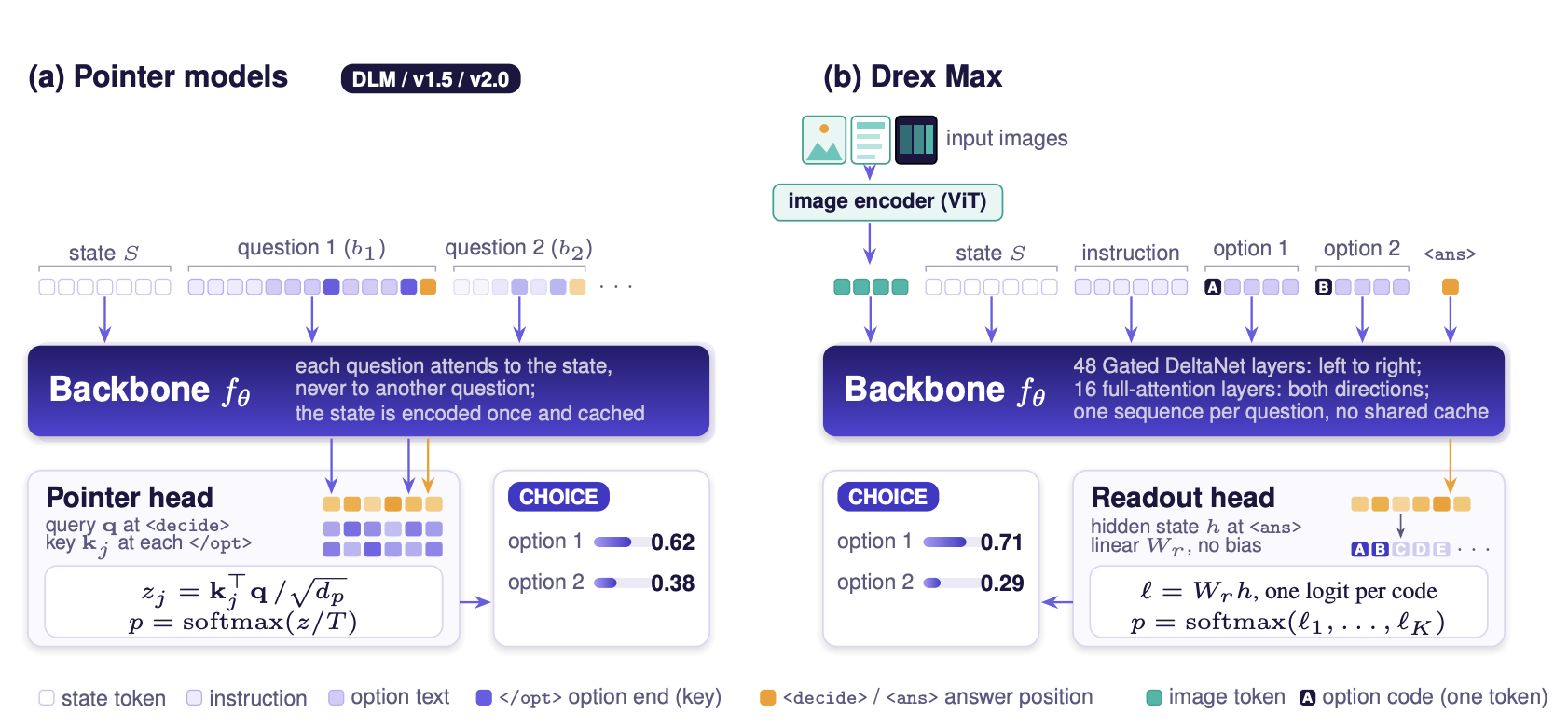
Max is the flagship, based on Qwen3.8-27B, with bidirectional attention and a linear readout head attached to the option encodings. The other three are pointer models: the input is encoded only once, and a small pointer head scores the options for each question.
Training has three layers. SFT lays the foundation, building decision-making ability using labeled data and teacher-generated data. RLAF reinforces on top of SFT, adjusting feedback with verified answers and adding a KL regularization constraint so the model doesn't drift too far from the supervised model. Max adds another layer of visual fine-tuning and reads images directly.
RLAF is the most worthwhile part of the report. A user on X pointed out that its key is using verified answers to adjust the probabilities given by the teacher model, rather than one-hot labels. The probability distribution is the product of a decision model; one-hot flattens this. The paper's ablation experiments say RLAF gains 2 index points over SFT alone.
Numbers
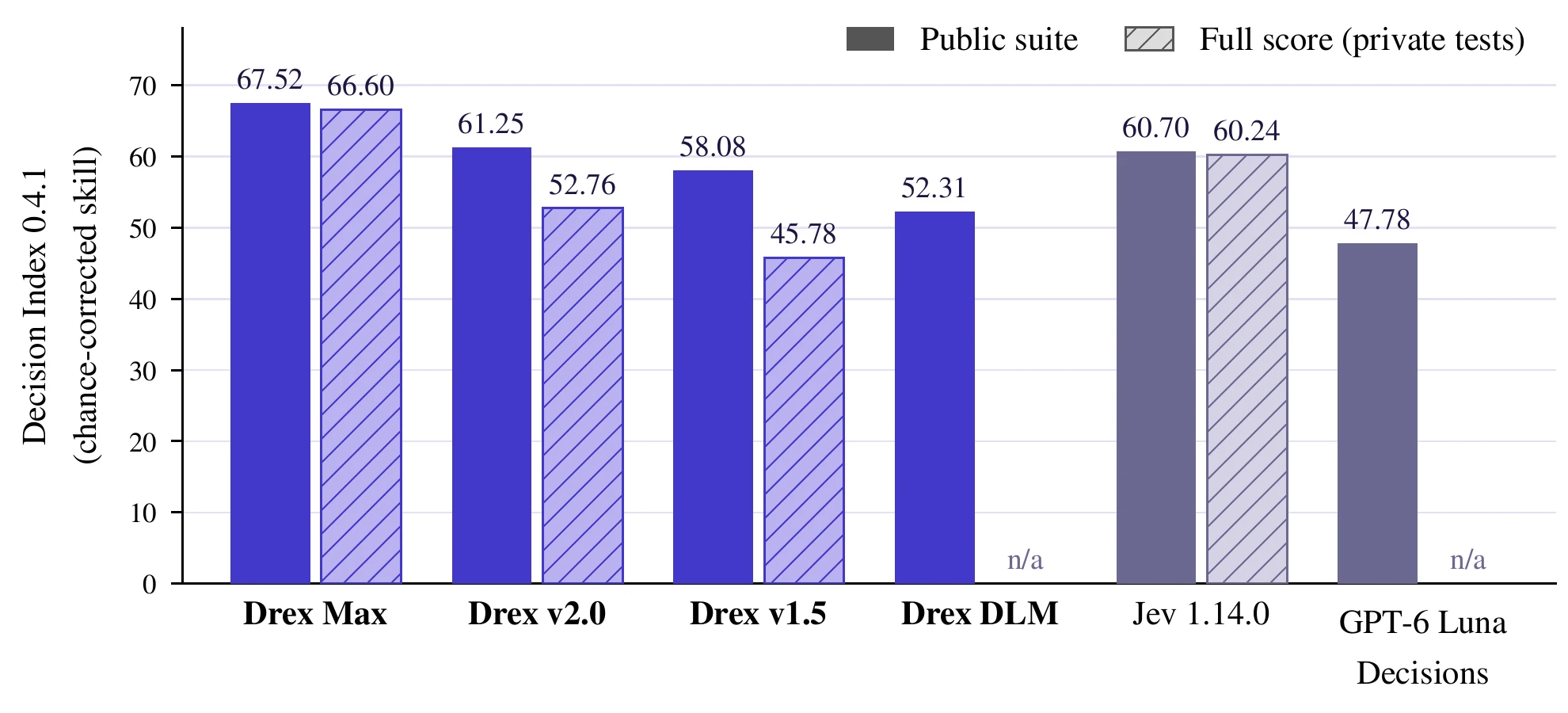
On Decision Index 0.4.1, Drex Max scores 67.52 on the public suite and 66.60 on the full set including private tests. Jev 1.14.0 scores 60.70 and 60.24. Including the private tests drops it by less than one point; generalization is decent.
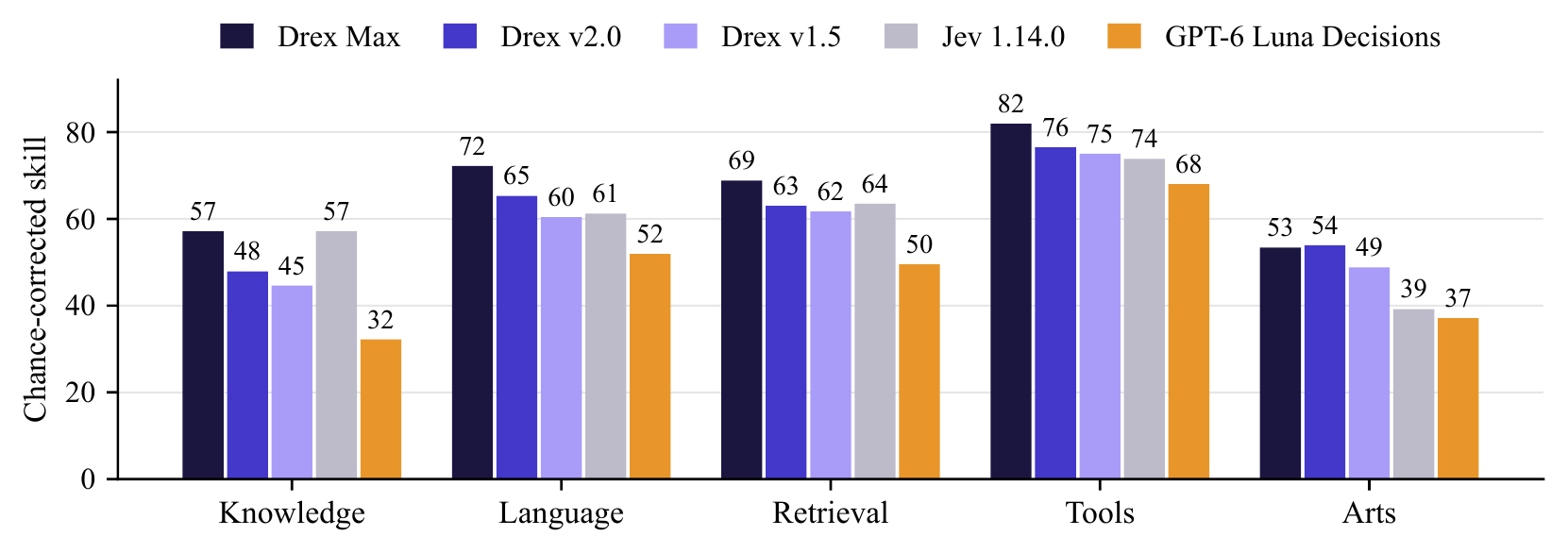
By domain, Max takes first place in four of the five domains—Knowledge, Language, Retrieval, Tools, and Arts—losing Arts to its own v2.0 by 0.5 points and tying with Jev on Knowledge.
On the independently run Artificial Analysis Decision Index, Max scores 64, within two points of the three leading decision models.
On Decision Bench v4, with raw image input, Max's accuracy is 94.0%, statistically tied with d3-turbo and GPT-6 Sol and 1.6 points below Claude Opus 5.5. Latency is 183 milliseconds. GPT-6 Sol takes about 2 seconds, Opus 3.5 seconds.
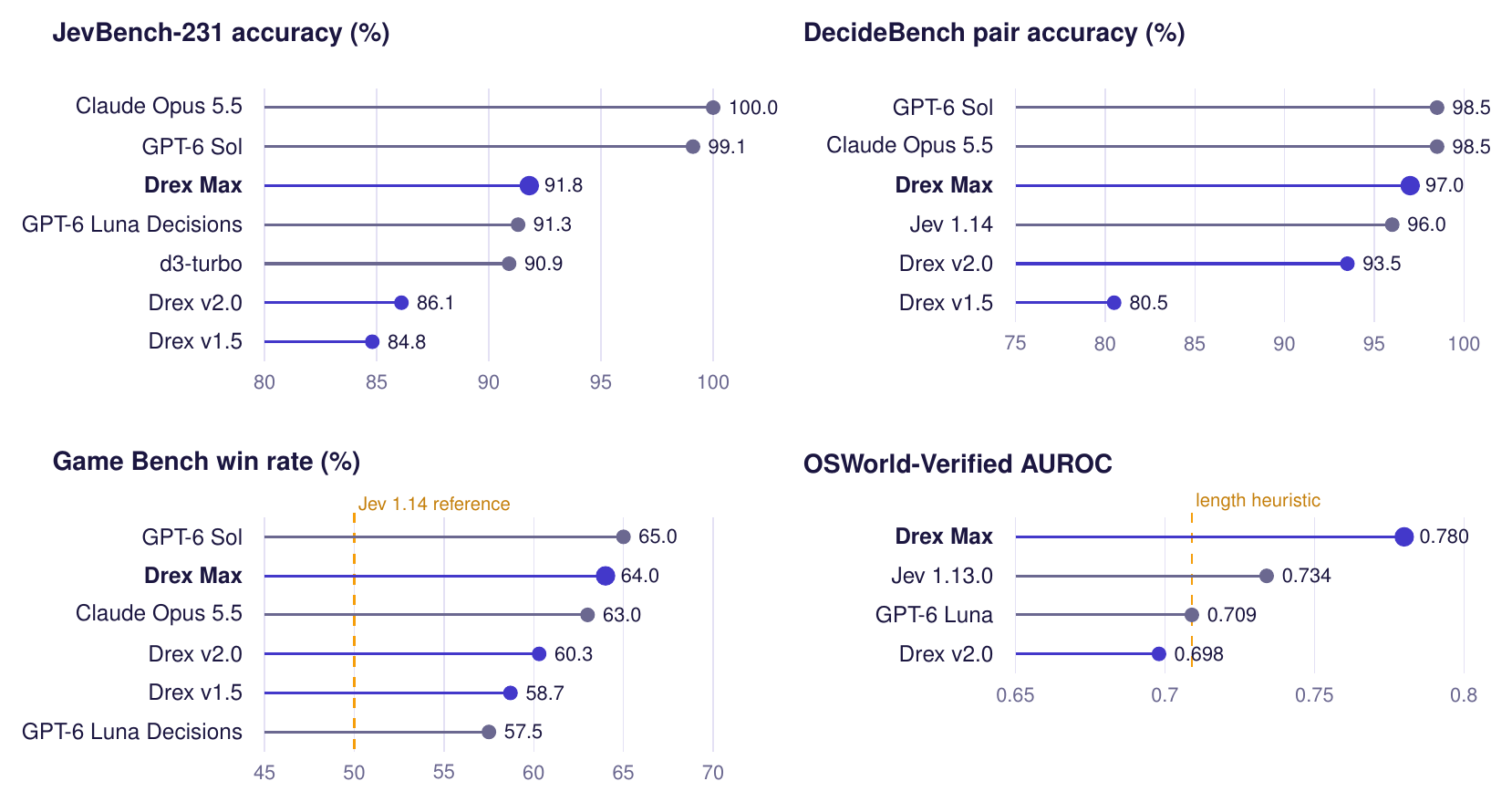
Several other benchmarks: on DecideBench it is the most accurate among decision models; on JevBench-231 it is close to the leaders; on OSWorld-Verified it has an AUROC of 0.780 and is the only model that clearly beats the transcript-length heuristic.
Probabilities Have to Be Usable
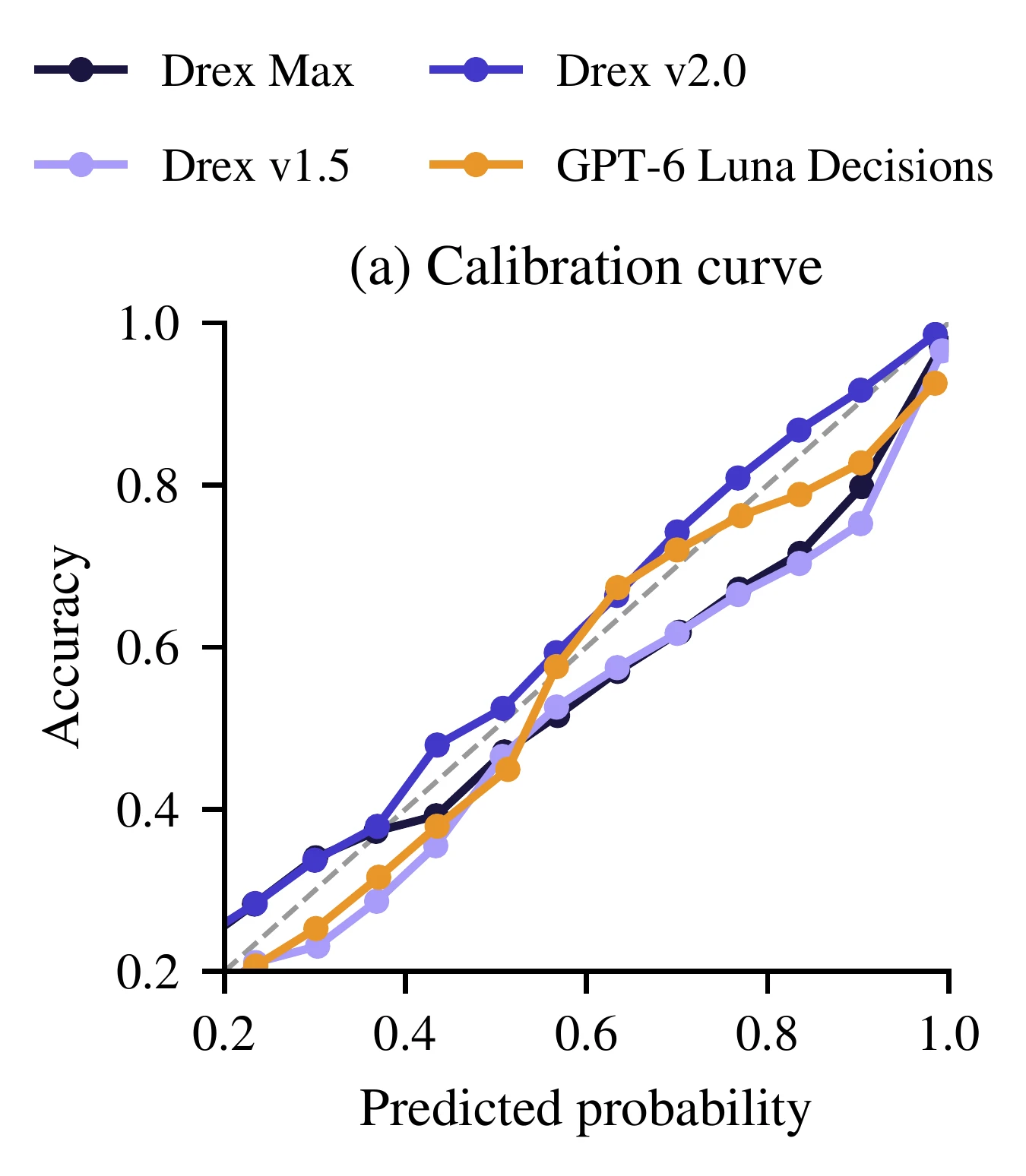
Decision models return probabilities, and probabilities are only meaningful if calibrated. The report's data says that when Max is at least 93% confident, its actual accuracy is 97%.
Option order was also made stable. With options randomly reordered, only 4.3% of answers change, and accuracy barely moves. The consistency loss reduces the flip rate from 6.3% to 4.2% during training. Most of the flipped cases are questions the model already marked as uncertain.
There's an illustrative comparison for images: on image-only questions, when given a text description, Max answers 63% correctly; when given the original image, 98%. It reads the original image, not someone else's paraphrase.
Unresolved Problems
The report lists its own limitations; the first is closed-book knowledge. A decision model's knowledge is limited by its training data. It has no retrieval, so questions about facts outside the training set can easily trip it up.
There are also two questions in the community that haven't been fully answered. A user on X asked whether, when the options themselves are wrong, Drex will say "none of these are correct" or force-pick the closest one. Another asked whether calibration after RLAF gets better or worse compared with pure SFT.
Drex Max 1.1 and Drex for Finance are closed-source and aimed at enterprises. The four open-source model weights and inference code are on GitHub and Hugging Face, and Max is offered through an API.
Paper: arxiv.org/abs/2611.07854
GitHub: nace-ai/drex-decision-models
Hugging Face: nace-ai
发布时间: 2026-11-07 06:37