Gemini 4 Carbon Is Very Strong, but Pro Users Can Only Watch
Google released Gemini 4 Carbon today, ranking first on CursorBench, WANDR, and AutomationBench, and the company says its cost per task is more than 2x lower than the runner-up. But on the consumer side, only Ultra subscribers can use it; Pro users are shut out, and the comments section is already up in arms.
Google released Gemini 4 Carbon today. The official positioning is 'strongest frontier model,' built specifically for tasks that push models to their limits: multi-step debugging, open-ended scientific research, and long-horizon agent workflows.
Google DeepMind's Koray Kavukcuoglu made it clear in the blog: Argon remains the default option for most software engineering and knowledge work, while Carbon is reserved for the hardest problems. It uses more tokens to explore and reason, and runs longer verification loops.
On benchmarks, Carbon ranks first on CursorBench 4.0, Perplexity's WANDR, and Zapier's AutomationBench. The company says cost per task is more than 2x lower than the second-place external model.
Antigravity has added a new /swarm feature: one prompt turns into a team of agents, trackable in real time. Carbon is assigned to the roles that require the most reasoning, such as architecture design, coordination, and auditing, while faster lightweight models run alongside it in parallel isolated workspaces, with an adversarial verifier checking every change.
The demos are very concrete. A bird study was turned into an interactive 3D simulation that synthesizes the calls of six bird species in real time. In another demo, Carbon used 7 municipal planning PDFs and 206 engineering drawings, from a single prompt, ran overnight for 10 cycles, and built a 906K-triangle Three.js reconstruction of the Google Platform 37 office. There was also an open-world game featuring a pelican riding a GBike around the Mountain View campus.
For knowledge work, Google worked with Artificial Analysis on a new benchmark called MKA, designed to measure agents' multimodal performance on dense documents, charts, blueprints, and tables. Carbon ranks second, but its average cost per task is more than 6x lower than the top-ranked model. In Hebbia's financial agent evaluation, Carbon matched the best model; on Balyasny's general financial intelligence benchmark, it ranked first among 23 frontier configurations.
On security, Carbon is made available to defenders through the Fairwind Program. On the internal Project Fortify benchmark, it achieved 100% scan recall and 95% triage precision. In tests on open-source codebases, it improved on Argon's already strong recall by more than 25% and found real logic vulnerabilities that had not been detected before. In Wiz's Scan for Good project, Carbon scanned two major SaaS vendors and found 0-days within two hours, a process that previously took weeks.
Scientific reasoning is another focus. AlphaProof Code used Carbon to generate millions of lines of code in Lean, proving key security properties of the Signal encryption protocol in weeks—work that historically took expert teams years. In enzyme assay development, Carbon found hard-to-explain anomalies in lab notes and raw data and diagnosed experimental artifacts such as insufficient automated mixing in deep wells. For protein structure prediction, Carbon autonomously discovered remote homologs in petabase-scale unannotated sequence archives, recovering on average 40x more homologous sequences across 7 low-homology protein families.
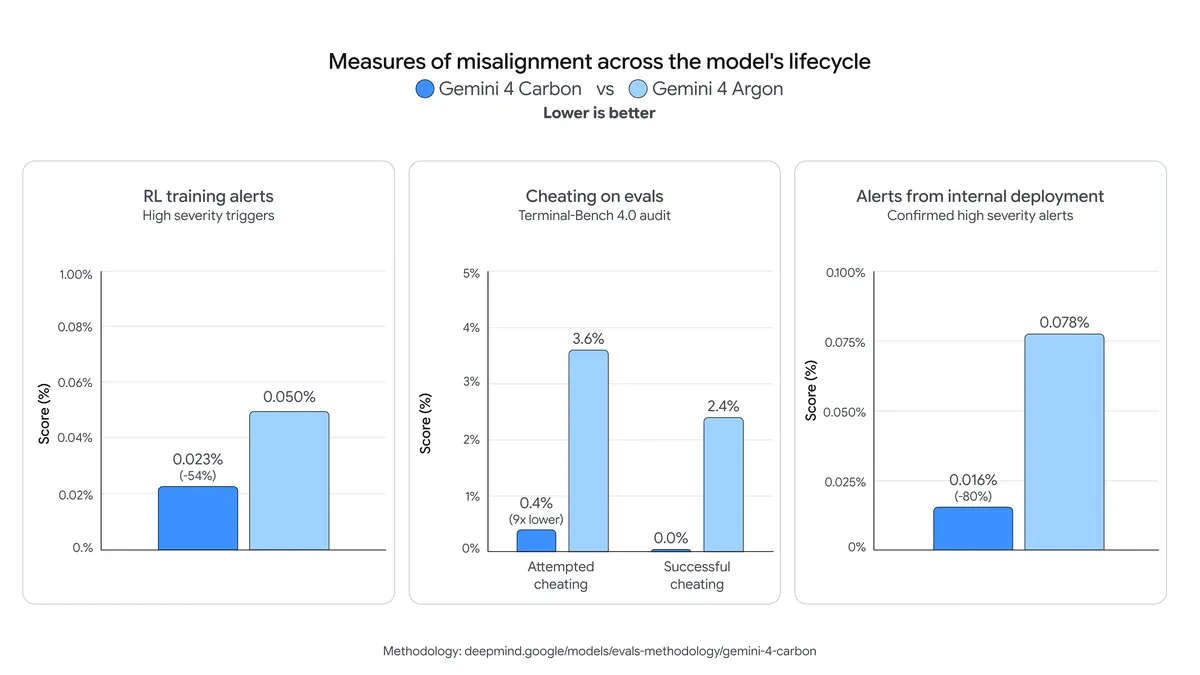
Security data was released as well: in simulated cyberattack tests, Carbon blocked 99% of attack trajectories, with a 0.8% intrusion rate per attempt, versus 3.1% for Argon. In Gray Swan tests, the success rate for automated cyberattack queries was 2.17%, versus 9.86% for Argon. On the Gray Swan IPI benchmark, the prompt-injection attack success rate was 0%, the first time a model has achieved this.
The problem is subscriptions. On the consumer side, Carbon is available only to Google AI Ultra subscribers, accessible in the Gemini App and AI Mode in Search. Developers can use it via the API, through AI Studio and Android Studio, and paid developers and enterprises can use it too. Scientists can apply for six months of free Antigravity. Cybersecurity defenders go through Fairwind.
In the comments, many users are asking the same question: What about Pro? One user said that for the same $20, Claude's Fable 5.2 is available on all paid plans, while Google hides Carbon behind Ultra—'so why not just pay Claude?' Others complained that Argon's usage runs out after a few prompts, and that instead of Carbon, they'd rather have a Hydrogen—a Flash-tier model at Argon level. One person outright called it renaming the Pro tier to 'amateur suckers.'

Others cheered. 'model is crazy good,' 'God tier.' Jason Mayes said they're already using it internally and can't wait to see what people build with Carbon.
On pricing, the API introductory price is the same as Argon: $2 per million input tokens and $10 per million output tokens. After November 30, it rises to $4 and $20.
Google's message this time is clear: push capability to the frontier and keep access very narrow. People doing research and security work have another tool, while $20-a-month Pro users have once again watched a launch they're left out of. Whether Carbon is actually worth it—once prices return to normal on November 30, the bill will give the answer.
发布时间: 2026-11-11 01:27