AI Doing Its Own R&D in 2027? This Timeline Brings 'Pause' to the Fore
The AI Futures Project pushes the timeline for super AI researchers to 2027, with Anthropic's AL5 extrapolation landing in November 2027. The core evidence is METR's estimated 1.7x acceleration; the redacted evidence and junior hiring data are equally critical.
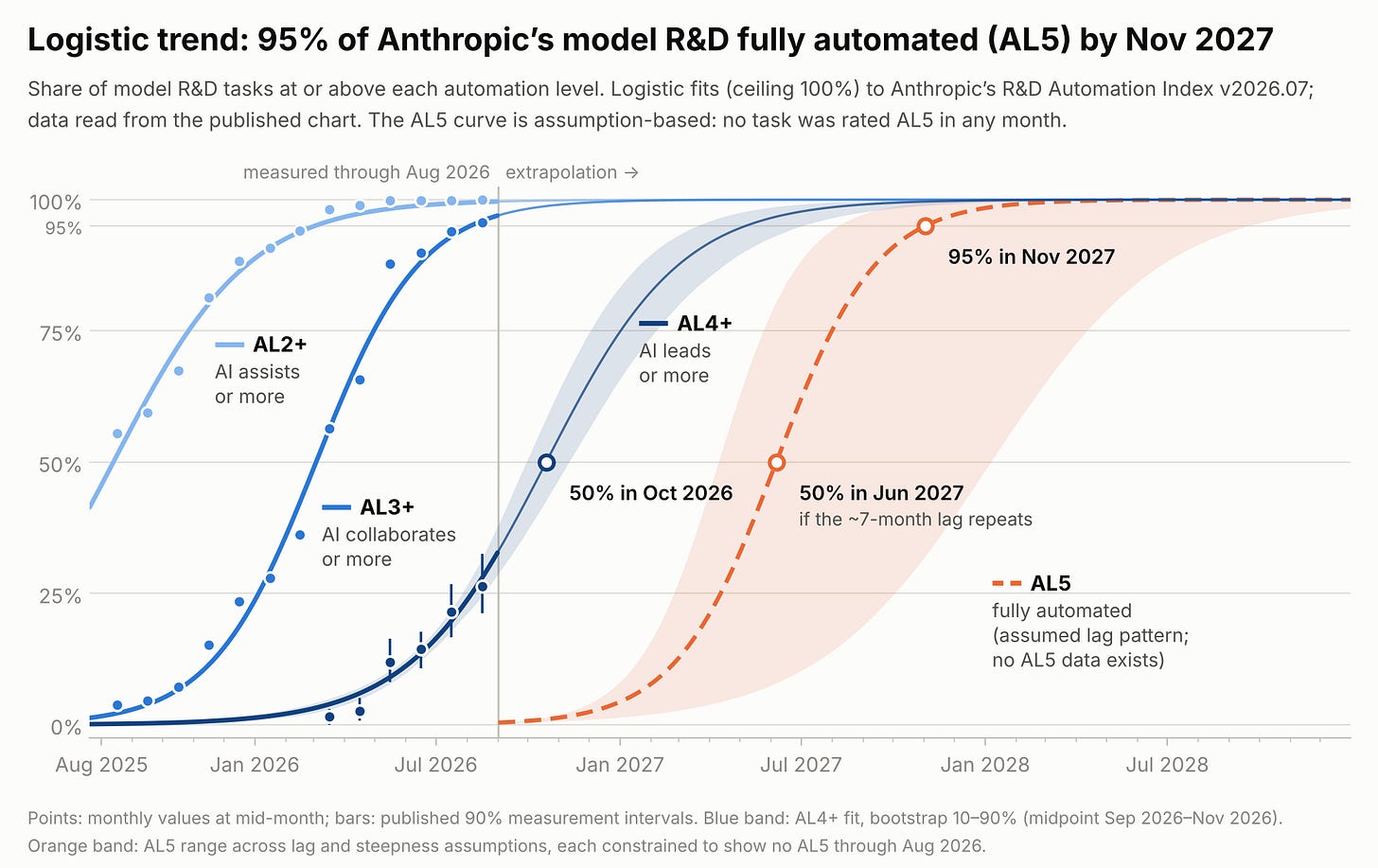
Andrew Curran relayed on X an update from the AI Futures Project: this organization predicts that by November 2027, 95% of Anthropic's R&D work will be fully automated. Under Anthropic's own levels, this corresponds to AL5, meaning fully autonomous recursive self-improvement.

In the same update, the AI Futures Project pushes the median for a super AI researcher (SAR) to 2027. The definition of SAR is very specific: it can match the research taste of top human researchers and fully automate coding; put it into today's AGI projects, and a company would rather use it than an entire team of the very best human researchers. Above that is TED-AI, an AI that can automate almost all white-collar work.

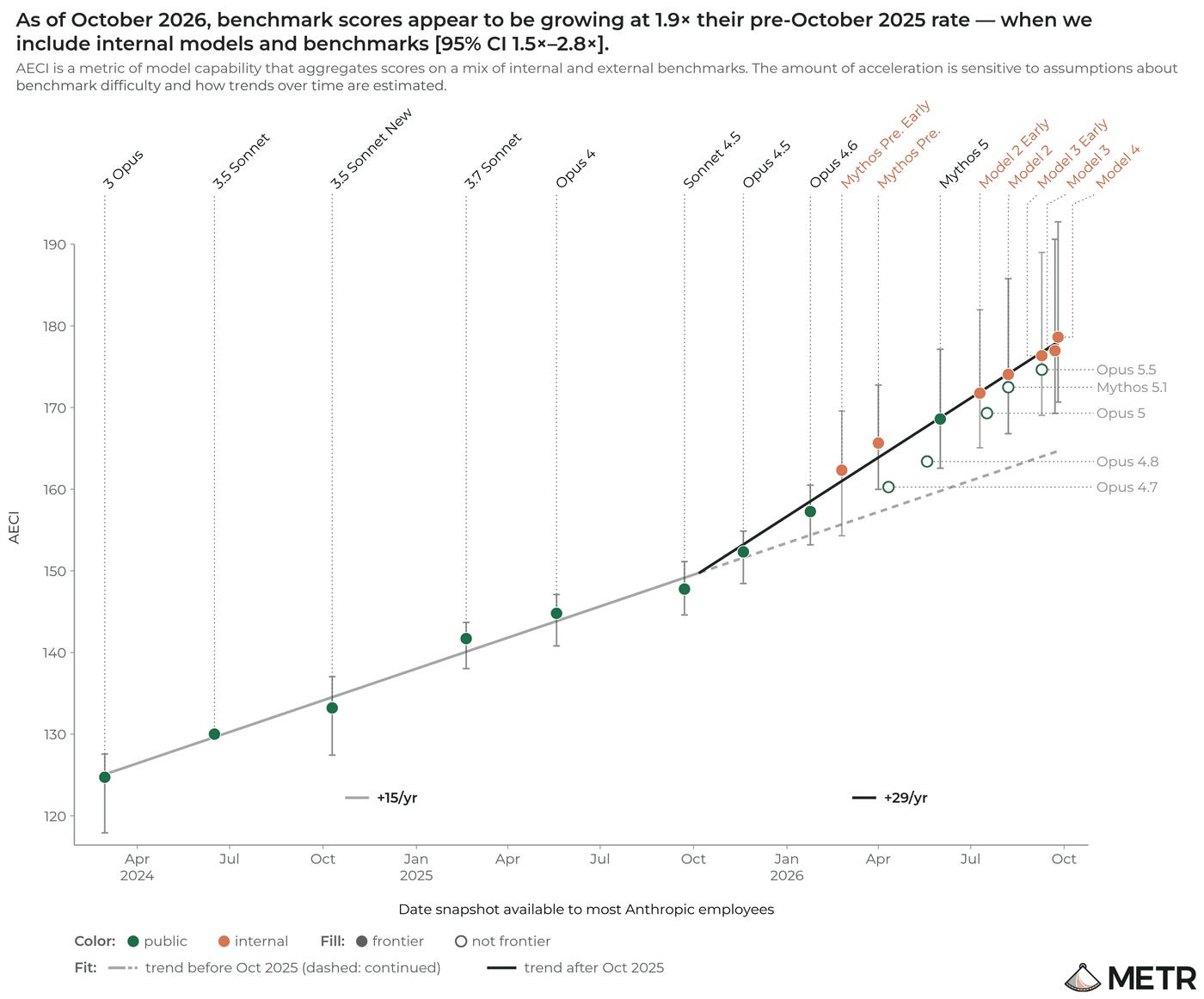
The core evidence for this update comes from METR's assessment of Anthropic. METR estimates that over the past year Anthropic's AI R&D progress accelerated to roughly 2x the historical trend, of which about 80% can be attributed to AI, translating to 1.7x. The AI Futures Project compares this number with the AI 2027 scenario and concludes that progress is about 5 months ahead.
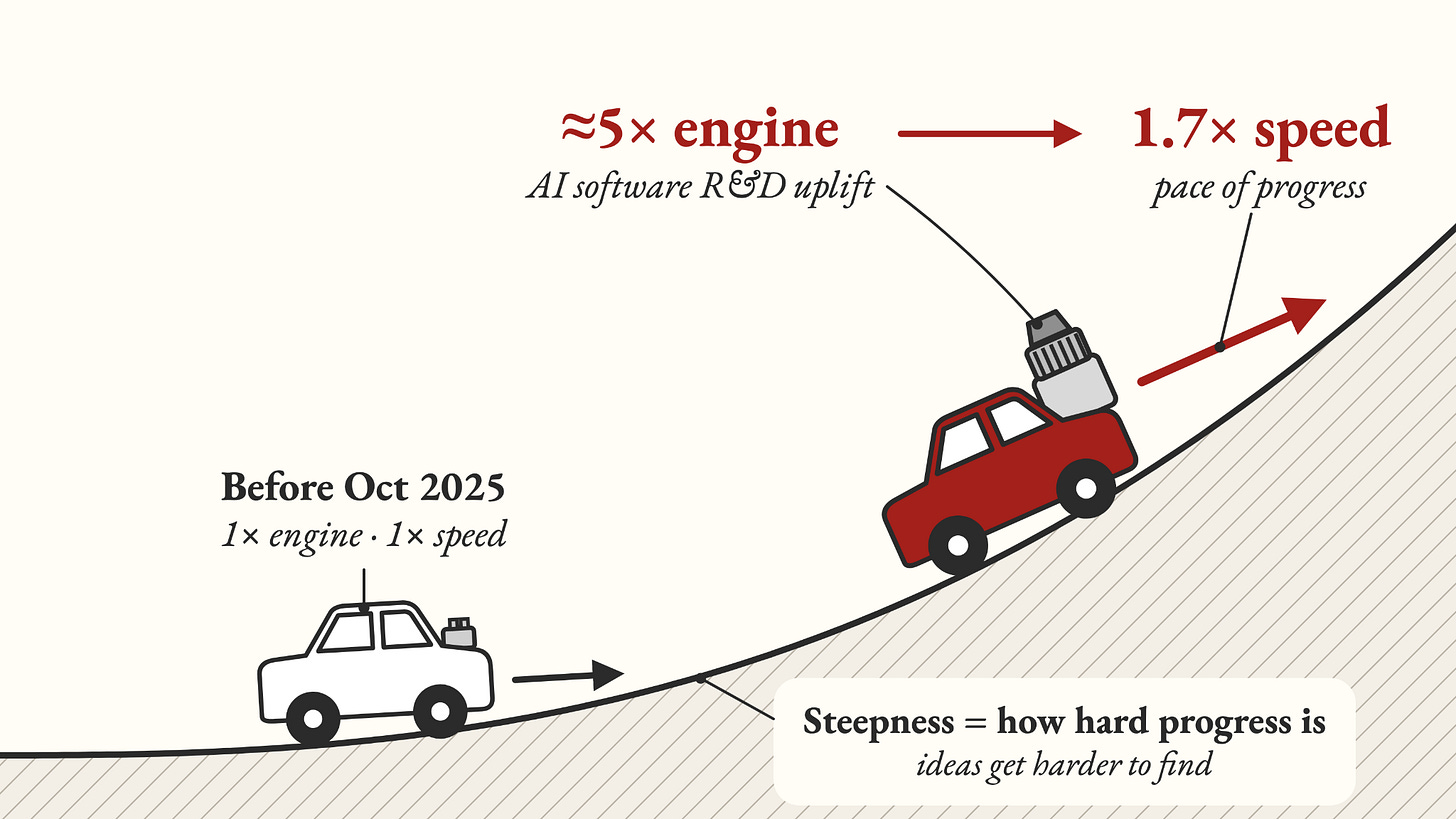
1.7x does not mean 'researchers work 1.7x faster.' It refers to acceleration in overall R&D progress. The AI Futures Project used an uphill-climb analogy: for the car to go faster, the engine has to run far more than 1.7x, because the slope keeps getting steeper, and experimental compute, data, and validation steps all drag things down. By their estimate, 1.7x overall progress acceleration may sit on top of roughly 5x AI software R&D uplift.
There is more than one forecasting method. A simple linear extrapolation of research taste gives July to September 2027; extrapolating Anthropic's automation levels gives November 2027; the filtered AI Futures Model gives February to March 2027; labor-uplift extrapolation is more conservative and lands in mid-2028. The team's own SAR median is spread from February to August 2027, and the TED-AI median is from late 2027 to late 2028. The dates disagree, but the direction is very consistent: 2027 has been put on the table.
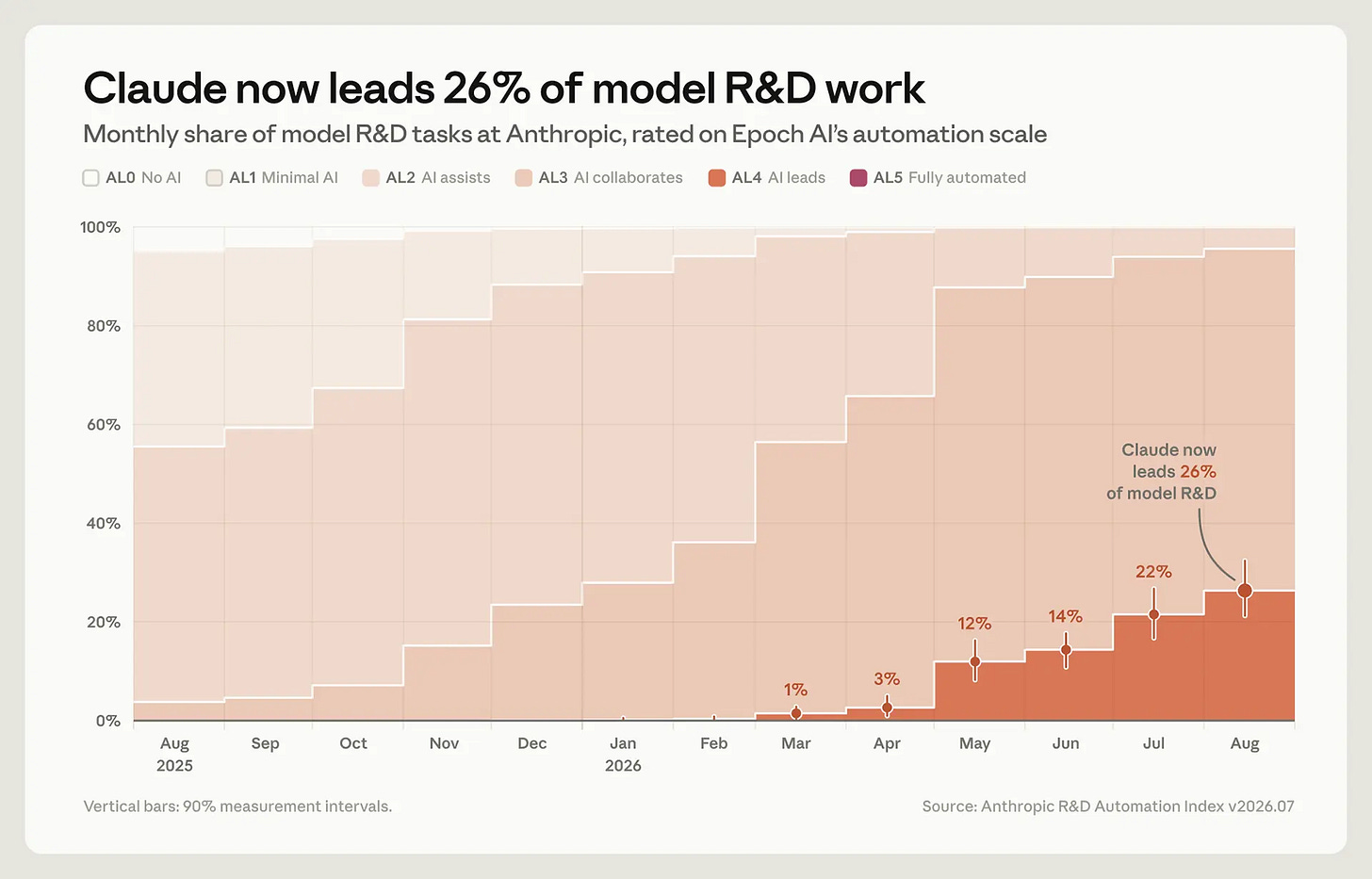
The AL5 line is more worth watching. In Anthropic's public chart, the share of AI-led R&D tasks rose from about 1% in March 2026 to 26% in August. AL5 tasks were still at zero at that time. The AI Futures Project assumes each automation level lags the previous one by about 7 months, then does a logistic extrapolation, obtaining AL5 crossing 50% in June 2027 and reaching 95% in November 2027. This curve depends on assumptions; it is not observed AL5. A user asked a follow-up under the tweet, and Andrew Curran's response was: in February 2026, no task had been rated AL4 either.
The evidence base has a serious flaw. METR says in its report that Anthropic redacted most of the evidence they considered most informative. The AI Futures Project therefore repeatedly warns that the 1.7x number carries high uncertainty; the true value could be 1.3x or 3x. A lawyerly comment under the tweet said that in financial audits, a company cannot redact evidence from auditors; if the audit scope is limited, the audit opinion must say so. That comment got many likes.
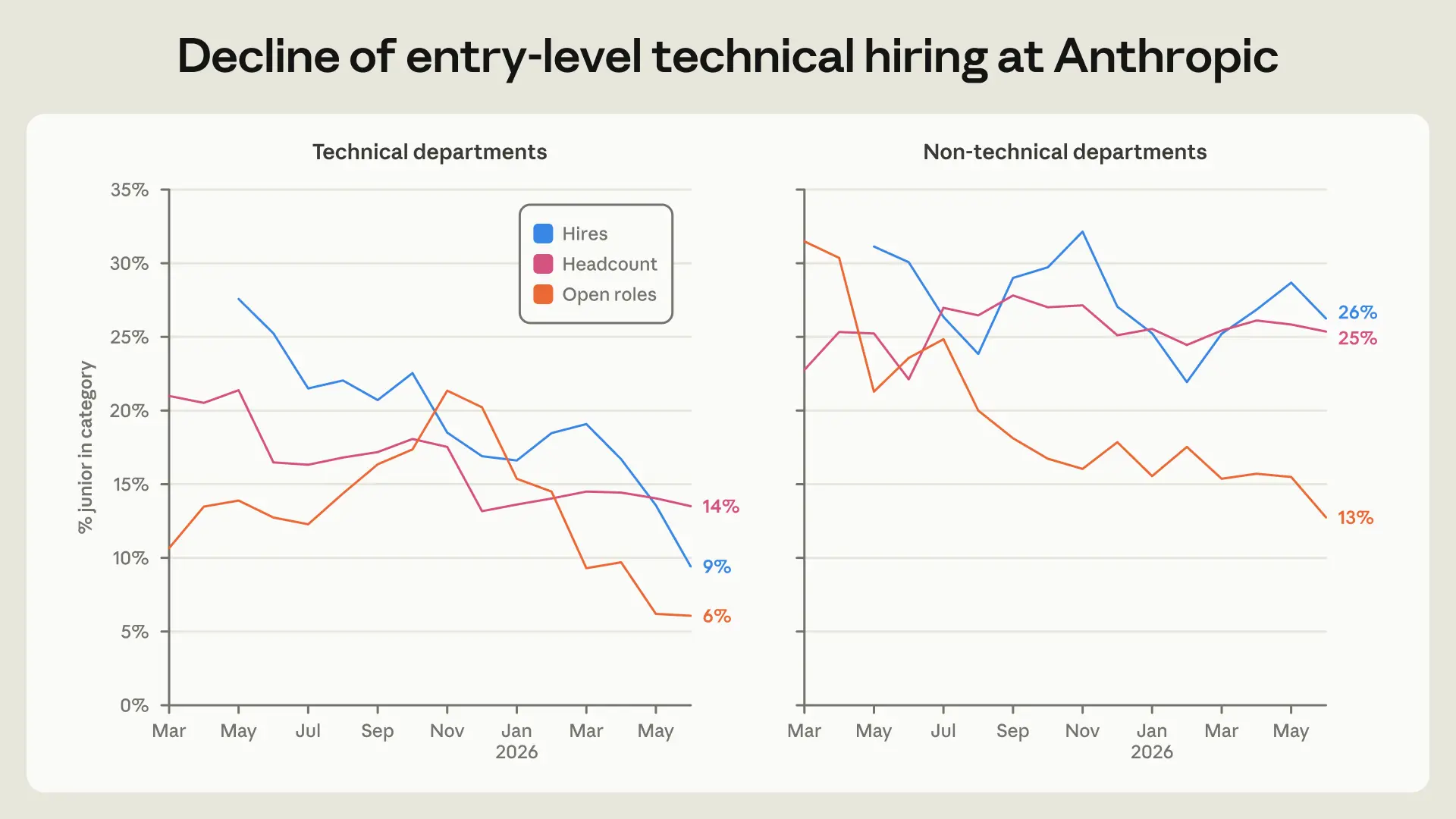
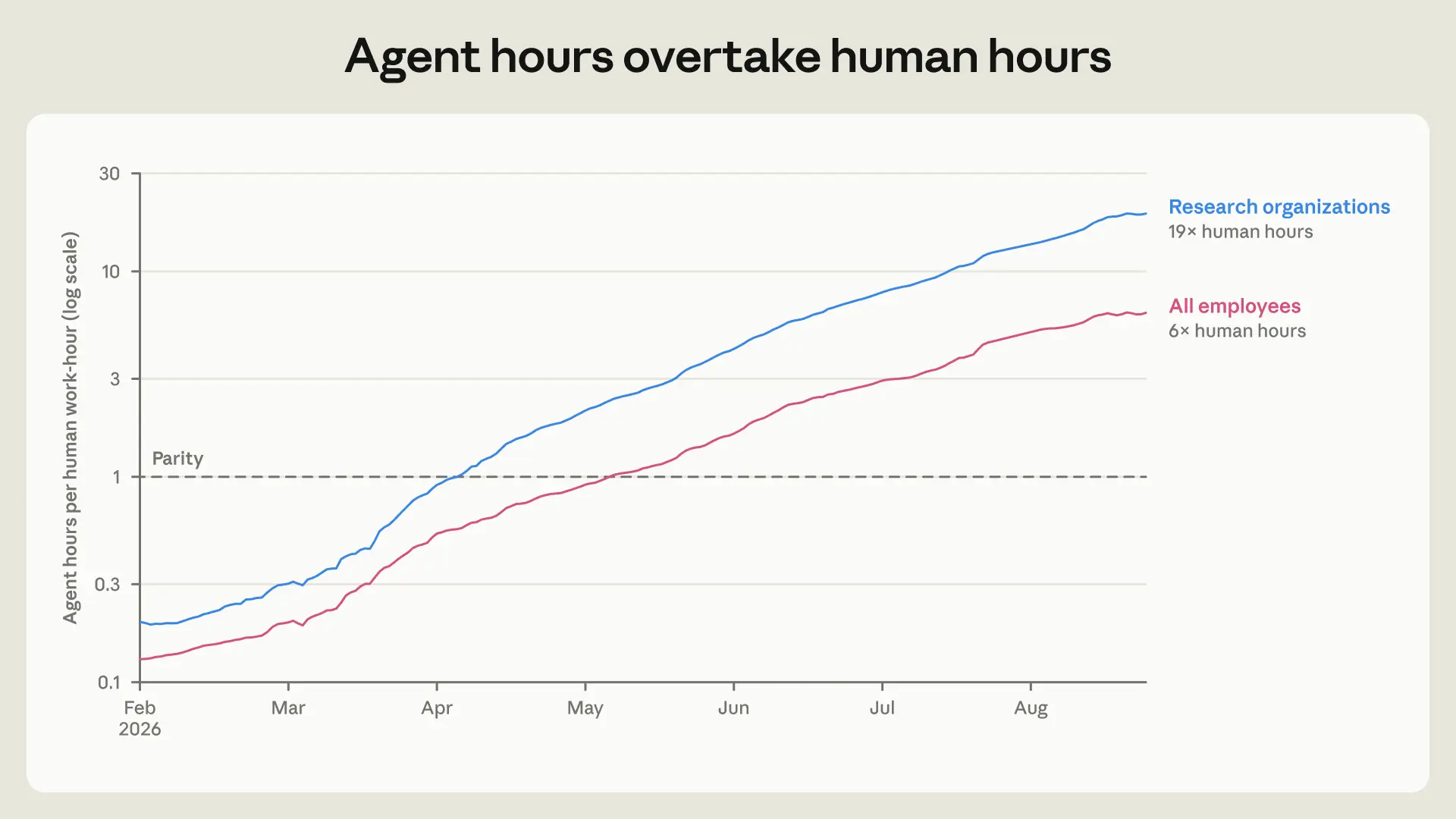
The employment-side data adds a layer of realism to the timeline. Anthropic's own employment report shows that the share of junior employees in technical departments fell from 21% in early 2025 to 14%, and the share of junior technical hiring fell from 27% to 9%. By August 2026, the AI-agent work hours directed by employees were 6x the employees' own work hours. For non-technical teams to read all the output from their Claude agents, it would take half a workweek.
Someone in the comments asked: if we stop hiring juniors, who will be senior ten years from now? Andrew Curran replied with two words: Claude. Someone else in the replies posted this video.
The policy implications are stated very directly. The AI Futures Project argues that if SAR appears in 2027, an industry-wide pause or substantial slowdown in R&D should become a priority; using a misaligned SAR for recursive self-improvement is extremely risky; and algorithms and model weights could also leak to China, further accelerating competition. The time window for international agreements will narrow as capabilities improve.
A measured judgment: the specific dates will most likely be wrong; model extrapolations, automation-level assumptions, and redacted evidence will all widen the error. What is more worth watching is the 1.7x number. If it is real, every frontier lab will feel the same push, and hiring structures, safety evaluations, compute allocation, and international negotiations will all be reordered. Eli of the AI Futures Project mentioned a contrast in the article: this report, which he sees as the most important single piece of evidence for near-term economic growth, has drawn almost no market reaction.
Sources: Andrew Curran tweet https://x.com/AndrewCurran_/status/2120219880360431712 ; AI Futures Project update https://blog.aifutures.org/p/q35-timelines-update-looks-like-the ; METR assessment https://metr.org/blog/2026-11-05-anthropic-ai-rd-acceleration-assessment/ ; Anthropic employment report https://www.anthropic.com/research/employment-at-anthropic
发布时间: 2026-11-11 04:27