Merchants Have Blocked Bots for Over a Decade. Now They Need to Start Winning Their Business
a16z published a thesis post on the B2A economy, arguing that agents are becoming the internet's primary users. The direction is worth watching, but the opening data points were dismantled in the comments.
a16z's Olivia Moore and Justine Moore published a thesis piece titled "Welcome to the B2A Economy." The core argument can be summed up in one sentence: agents have become the internet's primary users and will soon become the primary customers of every product.
The article opens with three data points. Agents now account for the majority of web traffic, write more than half of new articles, and generate most of the code pushed to production.
The authors compare the current moment to the early days of a platform shift. The web gave businesses a storefront anyone could visit; mobile put that storefront in everyone's pocket. AI has already run far ahead on the "what people can do" side, but on the "how businesses reach users" side, it is only just getting started.
This observation is not new. What is interesting is the inference that follows: once agents move from answering questions to completing tasks, they will gradually decide which product to use, which service to book, and where to spend money. If businesses still treat agents as second-class visitors, they may be left behind.
For the past decade or so, retail and platforms did the opposite: they built walls, fought scraping, and blocked bots. Now they have to reverse course and compete for bots' business.
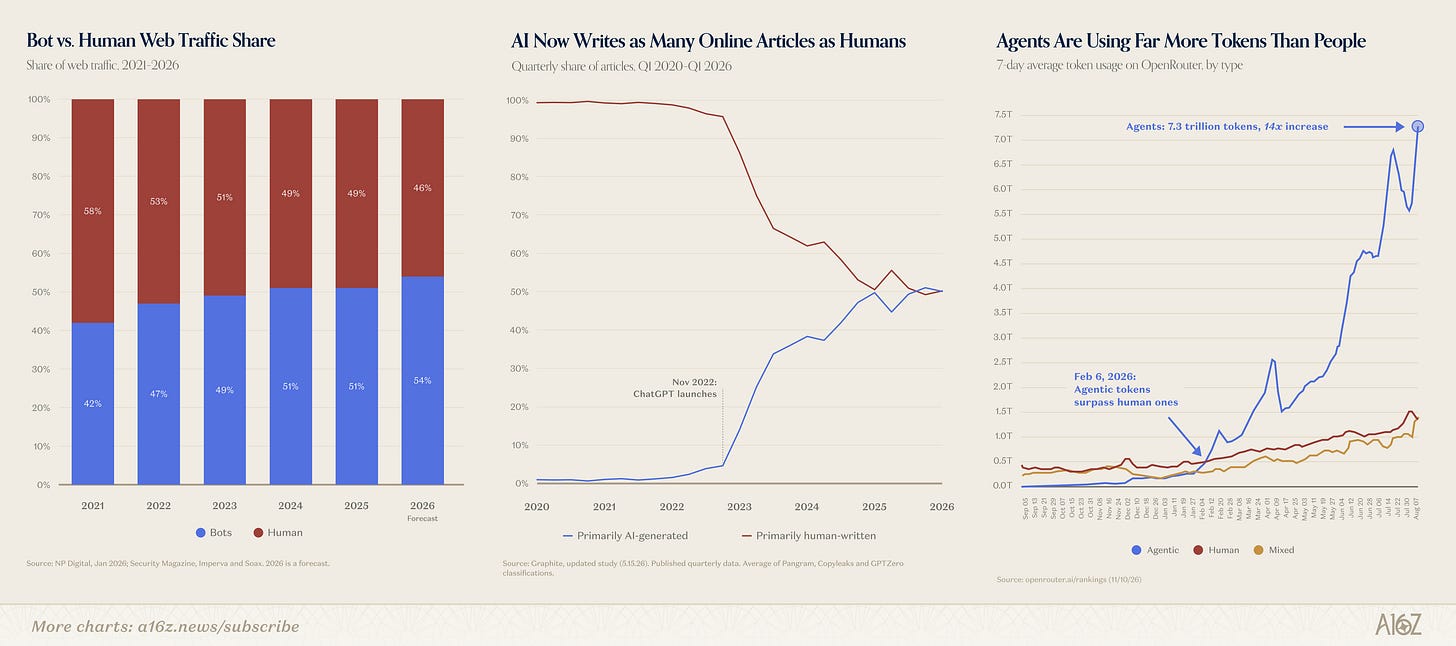
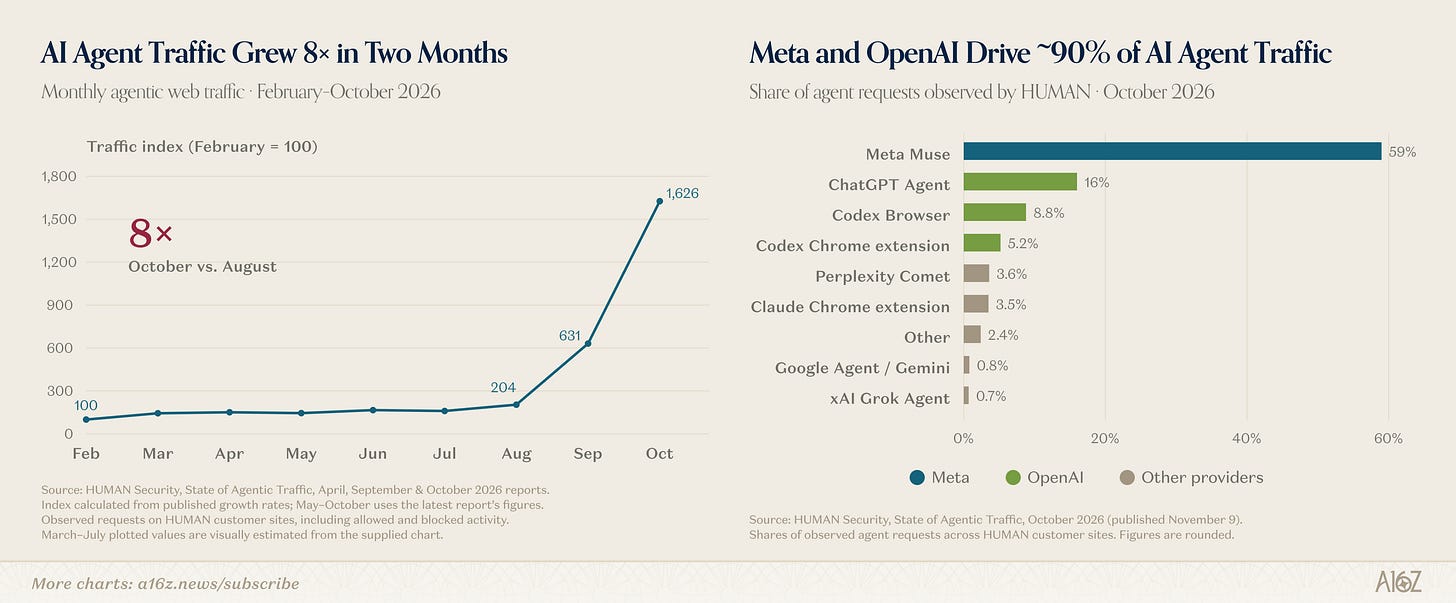
The data section looks compelling. Shopify says that in the first quarter of 2026, AI-driven traffic rose 8x year over year, and orders from AI search rose nearly 13x. Human Security observed that agent-browser traffic rose 8x between August and October, with Muse accounting for 60% and OpenAI products collectively accounting for 30%. On GitHub, 40% of PRs start from agent drafts; six months ago that number was 17%. Supabase says more than 60% of new databases are launched by AI tools; at Neon, it is 80%. Stripe's documentation traffic is 40% from agents, and 70% of CLI requests. Vercel saw agent-triggered deployments rise 28x over the past twelve months.
But someone in the comments threw cold water on this. A user named ByteCrafter pointed out that the Imperva data a16z cited is actually the sum of "all automated traffic," at 53% in 2025 and 51% the year before, including crawlers, monitoring scripts, and account-takeover bots. AI agents are just one new category within that, and the Imperva report did not break out their share separately. The code point is similar: Google says 75% of new code is AI-generated and then reviewed and approved by engineers, while Microsoft's public figure for 2025 is 20% to 30%. Using one company's data to infer the whole industry is not rigorous.
This rebuttal is worth hearing. a16z's thesis direction may be right, but the three opening data points are weaker than they read.
Setting aside the exaggerated data, what the article really wants to say is: if agents truly break through to ordinary consumers, it would be AI's biggest unrealized opportunity so far. Every platform shift requires two things to arrive at the same time: new product capabilities and a new distribution mechanism. AI has overdelivered on the first and is still behind on the second. Apart from ChatGPT, consumer adoption has remained limited.
Distribution is currently mainly through the browser. Agents either take over the user's browser or spin up their own virtual machine and click around like a human. Another form is emerging: connectors, plugins, and MCP, essentially an enhanced agent app store.
The authors give an example. They asked ChatGPT to make a video ad using three plugins: Krea, Descript, and Eleven Labs. ChatGPT coordinated across the three products and, in the process of completing the task, pitched them Descript's paid plan.
This detail is quite interesting. Agents are not only making choices for people; they are also upselling. When underlying platforms allow users to lend their identity or tokens to other products—for example, Sign in with ChatGPT—the barrier for agents to sign up and pay will continue to fall. Claude already allows enterprise admins to connect plugins for an entire organization. OpenAI just launched Businesses in ChatGPT, where businesses can claim their business page, upload product feeds, and see how users interact with them in ChatGPT.
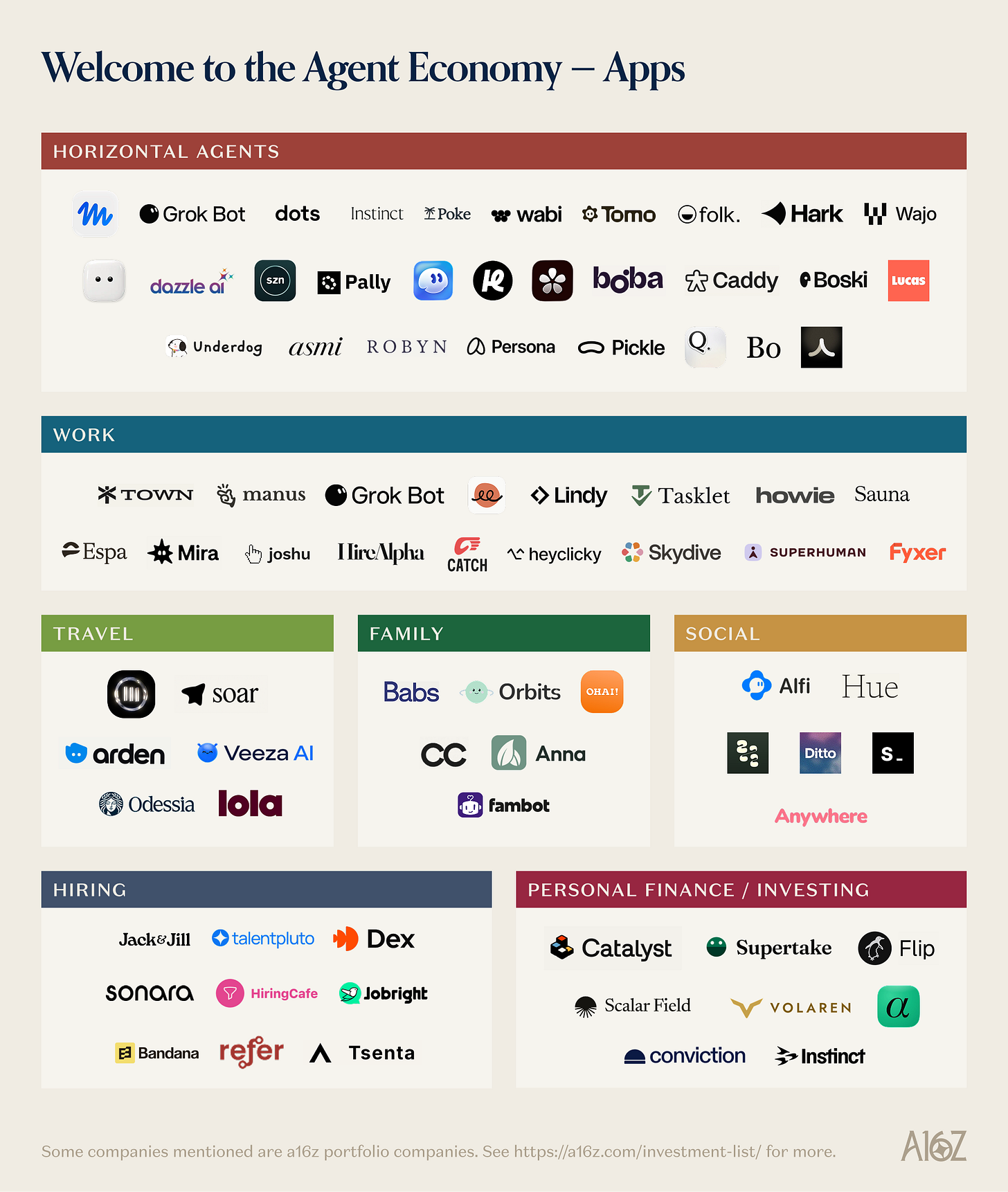
The article divides the beneficiaries into four categories: agents and agent models, new products spawned by agents, existing companies optimizing for agents, and agent infrastructure. The last category includes payments, fraud and identity, and communications. Current systems are already showing strain at very low agent traffic.
Coding agents are the only case that has truly worked. They have completely changed developer behavior, and like consumer agents, they must rely on external tools. When a user asks an agent to build a website, behind it are needs for databases, hosting, authentication, email, and monitoring. Players in these links have all seen growth.
Developers make up less than 1% of the global workforce. What happens when the other 99% start using agents? That is the question the article raises.
A commenter asked more directly: if agents are customers, who pays the bill?
The article does not answer this question directly. Agents make decisions and spend money on people's behalf, but the money is still people's. Businesses need to please agents but ultimately still serve people. How to position these two identities is the blurriest part of the term B2A.
Another comment was more cutting: agents have become the majority of internet users, but we didn't even get an invitation to the afterparty.
The internet has changed owners, but the bill still seems to be in our hands.
发布时间: 2026-11-12 02:30