Google's new API doesn't write answers—it only makes judgments, and can ask 1,000 questions at once
The Gemini Decisions API pulls large models back from writing mini-essays to true/false questions: three question types, confidence scores, batch questions, and no charge for output. It is suited to routing, classification, and QA, but caching and regional support still have pitfalls.
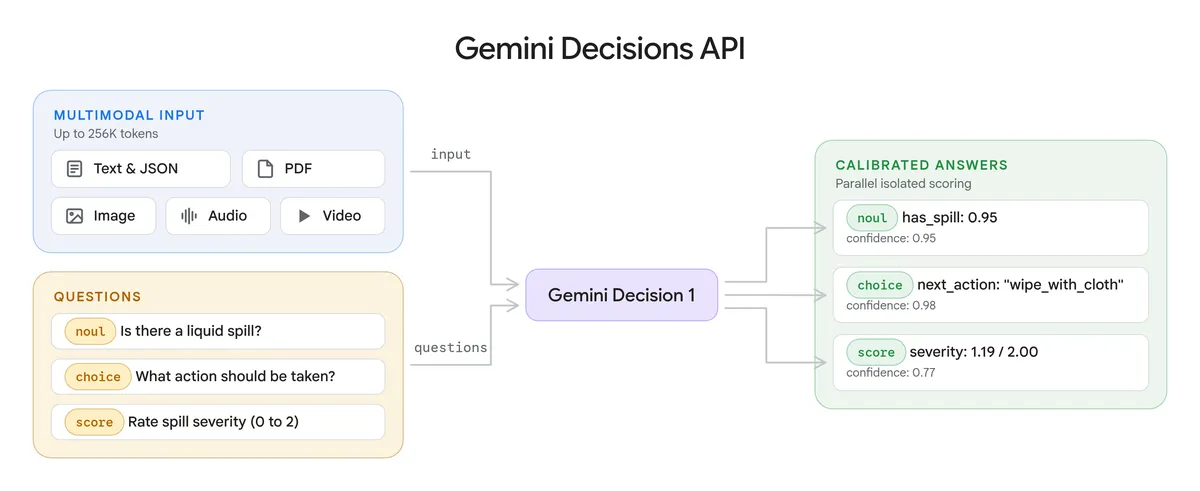
Google has launched the Decisions API in the Gemini API, with a companion model called Gemini Decision 1. It doesn't generate text; it only answers questions: give it an input and a set of questions, and it directly returns the answer to each question, plus a confidence score from 0 to 1.
When building AI applications, many calls really just need a judgment: which team should this customer service message be routed to, should this question go to a cheaper model or a reasoning model, does this image violate policy. Previously you could only have a large model write a paragraph and then parse the answer out of it—slow, prone to parsing failures, and you still had to pay for output tokens. The Decisions API turns this into a multiple-choice problem.

What problem does it solve?
The Decisions API has only three question types: yes/no, which returns the probability that the condition is true; multiple-choice, with 2 to 255 options, which returns the selected option and the probability of each option; and scoring, which scores according to the bands you define. Every answer comes with a confidence score from 0 to 1. Google says these probabilities are calibrated, meaning when the model says 90%, it is actually right about nine times out of ten, so the confidence score can be used directly as a threshold. For example, above 0.7 execute automatically; below that, hand off to a human.
However, some users pointed out that for binary questions, confidence is max(p, 1-p). It indicates how certain the model is about the judgment, not the probability of Yes. When p=0.08, confidence is still 0.92, but that just means it is more certain the answer is No. Code should first look at the direction of the answer, then use confidence to decide whether to review it; you can't treat greater than 0.7 as the condition being true.
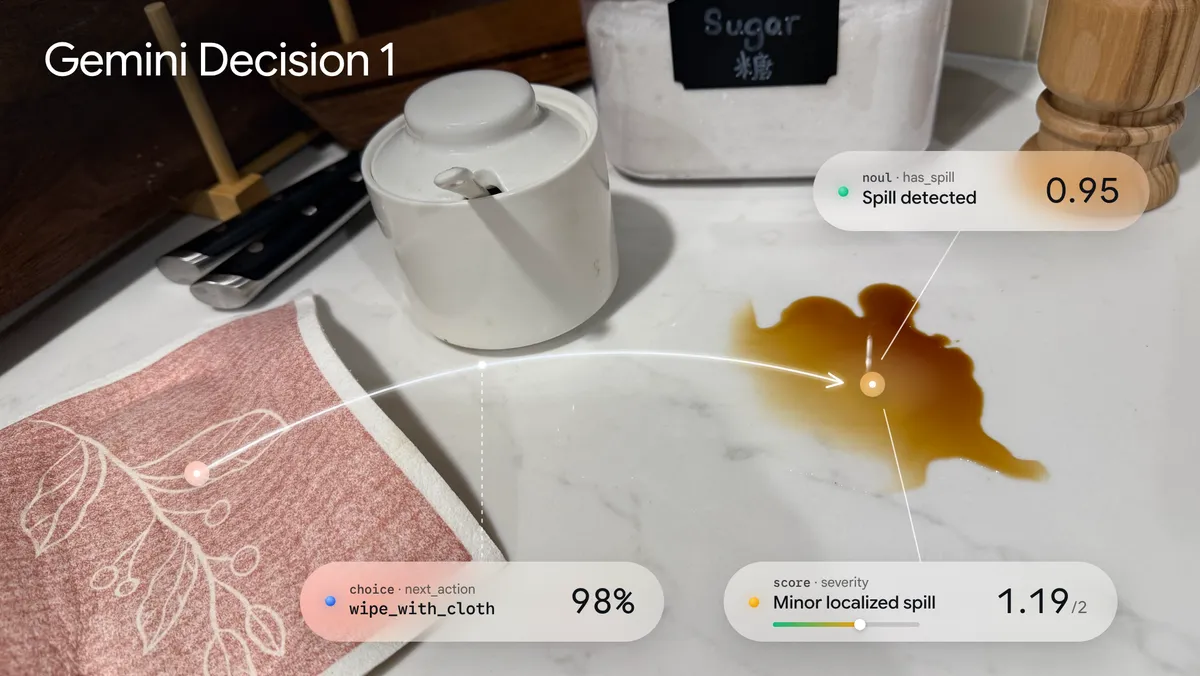
Google's blog gave an example: upload a photo of a break room counter and ask three questions at the same time. Is there spilled liquid? Answer: 0.95. What should be done? Choose wipe it with a cloth, confidence 0.98. Rate the messiness on a 0 to 2 scale: 1.19, confidence 0.77.
How fast and how cheap?
A single request can take up to 256K tokens of input, and text, JSON, images, audio, video, and PDFs can be mixed together—for example, a customer service call recording plus account information. Up to 1,000 questions can be attached to the same input, and they don't affect each other. Input is charged only once; each additional question only adds the cost of that question's own text.
Google says that for inputs under 16K tokens, end-to-end latency is 150 to 250 milliseconds, and asking 1 question takes about the same time as asking 100; under the same batch of tests, it is nearly 5 times cheaper than using Gemini 3.5 Flash-Lite to generate answers. Gemini Notebook already uses it to choose a model for each query, cutting latency for everyday questions by up to 40%.
Google for Developers also posted a demo of finding a zookeeper: the model looks at a board at once, checks 16 squares simultaneously, and quickly points out the correct location.
Who can use it, and where are the limits?
You can call it with an API key from Google AI Studio, using the model name gemini-decision-1 through the v1beta API. There is a free tier: 200 requests per minute and 10,000 per day; free-tier data will be used by Google to improve its products, while paid-tier data will not. OpenRouter, LangChain, Vercel, and others are integrating it, and Gemini on Google Cloud will support it later.
It does not support context caching or the Batch API; if you repeatedly ask about the same large document, input is charged at full price every time. You cannot pass a YouTube link directly, and the questions themselves can only be text. Some users added that if a later judgment depends on an earlier result, you have to send another request.
Compared with OpenAI's product of the same name
OpenAI did the same thing a month earlier, also called Decisions API: beta on October 6, generally available on October 22, using GPT-6 Luna, also at $0.10 per million input tokens with no charge for output. The difference is that OpenAI allows at most 400 questions at once and accepts only text, images, and JSON—not audio/video or PDFs; but it supports caching, offers discounts for repeated input, and can be directly inserted into conversation history and tool-call records.
Startup TypeSafe's Jev 1.14 also specializes in this kind of judgment; on OpenRouter it costs $0.042 per million input tokens and accepts only text and images.
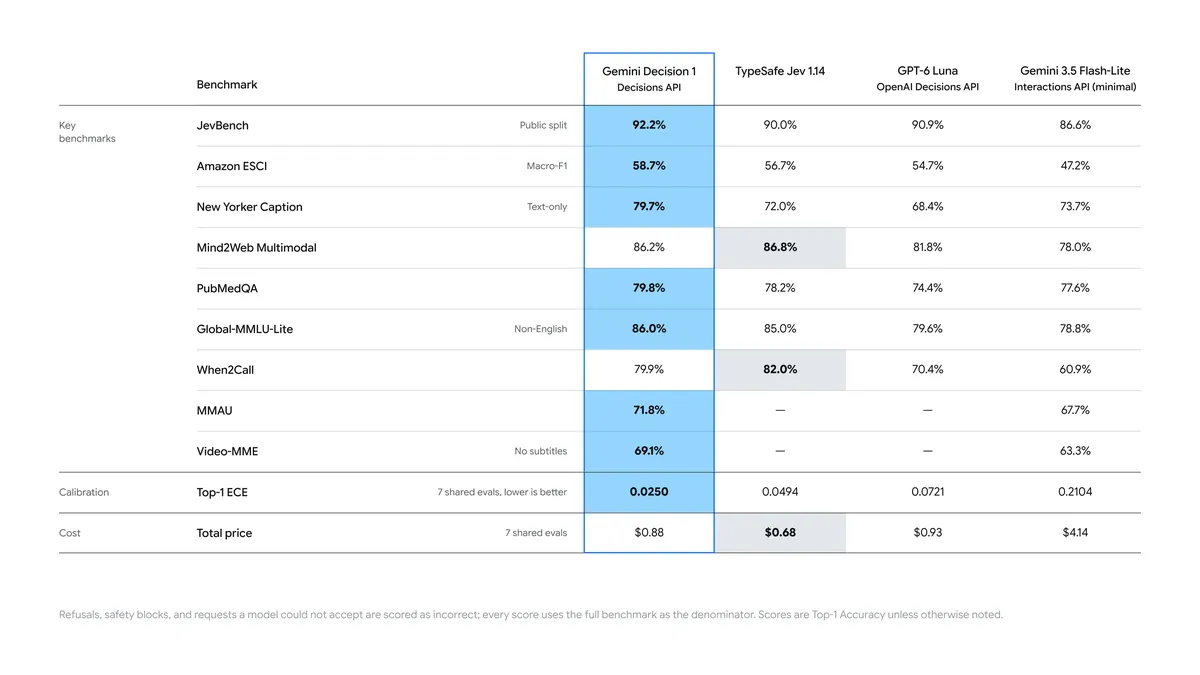
In the comparison table attached to Google's blog, Gemini Decision 1 ranks first in 7 of 9 tests. In the audio and video tests, only it and Flash-Lite participated; its calibration error is 0.025, versus 0.072 for GPT-6 Luna. It lost to Jev 1.14 on web operation and whether-to-call-a-tool. For total cost across the 7 shared evaluations, Jev is lowest at $0.68, Gemini Decision 1 is $0.88, and GPT-6 Luna is $0.93. All of the above benchmark scores were measured by Google itself.
If your business involves batch labeling, intent routing, QA, or safety judgment, this API is worth trying first. Before launch, it's best to run a few hundred of your own manually labeled samples through it to see how accurate the confidence threshold actually is; for scenarios where you repeatedly ask about the same long document, calculate the input cost first.
Google blog: https://blog.google/innovation-and-ai/technology/developers-tools/gemini-decisions-api/
Official docs: https://aistudio.google.com/docs/decisions-api
OpenAI Decisions API docs: https://developers.openai.com/api/docs/guides/decisions
发布时间: 2026-11-12 11:29