Gemini 4 Hydrogen Released: Available on the Free Tier, but 3.8 Flash Users Should Run the Numbers First
Google releases Gemini 4 Hydrogen to replace 3.8 Flash and target Claude Sonnet 5.5 and GPT-6.1 Terra. API pricing, free tier, benchmark scores, and practical pairing configurations—several calculations need to be separated.
Google released Gemini 4 Hydrogen on November 12. It replaces Gemini 3.8 Flash, and in its launch materials Google compares it with Anthropic's Claude Sonnet 5.5 and OpenAI's GPT-6.1 Terra. The positioning in one sentence: Carbon handles the hardest, longest tasks; Argon handles most complex tasks while saving tokens; Hydrogen is responsible for everyday coding and running agents, and can also assist Carbon.
On the Artificial Analysis Composite Index, Hydrogen scores 51 at its default level, slightly above Argon's 50; at the highest xhigh level it scores 54; Carbon is 60 on the AA website. Note that the benchmark results and costs Google published come from Google itself; the AA website currently lists Hydrogen but has not yet provided a score. Sonnet 5.5's highest level at 54.5 and Terra at 51.3 can be checked on the AA website.
Let's put pricing on the table first. API prices per million tokens for input and output: Hydrogen $1.50 and $7.50; Claude Sonnet 5.5 $2 and $10; GPT-6.1 Terra $1 and $5. Hydrogen is three-quarters the price of Sonnet 5.5 and 50% more expensive than Terra. There is no introductory discount on the paid tiers; Batch and Flex tiers get another 50% off.
| Model | Input price | Output price |
|---|---|---|
| Gemini 4 Hydrogen | $1.50 | $7.50 |
| Claude Sonnet 5.5 | $2 | $10 |
| GPT-6.1 Terra | $1 | $5 |
The free tier is the most practical change in this release: Hydrogen is available in the free tiers of AI Studio and the Gemini API, with limits based on call frequency; neither Argon nor Carbon is in the free tier. In the Gemini App, Plus at $4.99 per month, Pro, and Ultra users can manually select Hydrogen from the model menu. Free users cannot select it and can only leave automatic model selection on; most questions still use the lightest Flash-Lite, and only questions that need a bit more thinking may be handed to Hydrogen. If you turn off automatic selection, everything uses Flash-Lite. Google Search has switched to Hydrogen, available to all users. In Antigravity, paid Pro and Ultra users can use it.
A user posted an image under Sundar Pichai's tweet, saying they had already seen Hydrogen in Antigravity.

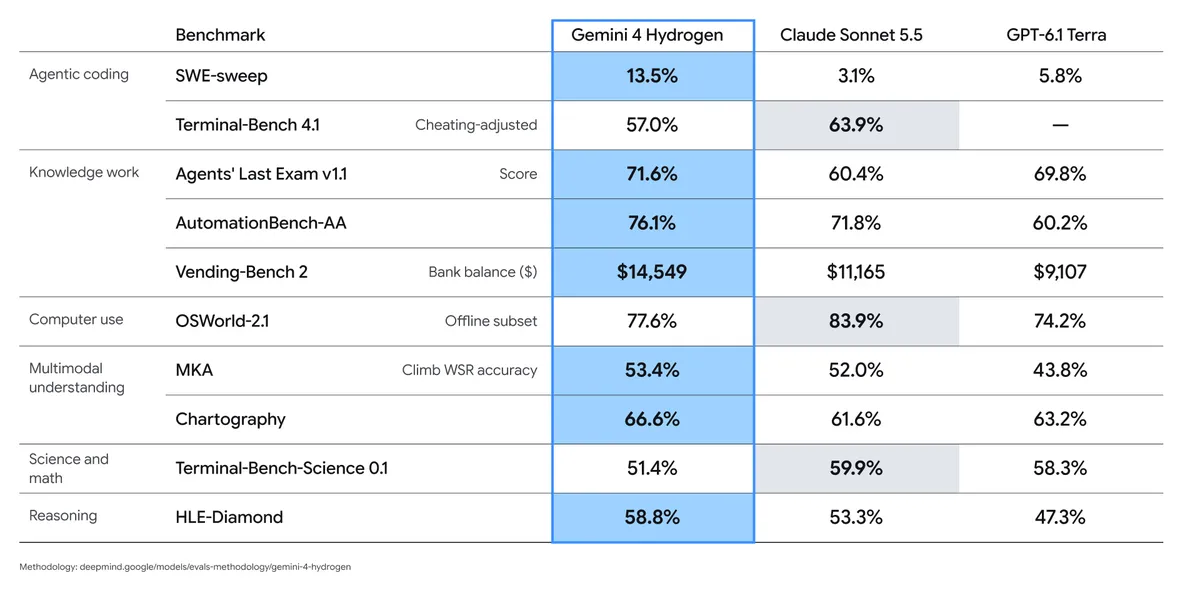
Google published 10 benchmarks, and Hydrogen came first in 7. The biggest gap is in SWE-sweep, which requires finding and fixing bugs without breaking existing code: Hydrogen 13.5%, Sonnet 5.5 3.1%, Terra 5.8%. Sonnet 5.5 won the other 3: Terminal-Bench 4.1 at 63.9% vs. 57.0%, OSWorld at 83.9% vs. 77.6%, and a science task. Note: Hydrogen's lead in overall score does not mean it leads on every benchmark.
The cost math is more detailed. According to Google's own chart, with all three set to their highest level, Hydrogen scores 54 at about $3 per task; Sonnet 5.5 also scores around 54 at about $10 per task; Terra scores 51 at under $1 per task. Comparing at the same 51-point score, Terra is half the price of Hydrogen's default level, but Hydrogen takes less than half the time of Terra. The choice depends on whether you are more short on money or time, and whether the task falls in Hydrogen's strong suit.

Price migration also needs to be calculated. Argon and Carbon's introductory prices of $2 and $10 run through November 30; starting December 1 they rise to $4 and $20, at which point Hydrogen's unit price will be less than 40% of theirs. 3.8 Flash's current promotional prices of $0.75 and $3.75 run through the end of the year. If you switch from 3.8 Flash today, the unit price will first double, and starting in January next year the two will be on par. This calculation affects day-to-day use more than the overall score.
What it can do: Compared with 3.8 Flash, Hydrogen completes tasks 2.5 times faster, Terminal-Bench 4.1 rises from 18.2% to 57%, hallucinated content is down by more than 80%, and operations like reading files and searching can be issued several at a time in parallel. Google recommends pairing Hydrogen with Carbon: Carbon does planning and tackles hard problems, while code changes and test runs are handed to Hydrogen. Antigravity has added an Orchestrator that automatically switches between the two models within the same session. Google's tests found that success rates were close to using Carbon throughout, with 24% less quota used and 19% faster speed.
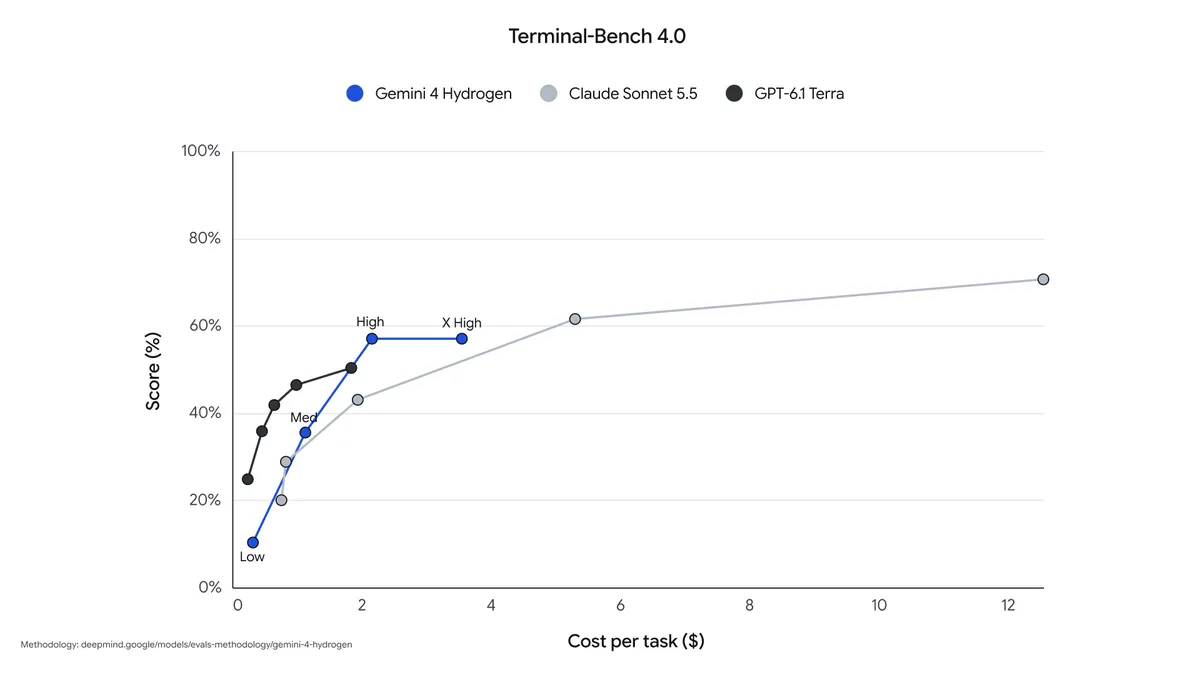
The thinking levels add xhigh in addition to low, medium, and high; the default is high. The context window is 1 million tokens, shared across input, thinking, and output. In the replies to the tweet, a user said that with four thinking levels, they always click the highest one. That reaction is closer to real usage habits than the official copy. For cost-sensitive users, you'll need to test the difference between the default high and xhigh yourself.
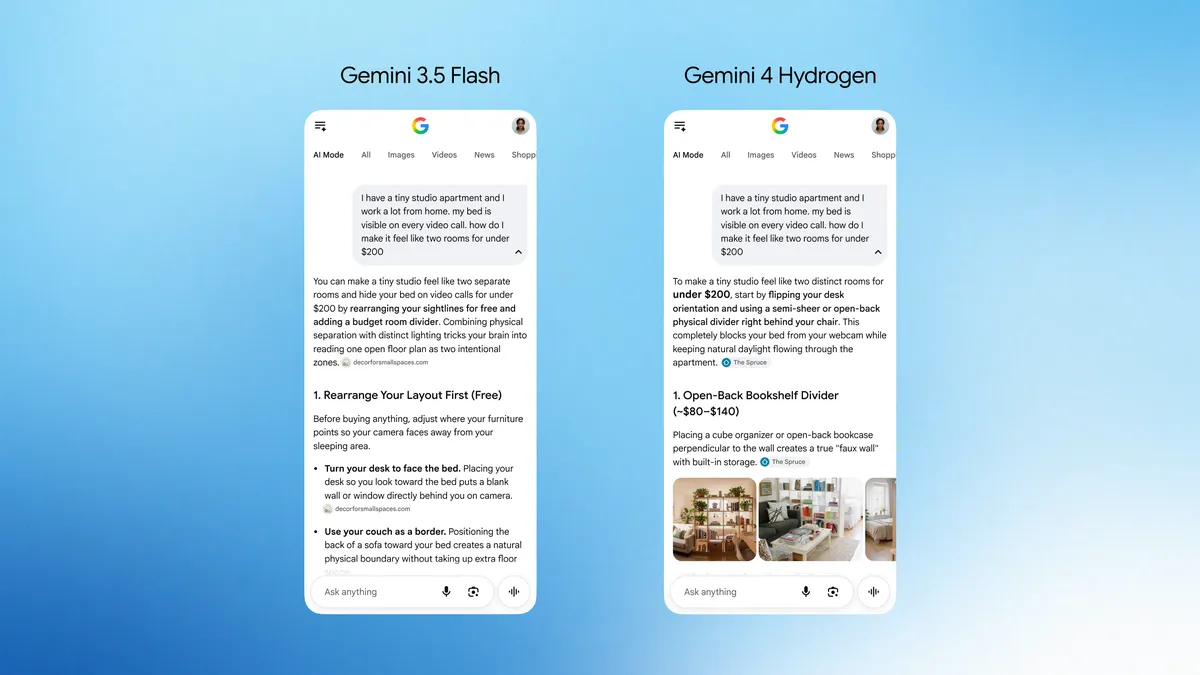
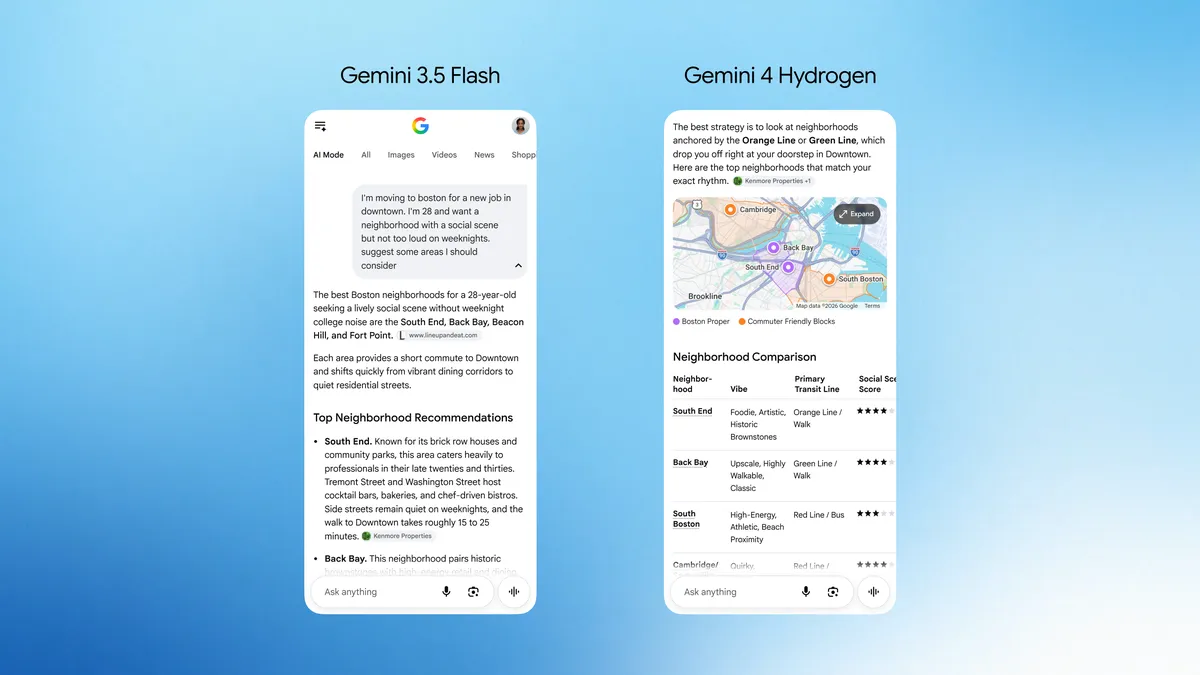
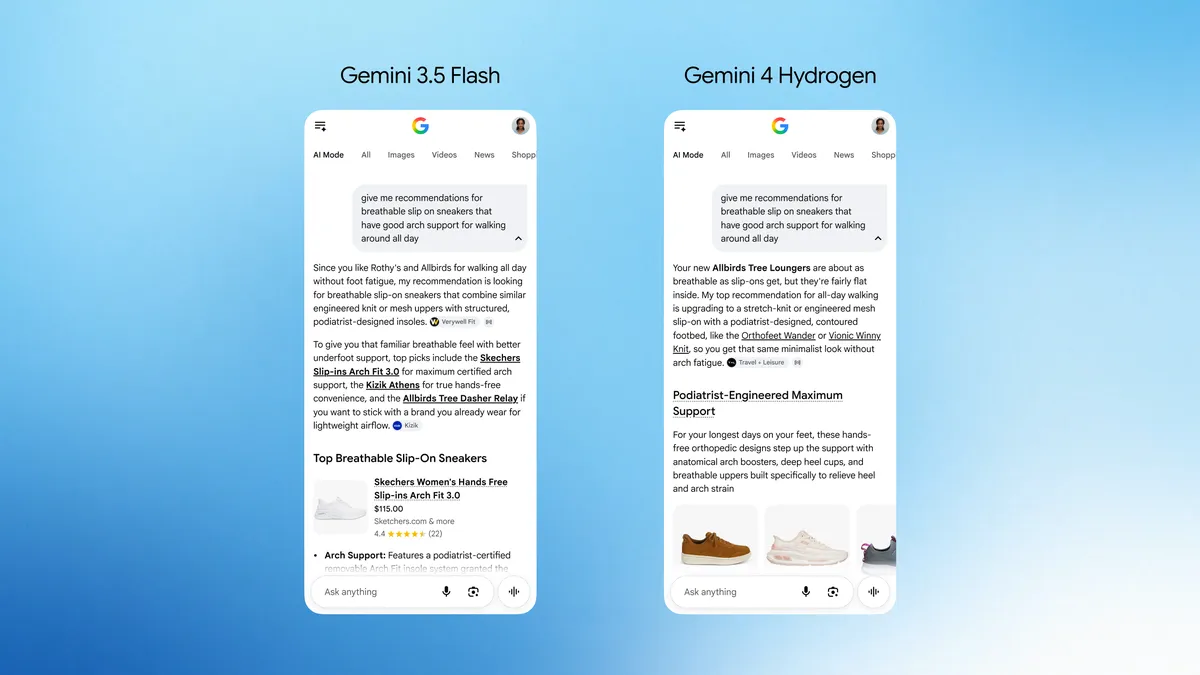
Consumer side and Search: In the Gemini App, Hydrogen is better at following tone, format, and specific rules; email drafts, study guides, rewrites, and documents are more likely to be usable on the first try. It can pull context from uploaded files, Gmail, Google Drive, and connected apps such as Airtable and Dropbox. Search has also switched to Hydrogen; Google says it better understands natural language, multi-part questions, typos, and specific requirements, and gives more visual, easy-to-scan results while broadening the range of related links.
If you currently use 3.8 Flash heavily and are cost-sensitive, first note the timing of the year-end promotional price and the January next year parity point; if you need the developer free tier or faster everyday execution, Hydrogen has clear appeal. Google has turned the choice into four thinking levels plus multi-model orchestration; the actual results depend on your task mix and limits. The benchmark scores come from Google; AA has not yet published its scores, so it's not too late to wait for third-party data before drawing conclusions.
Sources:
Google official blog, 'Introducing Gemini 4 Hydrogen,' Koray Kavukcuoglu, 2026-11-12
Gemini App Help Center: Models available by plan
https://support.google.com/gemini/answer/18648722
Developer docs, 'What's new in Gemini 4 Hydrogen,' and pricing page
https://aistudio.google.com/docs/whats-new-gemini-4-hydrogen
https://aistudio.google.com/docs/pricing
Business Insider hands-on report, Hugh Langley, 2026-11-11
https://www.businessinsider.com/google-hydrogen-test-new-gemini-4-flash-model-ai-2026-11
Artificial Analysis Composite Index
https://artificialanalysis.ai/
Sundar Pichai tweet
发布时间: 2026-11-13 02:27