Claude’s Agent backend can now fit into your own data center
Private testing, full self-hosting, and optional egress for model requests. For teams that need to keep code on the internal network, this is a key step; for operations, the bill and complexity have also changed hands.
On November 12, Claude Devs announced that Self-hosted Claude Managed Agents has entered private beta. The Managed Agents backend that runs long-running task Agents can now be deployed as a complete set in your own cloud or on-premises data center. The hosted scope includes the agent harness, sandbox, credentials, and session history. You can also choose where requests are sent: Anthropic, Amazon Bedrock, Google’s Agent Platform, Microsoft Foundry, or your own gateway.

This solves a very specific pain point. For an Agent to fix a broken build, handle alerts, or dig through a bug backlog, it has to read code and access internal systems. Many teams do not avoid using it because they do not want to; it is because code and session records cannot leave the internal network. Claude previously offered self-hosted sandboxes; now it is handing the harness, database, worker, and server side over to customers to operate. Developers still build Agents using the same core API.
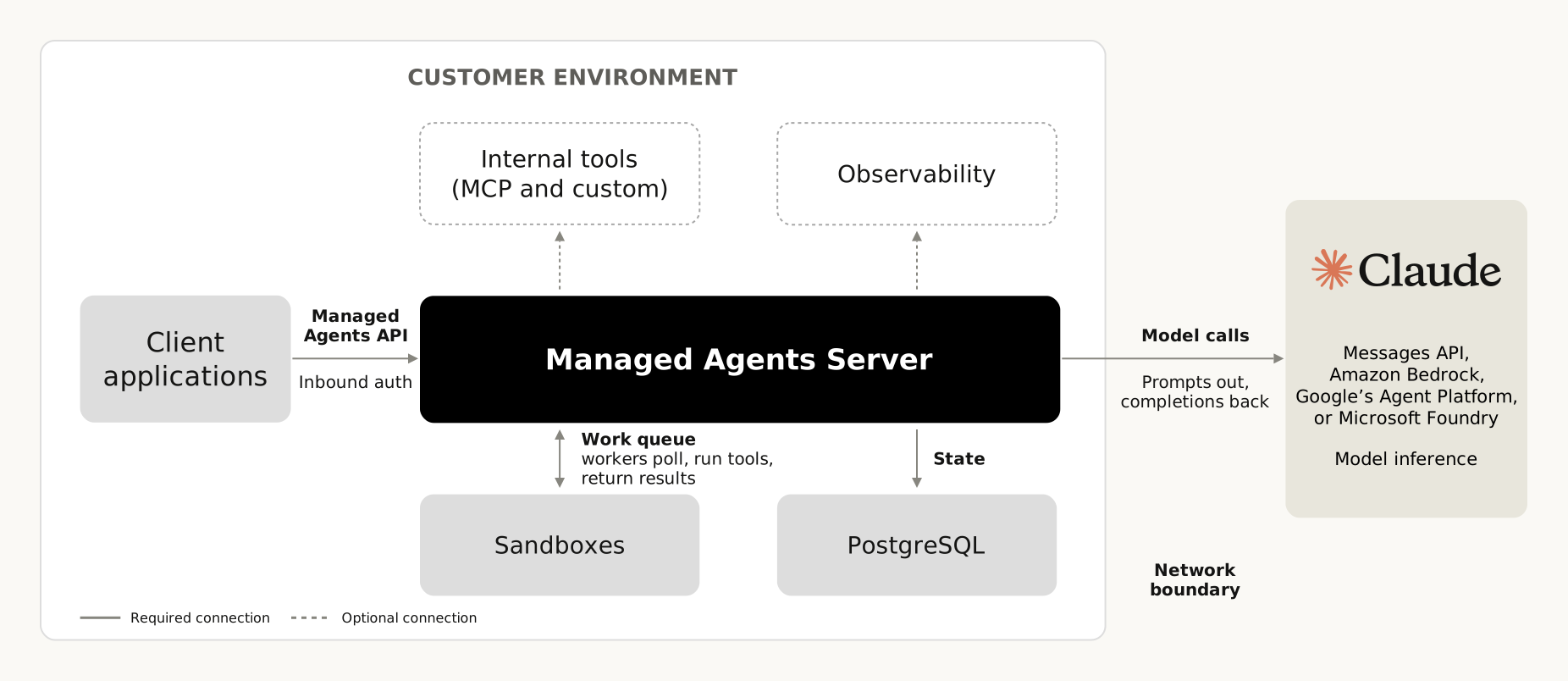
The security design has four parts. First, brain and hands are separated: the harness calls Claude, code runs in the sandbox, and the agent loop, session history, and vault secrets stay outside the sandbox. Second, credentials do not enter the sandbox; MCP and some API calls are made by a proxy outside the sandbox with credentials added, and when self-hosting you can also connect your own secrets manager. Third, network access can be restricted by allowed hosts, for example allowing only git hosts and package repositories. Fourth, every session keeps a complete record, and tool calls and returned results can be exported to existing monitoring via OpenTelemetry.
Session history is stored in your own database. If the organization already has zero data retention with Anthropic, the same applies to requests sent to Claude. Some users pointed out that session history is only a record; if no one reads it back before the next run, it will not become memory. This distinction will become increasingly important for long-running task Agents.
Note that this is a private beta, open only to eligible organizations, and you need to apply through the Anthropic account team. The linked documentation provides an entry point, but it is not something you can use with one click. In community replies, some asked whether they can use their own Claude subscription, and others asked whether the sandbox supports Mac; there were no answers under the tweet. Another commenter mentioned that the database requires PostgreSQL 16 or higher; otherwise the service puts data in memory and it will be cleared on restart. This is an addition from the replies and is worth confirming with the official team before integration.
Some see this as Claude building its own Vercel, while others’ first reaction was that the domain they bought yesterday should be refunded. Jokes aside, self-hosting lowers the compliance barrier by a notch, while at the same time putting operations, databases, upgrades, and monitoring into your own hands. For security teams, keeping code on the internal network is a good thing; for platform teams, the work has really arrived.


The application entry point and documentation are in this official article and the self-hosting docs.
发布时间: 2026-11-13 02:29