LangChain Raises $300M at a $3B Valuation—The Focus Is No Longer the Framework
LangChain has completed a $300 million Series C at a $3 billion valuation. The company, which built its reputation on an open-source framework, devoted most of this announcement to LangSmith: a framework-agnostic Agent platform spanning running, improving, and governing Agent systems. More than 7,000 organizations use it, and Workday cut the time to deploy a new Agent from five months to less than a day.
On November 13, LangChain announced that it had completed a $300 million Series C at a $3 billion valuation. Existing investor CapitalG led the round, with new participation from GIC and DFJ Growth; IVP and Sapphire Ventures continued to participate.
If you've built Agents, chances are you've used LangChain or LangGraph. The company first became known for its open-source framework, but in this funding announcement, Harrison Chase spent much of the announcement discussing something else: LangSmith.
His assessment is straightforward: Agents will reshape the economy, and only companies that own their intelligence will be able to build lasting competitive advantage. In product terms, this means letting enterprises freely choose models, control data and infrastructure, continuously improve Agents, and maintain the governance needed to run them at scale.
LangSmith is positioned as a 'framework-agnostic' platform. No matter what models or frameworks a team uses, it can use LangSmith to run, improve, and govern Agents. The official data says more than 7,000 organizations use it, from newer companies such as Harvey and Rippling to large enterprises such as NVIDIA, Toyota, and Salesforce. Clay uses it to monitor hundreds of millions of Agent runs every month.
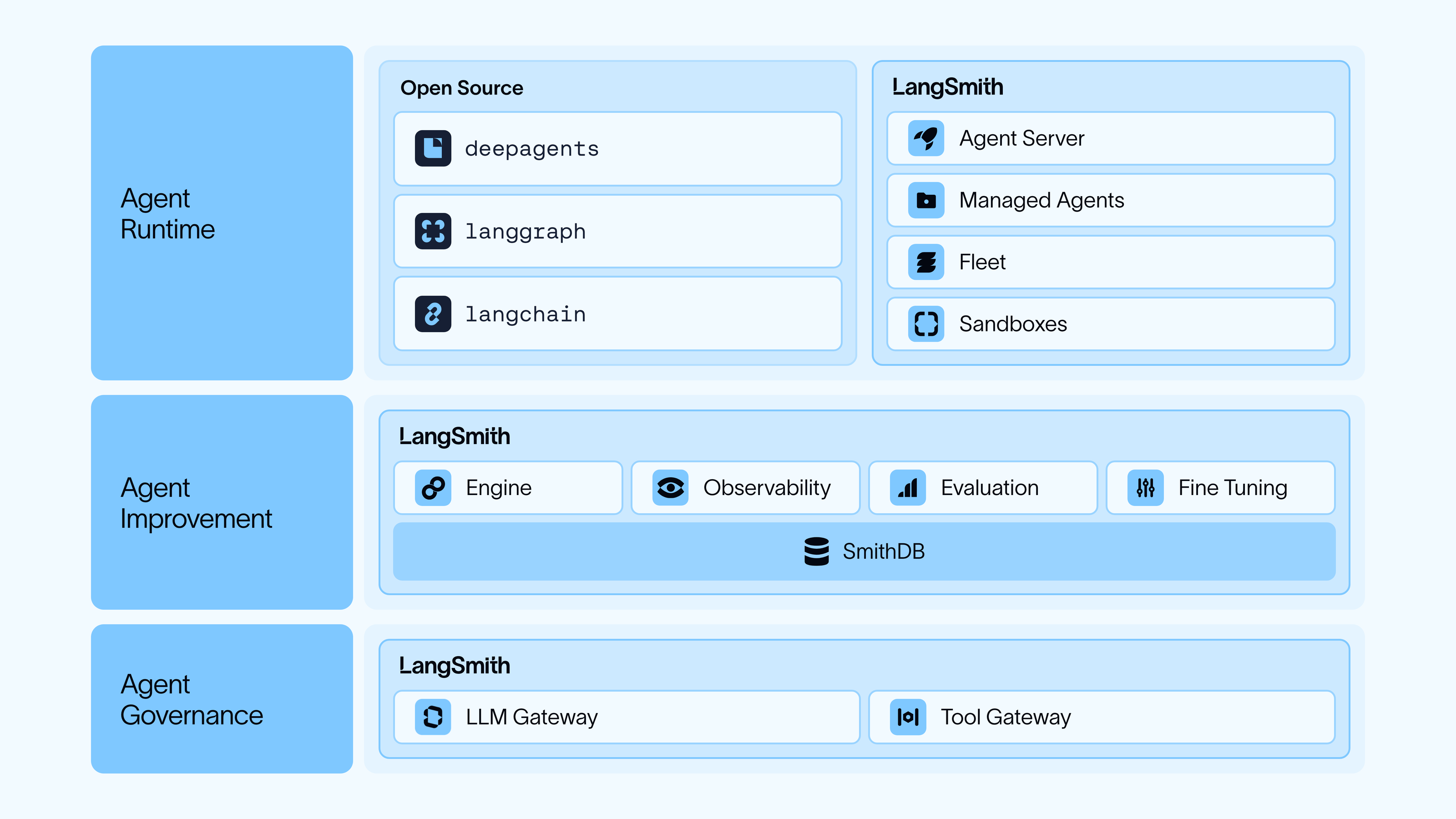
The platform has three parts:
Agent Runtime, responsible for running reliably. Deep Agents, LangGraph, and LangChain give developers flexibility and context control; Agent Server and Sandboxes handle secure deployment; Managed Agents and Fleet provide managed services.
Agent Improvement, responsible for testing, monitoring, and improvement. Observability and Evaluation let teams see what Agents are actually doing and how good they are. Engine automatically finds errors, writes code and prompts to fix them, and monitors for regressions. Fine-Tuning turns Agent traces into training data for fine-tuning specialized models.
Agent Governance, responsible for controlling the use of model calls, tools, and data. LLM Gateway and Tool Gateway help teams manage model budgets, protect sensitive data, and control tool permissions.
One concrete example: Workday used LangSmith to cut new Agent deployment time from five months to less than a day.

What does a $3 billion valuation mean? For a company still transitioning from an open-source framework to an enterprise platform, the market is clearly betting that the Agent infrastructure layer will produce winners. LangChain has chosen a platform strategy and emphasizes being 'framework-agnostic,' meaning it will not be tied to its own open-source framework; it wants to build a more foundational business.
Next Friday (November 20), they will release a set of new LangSmith capabilities. At the end of the announcement, Harrison said that building high-performance Agents is far harder than it should be—and that is exactly what they intend to change.
That is also the most informative line in this funding round: Agent development is still at a 'hard to use' stage, and whoever can make it simpler will have an opportunity.
发布时间: 2026-11-14 02:25