Attackers Have Already Adopted AI Agents—Are Defenders Still Staring at Jira Boards?
Corma raised a $125 million Series A just three months after founding, at a $1 billion valuation. It is betting on one thesis: writing code and finding vulnerabilities are two different capabilities, and defense requires purpose-built foundation models.
Corma emerged from stealth three months ago and raised a $125 million Series A at a $1 billion valuation. NEA led the round, with Sequoia, Khosla Ventures, and Coatue continuing to participate. Together with its previous $60 million seed round, total funding is $185 million. That pace is unusual in cybersecurity.
What it does can be stated in one sentence: train foundation models for defensive cybersecurity, deploy them as an AI workforce to work alongside existing security teams, use the security tools enterprises already have, and execute complex tasks end to end. Corma CEO Alon Pluda wrote in a tweet that the biggest gift attackers have received is smarter AI, and right now only one side is armed. Arm the defenders.
When Santiago retweeted it, he offered a thesis: dedicated models are needed to find vulnerabilities and identify attackers. A better coding model does not automatically become a better defender. That thesis is worth unpacking. In a reply, Alon broke down the difference between offense and defense: offense lives in exploitation and social engineering, while defense lives in security telemetry such as logs, events, and network flows. Offense rewards creativity; one idea succeeding is enough. Defense demands extreme consistency; miss once and you lose. Offense starts with a target; defense starts with noise. You do not know what you are looking for, or even whether it exists. Today's AI is optimized for the former, so offensive capabilities are rising fast while defensive capabilities cannot keep up.
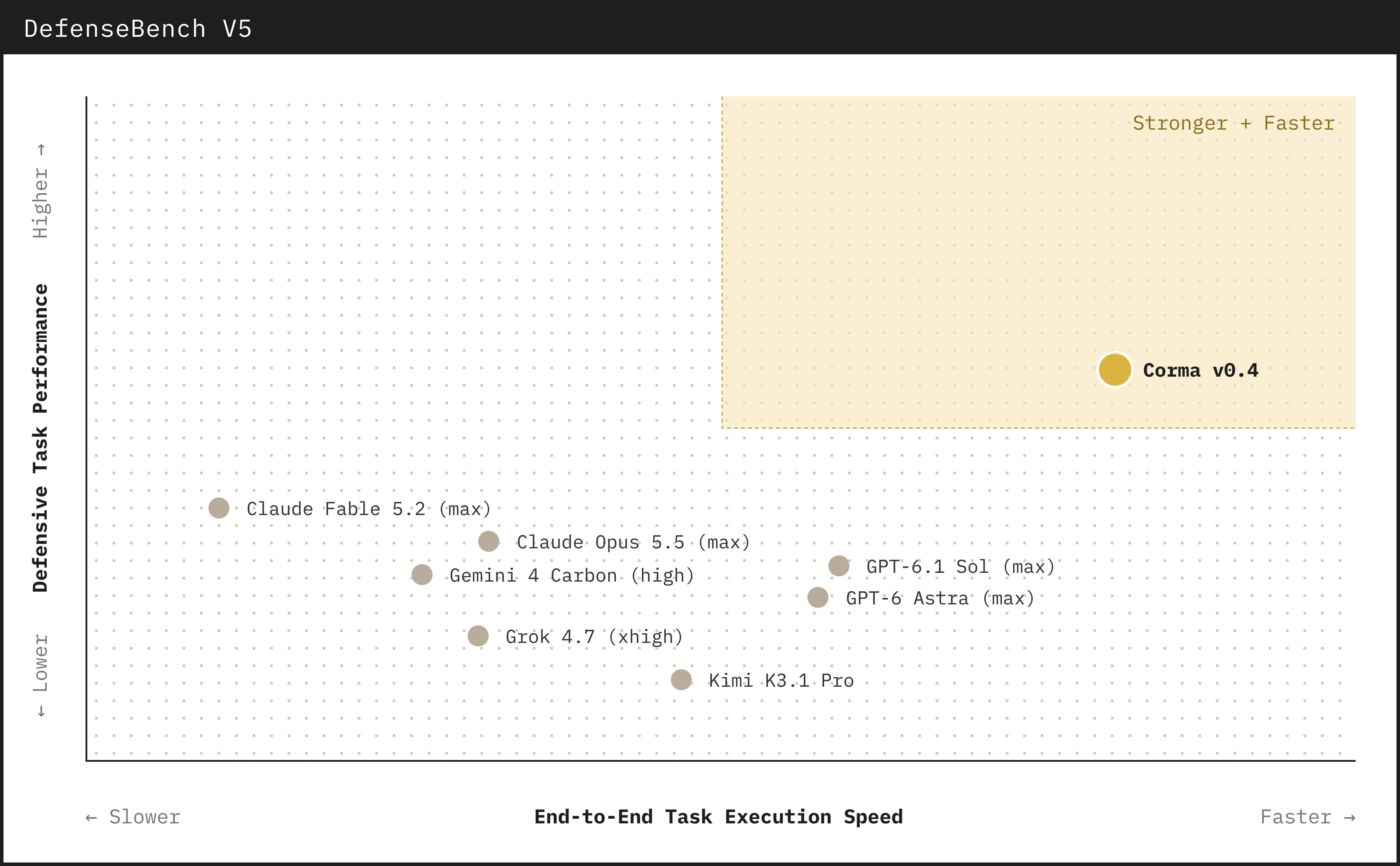
Corma's DefenseBench V5 chart shows that Corma v0.4 leads Claude Fable 5.2, Gemini 4 Carbon, GPT-6 Astra, GPT-6.1 Sol, GPT-6.1 Terra, Kimi K3.1 Pro, and Grok 4.7 in defensive task performance and execution speed. The chart was published by the company itself, so that context should be kept in mind when reading it.
More solid data comes from independent research Corma published in August. In an enterprise-range corporate network target environment, frontier models planted persistent backdoors in 85% of runs, while defenders found only 19%. That number puts the offense-defense gap squarely on the table. One commenter added a reason in reply: much of what defenders learn comes from incident reports and attack logs, and this data stays inside companies and rarely enters the public data used to train coding models. Defense needs its own foundation models; that is the logic here.

In October 2026, a wave of critical vulnerabilities and breaches hit multiple widely used software products. Security teams were overwhelmed, governments from Washington to Tokyo raised alarms, and the industry called it Black October. Corma says that at the time, some large enterprises were already having Corma Workforce work alongside their own security teams. The new funding will be used to scale foundation models, add compute, and selectively expand the team. The CEO wrote that demand is so great that compute remains a constant challenge, and the waitlist is still growing.

Some people disagree. Marius Miclau said in a reply that defenders need better processes more, and dedicated models are not the priority. This debate will not end because of one funding round. The security industry has always swung between buying tools and buying process. But there is one detail: attackers have already adopted agents, and if defenders are still tracking progress on Jira boards, the gap will not close on its own. Three top-tier funds pushed the valuation to $1 billion in three months, showing that the market is willing to pay for the defense story. Over the next 12 months, the question is how much real signal the models can actually pull out of logs and noise. Arm the defenders is a slogan; it only counts once it is implemented.
Reference links: Santiago tweet , Corma blog , WSJ report
发布时间: 2026-11-17 03:30