Subagents Aren't Dead, but Your Agent Org Chart Needs Dismantling
In multi-enterprise deployments, Anthropic's Applied AI team found that a single agent plus skills and tool search often wins on quality, cost, and latency at the same time over multi-agent orchestration. Matt Stockton's summary sparked debate; what is really worth examining is the three conditions for keeping subagents, and the places where migration tends to go wrong.
On X, Matt Stockton compressed a long Anthropic article into one sentence: most agent workflows do not need subagents; one main loop is enough. The summary is controversial, but the article itself is more nuanced than the tweet.
First, some background. Subagents are agents with independent context windows, tools, and instructions, orchestrated by a coordinator. They are good at verification, parallelism, and permission isolation. Anthropic itself uses them in multi-agent research systems. The problem arises when enterprises put them into practice: many teams treat subagents as a mirror of the org chart: each capability belongs to a team, each team builds a subagent, and a central platform stacks an orchestrator on top. Conway's law gets written into the prompt.
The article lists the complexity this approach immediately creates: context is exchanged back and forth between agents and loses fidelity; subagent sprawl, with hundreds of overlapping ones, no standards, and no clear owner; Frankenprompt, where every team adds a sentence to the system prompt, rules conflict, and tone is inconsistent; evaluations each optimize a subtask, while leadership sees diluted local scores; and latency. One customer compared a multi-agent harness with a single-agent loop, and the latter ran about 2x faster.
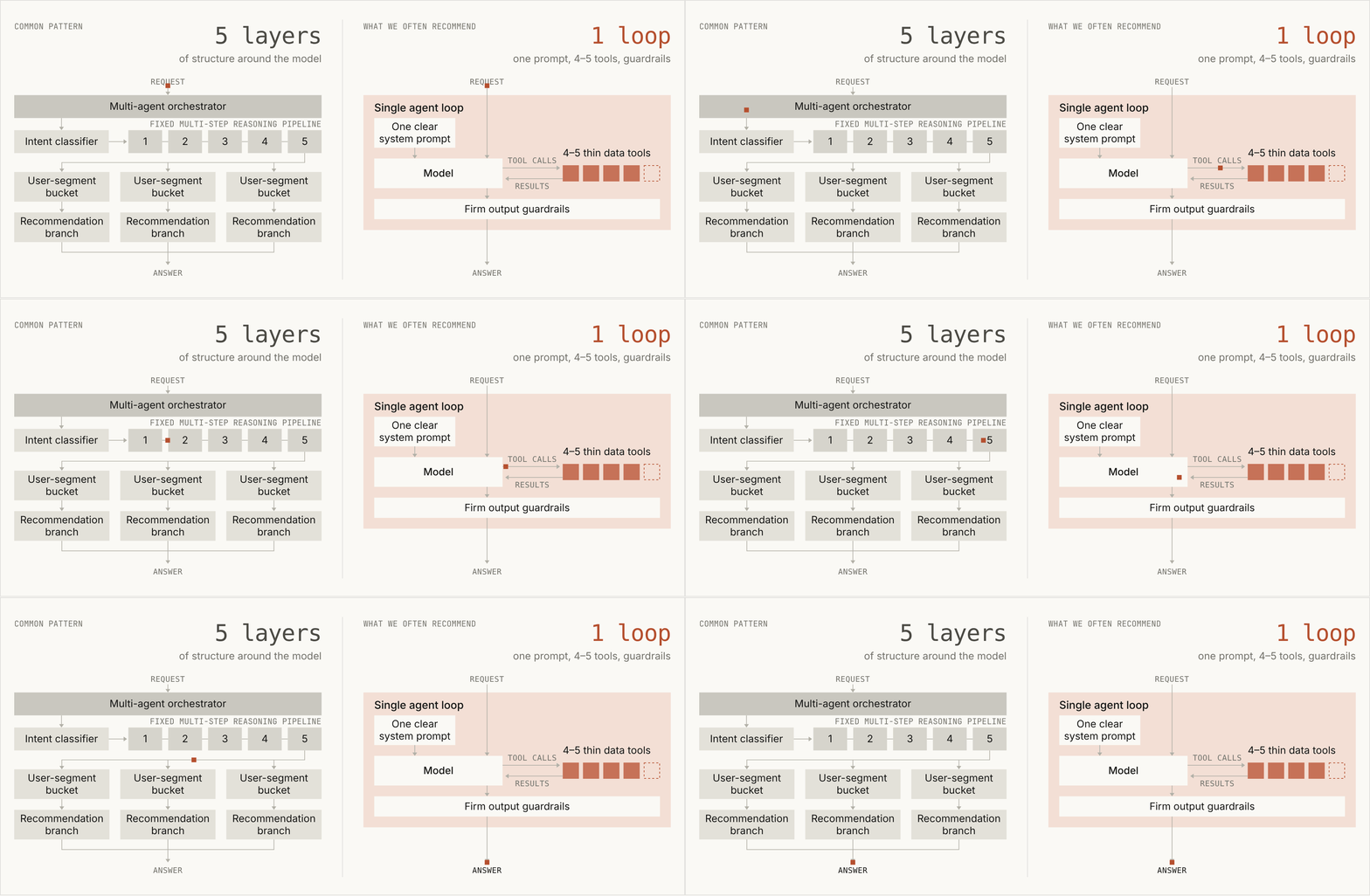
After comparing deployments across multiple enterprises, Anthropic's Applied AI team saw that a single agent plus skills often beats both the one-prompt-to-rule-them-all approach and multi-subagent designs on quality, cost, and latency at the same time. One company's customer-facing agent had more than a dozen expert subagents; the brand experience was hard to maintain, and latency hurt user experience.
Why can we consolidate now? Three reasons. Shared context produces better answers: in long tasks, results from earlier steps stay in the main context window, and the agent can connect them, which is richer than summaries handed back by subagents. Progressive disclosure prevents context bloat: skills and tools first show only short descriptions and load when needed, so teams do not have to stuff all context into a long system prompt. Models are stronger: the article mentions that Claude Code cut its system prompt by more than 80% for more advanced models, including cuts related to progressively disclosed skills and tools. Each new model moves more decisions from the harness into the model, and simple loops are easier to migrate to the next model.
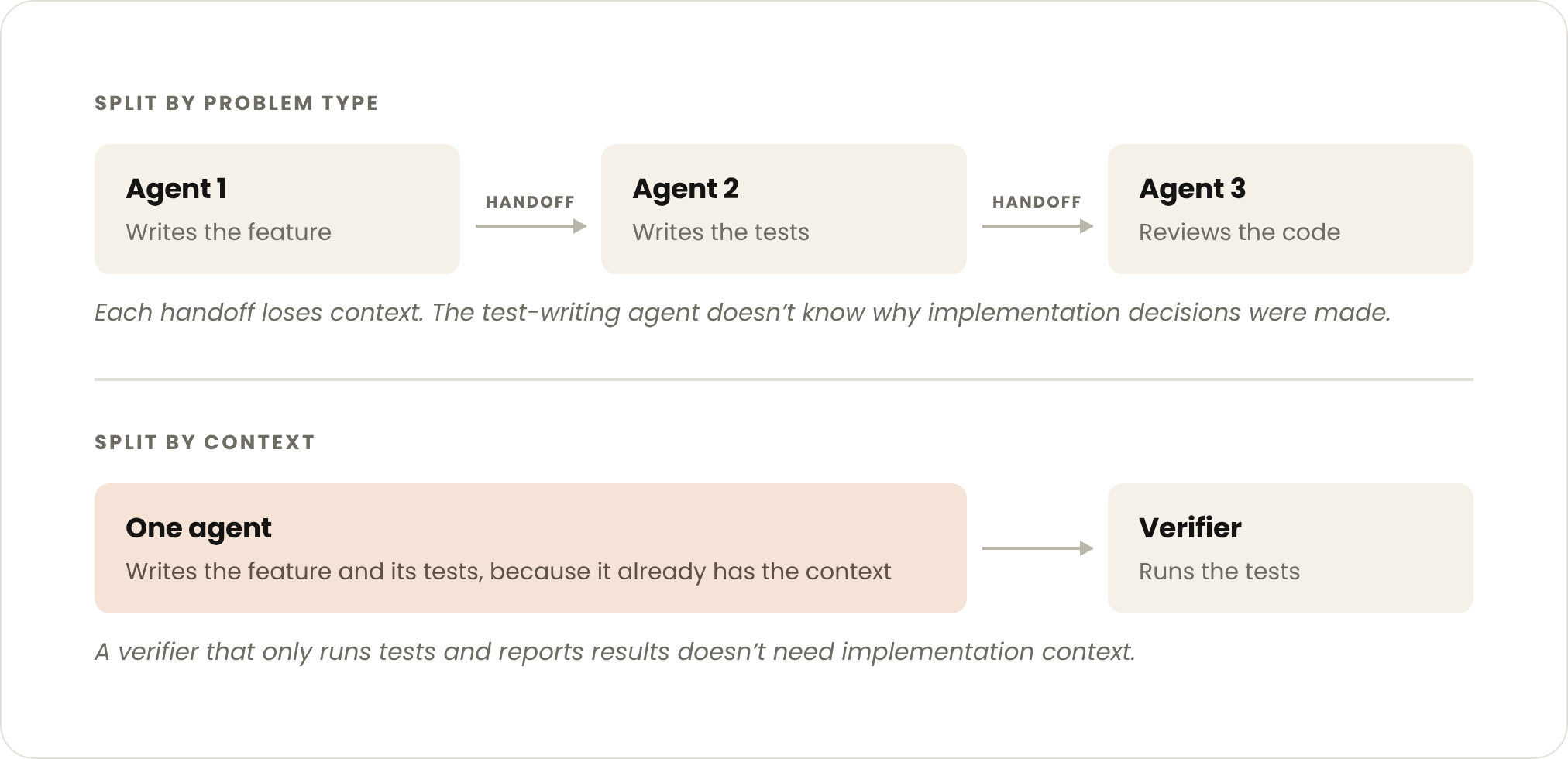
But subagents are not dead. The article explicitly keeps three conditions: a single agent loop shows measurable performance degradation due to context bloat; multiple tasks need to run in parallel with fresh context, discarded when done; a single agent struggles to choose the right tools, or the system prompt contains conflicting instructions. When these conditions hold, subagents still have a place.
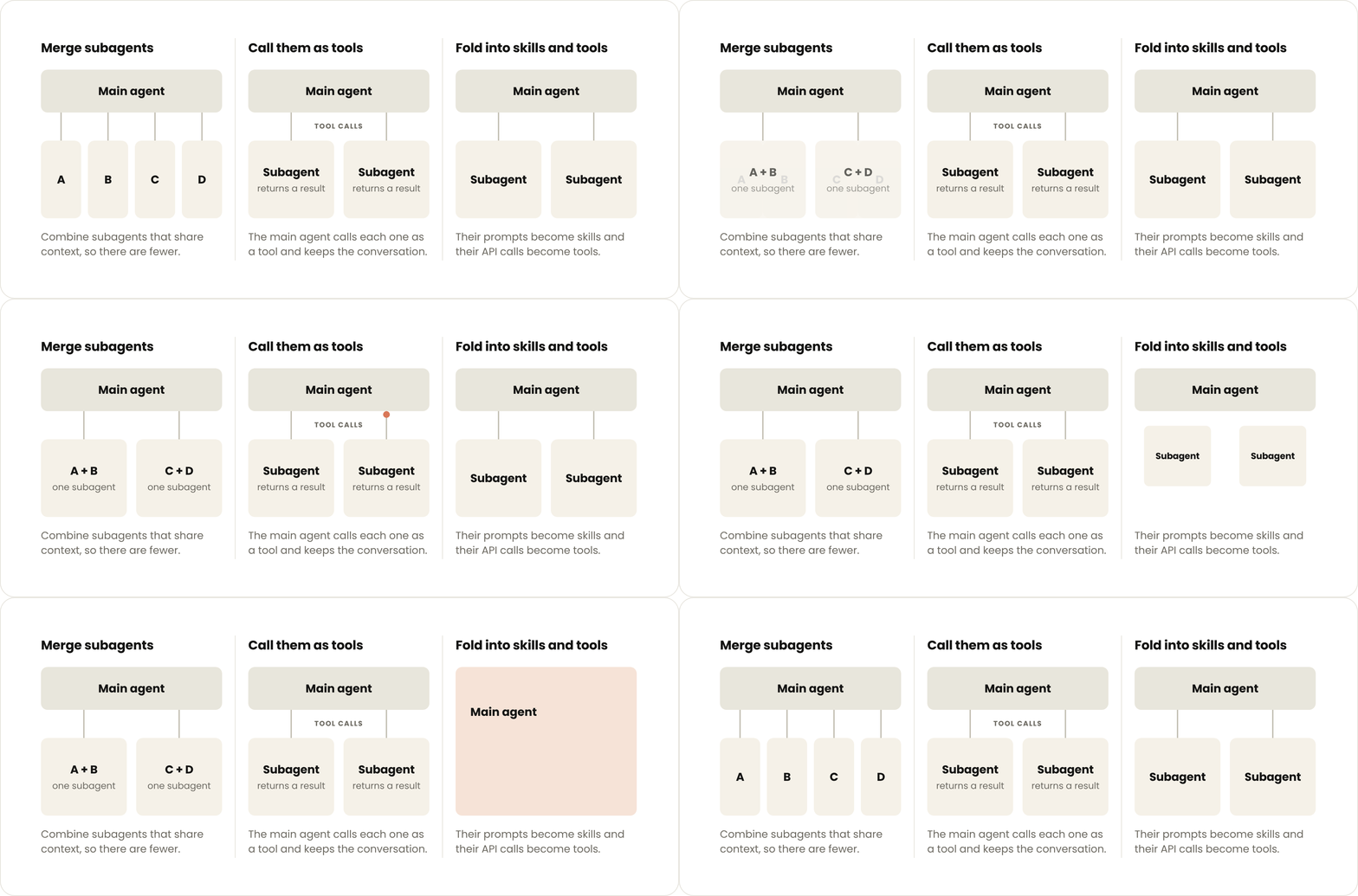
Do not migrate all at once. First build task-completion evaluations. A central team owns end-to-end evals, skill teams carry small evals, and 10 golden examples are enough to start. Score the final output; while still in the orchestration stage, also track routing accuracy, and after folding, check whether the right skill was loaded or the right tool was called. Then merge domain subagents by shared context, prioritizing the most-used ones. When keeping a subagent, have the main agent call it as a tool, and let the main agent keep talking to the user. Finally, fold subagents into skills and MCP tools one at a time, comparing evals before and after folding, looking not only at the total score but at which tasks flipped.
Tool design has details. Group MCP tools by jobs to be done, not one tool per API. When the system prompt has more than 30 to 50 tool definitions, tool selection tends to degrade. Use tool search and lazy loading. Skills hold the team's methods, steps, rules, and judgment for doing work. The knowledge base holds reference material that is only occasionally needed. A small central team manages the system prompt and end-to-end quality, and teams shift from owning agents to owning skills and tools.
The comments are closer to practice than the body of the article. @不正经的Ai局长 says subagents exist to limit context and isolate failures; the real issue is the failure bill: one bad subagent costs one retry, while one bad main loop costs the entire run. @John Rood points out that if you put the plan in the main agent's context, it is the first thing compression eats; a plan from an hour ago gets summarized away exactly. @Armalo AI offers an approach: write the plan to a file outside the chat, have the agent reread it after each step and check off completed items; context can shrink while the plan stays intact. @Daniel Lenton says they keep subagents but change them to forks, with each subagent starting from what the main agent has already read; prompt caching makes the cost lower than it sounds. @Ashot says give the agent an org chart, where roles do not split tasks but own a domain for weeks, while actual tasks are still handed to one agent with full context.
There are also direct rebuttals. @Toast thinks Matt's tweet is misleading; the article mainly argues against a specific kind of overengineering, and subagents overall are becoming more important because of the coordination thread model. This rebuttal is worth reading because the article does keep subagents and gives a migration path; it is not one-size-fits-all. @Lachy asks whether, when keeping a subagent, the main agent gets only a summary or the full output; that choice determines whether it really controls context.
The article's final principle is not fancy: measure, change one thing at a time, keep what works. Build a small eval, fold one subagent, keep it as a subagent only if the folded version is worse, then repeat. For teams doing applied AI, this is more useful than arguing single-agent versus multi-agent.
发布时间: 2026-11-17 12:29