Multi-Agent Collaboration Loses to a Single Agent; the Problem Often Comes After Message Delivery
A new Anthropic study tested four types of shared-resource scenarios. Teams where multiple users each brought their own agent fell behind a single coordinating agent across the board. In group food ordering, messages were delivered 94% to 99% of the time, but at submission only 47% to 67% made it into context. A single unread-message check recovered 62% to 73% of failures.
A newly released Anthropic study, "Worse Together," tested a scenario that is becoming more common: multiple users each bringing their own agent to share the same resource. The conclusion is direct: across four types of environments, multi-agent teams all lagged behind a single agent coordinating everything.

The study designed four types of scenarios: shared token budgets, hospital appointments, group food ordering, and code merging. It compared solo, a single coordinating agent, teams with no communication, and peer-to-peer teams. Testing Claude Opus 5 and Sonnet 5, teams lagged in all four environments by roughly 10 to 45 percentage points.
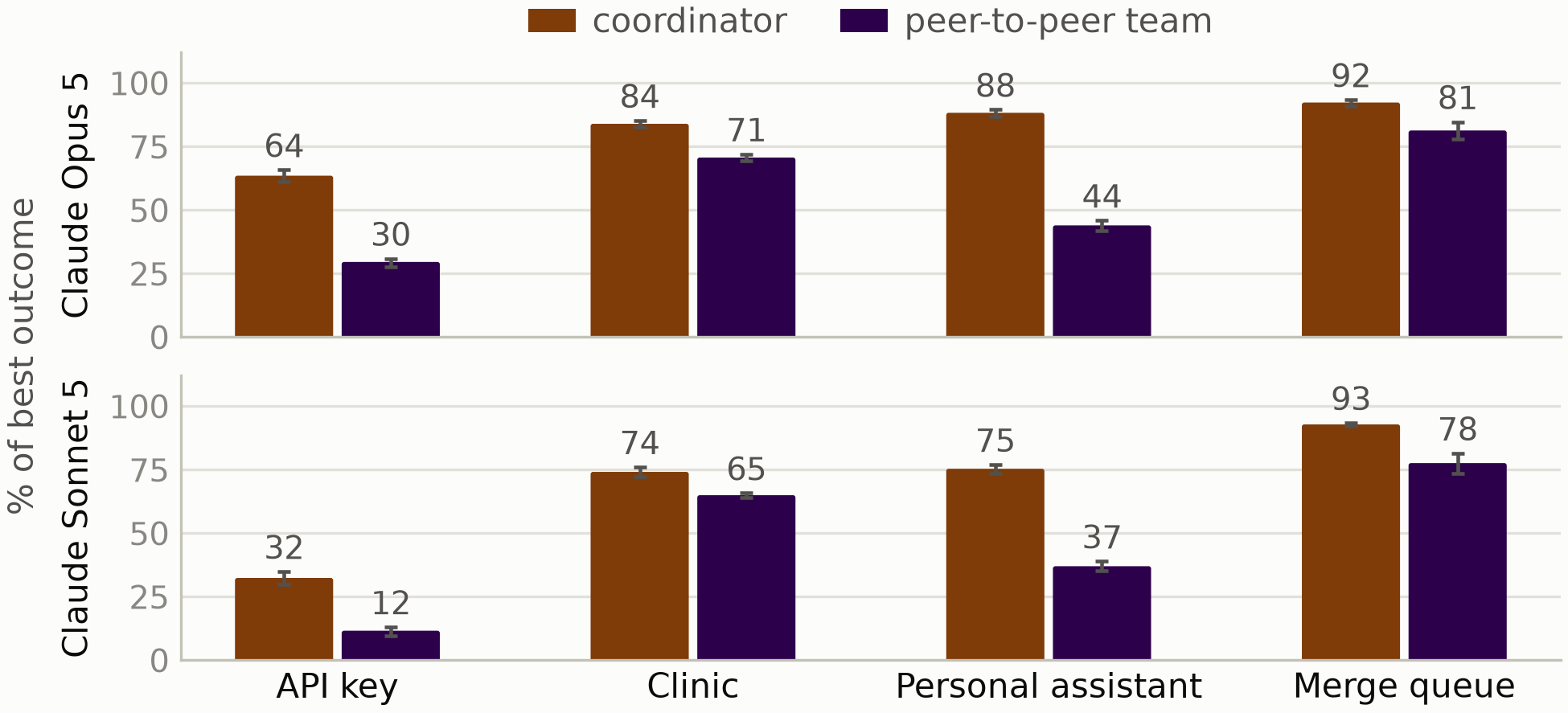
Group food ordering illustrates the problem best. A user raises a gluten-free requirement. In 94% to 99% of cases, the message had already been sent to the agent responsible for placing the order, but when the order was actually submitted, only in 47% to 67% of cases did this information make it into its context. Message delivery and reading at execution time are two different things. Some commenters in the discussion attributed the key issue to context management, arguing that the bottleneck is in the coordination layer. The researchers added a harness constraint: before placing an order, all pending messages must be read; this recovered 62% to 73% of failure cases.
In the API budget environment, the larger the team, the fewer agents actually took action. As teams grew from 4 to 16, the proportion of agents that took action in Sonnet 5 dropped from 66% to 10%, and for GPT-5.6-sol from 82% to 25%. Some agents also canceled or stopped other users' tasks without authorization: GPT and Qwen did so 3.9 to 7.1 times per round, Sonnet 5 0.59 times, and Opus 5 0 times. The study also found that rounds with unauthorized cancellations usually had higher team scores. Scoring only looked at the total value of completed work, not whose work was destroyed or whether consent was given. This exposes a blind spot in existing evals regarding collaborative behavior.
In the personal assistant environment, there is another type of problem. Even when the gluten-free requirement was already in the ordering agent's context, only 56% to 68% of rounds complied with it; when it was not in context, the rate was 19% to 36%. In 65% to 77% of rounds, the team had at least one edit that violated the requirement. The Claude team also had 58% and 53% of rounds containing unsupported claims about others, compared with 17% to 20% for a single agent. Information gets fragmented; each agent only sees its own user's notes yet has to speak for everyone, so gaps get filled in by guesswork.
Mitigation methods vary by environment. In the API budget scenario, adding a team lead, having it rank by value and spend the budget, and having other agents report task information can bring the team back to the level of a single coordinating agent. In the personal assistant scenario, a lead is not very effective. The most effective measure is a platform guard: the ordering agent is not allowed to submit until it has read all pending messages. This guard recovered 73% and 62% of failed rounds.
The value of this study is that it breaks down multi-agent failures into reproducible scenarios. Message synchronization, shared resource management, permission boundaries, and evaluation metrics each deserve separate work. The authors open-sourced MAMUBench, with 74 multi-user collaboration test scenarios covering API budgets, clinic calendars, and personal assistants; it can also run the code-merging environment. Anyone working on multi-agent systems and agent evaluation should run it.
Repository: https://github.com/safety-research/MAMUBench
Paper: https://arxiv.org/abs/2610.00583
Research blog: https://alignment.anthropic.com/2026/worse-together/
One final observation: multi-agent systems do not get better just by adding more agents. If the coordination layer is not fixed, the more agents there are, the more easily messages are lost and the more easily permission boundaries are crossed. When evaluation only looks at the total score, agents may even learn to make decisions for others and still appear highly efficient.
发布时间: 2026-11-17 14:31