Agents Do Not Remember What Matters; the Memory Store Is Not Too Small
Meta, Google, and several new papers are all moving in the same direction: let models design their own memory habits, then distill that judgment into the weights. But cost, forgetting, and cross-model transfer remain hard problems.
An agent spends a week fixing bugs in the same project, and in the next round it still falls into the same pit. Give it a notes directory, and it keeps a running log, while the key decisions are not captured. The problem is judging what is worth remembering; storage is not the point.
Last week Meta and Google released research on self-improving memory almost simultaneously. The direction is the same: memory design should not be hard-coded by humans; let the model try for itself, then train the habits it discovers into the weights.
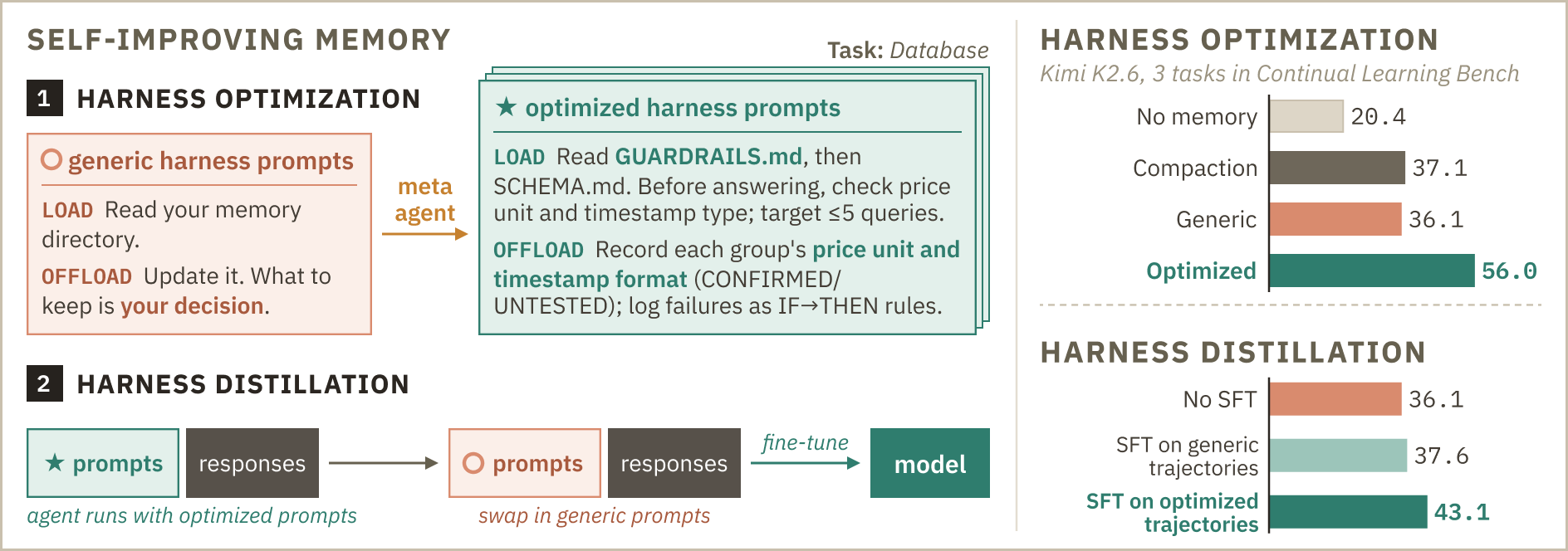
Meta's Self-Improving Memory has two steps. First, a meta agent looks at the task agent's trajectory, rewrites the LOAD and OFFLOAD prompts, and searches for a better memory strategy. Then the optimized prompts are swapped back into the generic prompt, and these trajectories are used for LoRA fine-tuning. The model is Kimi-K2.6. On three tasks in Continual Learning Bench, the optimized prompts average 56.0, versus 44.6 for the best human prompt. After distillation, the model can reach 43.1 using only the generic prompt, 5.5 points higher than 37.6 from fine-tuning on generic trajectories. Source: Meta Research blog, authors Tong Chen et al.

RIME took a different path. It uses RL to train one model to do two things at once: act as the actor, using existing memory to solve problems, and act as the writer, reviewing and updating notes. The writer's reward comes from whether performance on subsequent tasks improves; the actor's reward comes from task completion and discovering new information. In experiments, a 4B-parameter model reached scores close to GPT-5.4 and Claude Opus 4.7. Some researchers noted that training a 4B model to match frontier scores is the headline, but the real test is whether memory judgment can transfer to tasks it was not trained on.

Google's SIM does not train the task model; it trains a harness optimizer. It groups past edits by harness problem, recording the rationale, predicted outcome, actual outcome, and evaluation context. Both the proposer and selector read this memory. Across four domains and ten independent coding runs, SIM improved the continuing-optimization score in 9/10 cases, with an average gain of +2.36 points, p=0.003. But one counterexample stands out: a harness evolved on Opus had an initial score of 68.41 when moved to Gemini, lower than the original seed harness at 73.89. A commenter noted that only the coding results were reproduced; in other domains, each condition was run only once.

SoMem has agents organize memory using ordinary linked documents. The agent decides what to summarize, what topics to create, and when to revise; each summary links back to the original interaction as evidence. Updates are verified at runtime, and temporal, relational, and recent views are generated. On LoCoMo, BEAM-100K, and LongMemEval-S, it outperforms the strongest baseline by 2.66, 3.10, and 2.00 percentage points, respectively. The cost is not low: one user posted the cost, and on full LoCoMo, SoMem cost $229.73 in total, versus $6.75 for Mem0; $118.85 of that was one-time construction, after which each query costs about $0.07 and 20 seconds. It is suitable for memories that are queried frequently.

Route to Remember handles another kind of memory: user facts. It uses on-policy self-distillation to train user memory into the weights, and the student model answers without reading retrieval context. On eight HaluMem-Long users, OPSD reaches 59.9% QA accuracy, MemOS-style retrieval reaches 47.8%, extracted context 51.9%, and raw dialogue 51.3%. Plain SFT reaches only 36.9%. The problem with weight-based memory is that old facts are forgotten, and it cannot distinguish a fact that was never recorded. A verify-then-regenerate router checks textual storage and adds another 6.2 points.

Continual-ARC's conclusion is more direct. Daniel Lenton's team tested OpenClaw, Hermes Agent, and Prime Agent and found that on the new benchmark they failed to remember valuable information and failed to generalize to new tasks. Training the weights of a 9B model achieved both.
These works point to the same thing: the competitiveness of a memory system lies in judging what to write, when to write, and when to delete. Storage capacity and retrieval speed are not the core. One user said their agent uses linked markdown notes; setup takes one Saturday and it can run, but the problem is that it adds new pages quickly and almost never goes back to fix old pages. Another comment is more specific: expiration cannot be solved by organization; a new note needs to overwrite an old note and kill the old note at read time. With append-only plus search, the system becomes messier the more it is used.
Evaluation is also a weak point. Google's SIM has multi-seed reproduction only on coding; other domains have few samples. Meta's distillation improvement is descriptive, and the base model was evaluated separately. RIME's 4B model scores are close to the frontier, but cross-task transfer has not been sufficiently tested. Whether Route to Remember's weight-based memory needs re-distillation when facts are updated is not answered in the source material.
One actionable suggestion: if you are building an agent, do not rush to add a vector database. Record every change to the harness or prompt, the reason for the change, the predicted outcome, and the actual outcome together. Have the agent read this record in the next round. This approach is low-cost and can expose edits that changed something but did not help. Once the records grow large enough to need retrieval, then consider linked documents or vector storage. The value of memory is not how much is stored, but whether it can save you one step when the next task begins.
发布时间: 2026-11-19 00:37