How a 21,000-Line PR Gets Through Review: A 70-Minute Walkthrough, and the Line ‘No One Can Read It All’
Matt Pocock posted a 70-minute recording in which he uses a set of skills to run a 21,000-line PR from scratch. The workflow, Stacked PRs, and what human review focuses on are all out in the open. Someone in the comments points out: with a PR this large, no one will read it all, so review is really about choosing what to read.
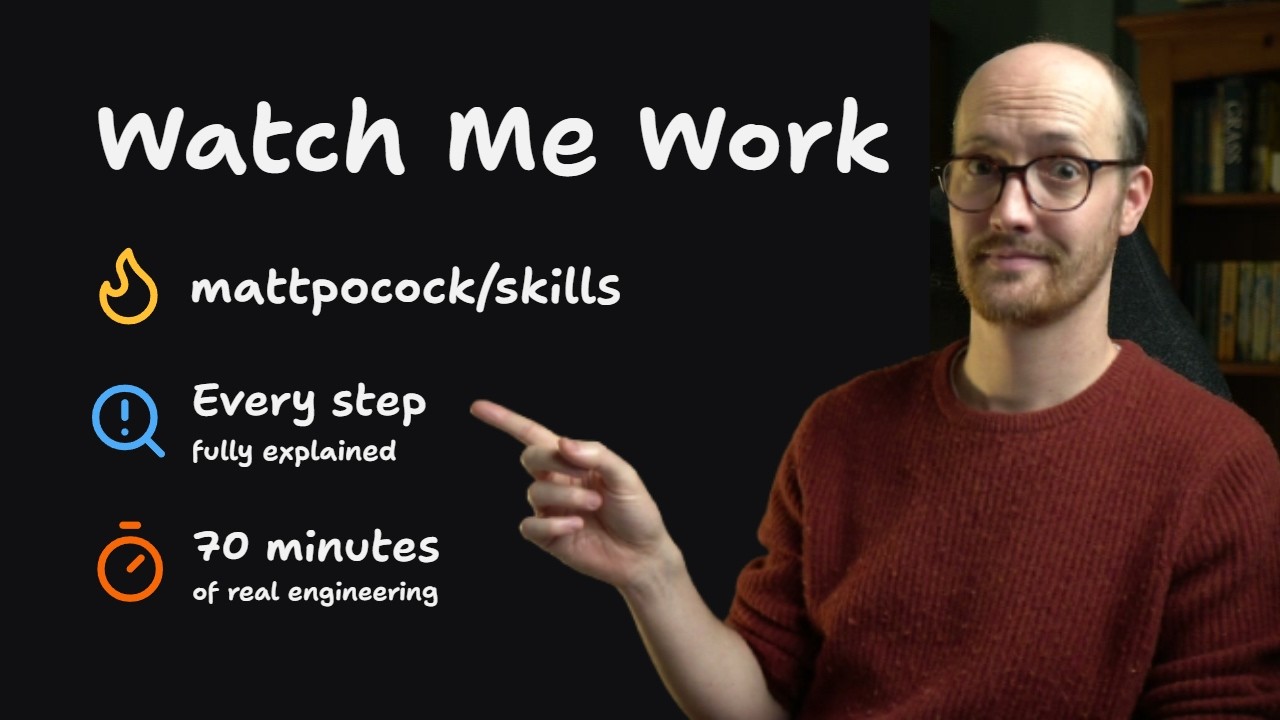
Matt Pocock posted a 70-minute hands-on recording, running a 21,000-line PR from scratch. It had been nearly six months since his last deep ‘watch me work’ video of this kind. He says that during this time his skills repo became the most-starred skills repo.
The workflow roughly goes in this order:
First, /grill-with-docs, using domain-driven design to interrogate vague requirements until they're clear. This section takes more than twenty minutes and covers a glossary, ADRs, data model decisions, and even uses thumbnail naming as a scenario test. No code is written until the requirements have been thoroughly discussed; this order stands out in the video.
Next, /prototype produces several variants, fixes a white-bar bug, and along the way he talks about his own distinction between the smart zone and the dumb zone. Then /to-spec and /to-tickets slice the work into reviewable vertical slices, compress the context, and go AFK while the agent runs the implementation.
Once implementation is done, the 21,000 lines don't arrive as one giant PR dropped all at once; instead they're split into stacked diffs and reviewed layer by layer. During human review, Matt doesn't focus on every line of implementation—he focuses on patterns. Immediately after review, he runs /retro to write the judgment criteria exposed in that round back into the process, making the next round's criteria a bit stricter. Later there's also a comment audit section, where he talks about banning code comments.
Someone in the comments left a pretty sobering line: 21,000 lines means no one will read the entire PR, so what we call human review ultimately becomes a matter of choosing what to read. His advice is to look first at tests, boundaries between modules, and any code touching payments and auth.
The person who posted the tweet said they hadn't watched such a substantial 70 minutes of live coding in a long time, and seeing Matt still treat PRs so seriously was even a little moving. They also admitted that they now use AI review almost entirely and only get involved in key decisions.
The video chapters are cut very finely, from 0:00 Intro, to the human review at 51:30, to 1:08:02 where he talks about where he thinks he provides value. If you want to jump straight to the review section, start at 51:30.
The full video is on YouTube:
Watch me ship a 21,000-line feature with mattpocock/skills
Matt also has a free seven-lesson email course that covers exactly this workflow from the video, breaking it down lesson by lesson from /grill-with-docs to /code-review:
Original tweet:
https://x.com/vikingmute/status/2123399476723507658
Tools are changing, and the role of review is moving higher up. Judgment hasn't been replaced; it has just moved from every line of code to how slices are divided, where boundaries are drawn, and which places must be looked at with your own eyes.
发布时间: 2026-11-19 23:29