RAG Doesn't Need a Vector Database Anymore? PageIndex Hits 98.7% on FinanceBench with Tree Indexing
No chunking, no embedding, no vector retrieval. PageIndex builds documents into a tree index and lets the LLM flip through pages to find answers. Beyond its 98.7% score on FinanceBench, its applicable boundaries and costs are also being discussed.
A tweet says the entire RAG industry is doomed.
The tweet comes from @byteonai, and the subject is PageIndex, an open-source retrieval approach from VectifyAI. It claims to need no vector database, no embedding, no chunking, and no similarity search. Its method is to build documents into a tree index and let the LLM find answers on the tree the way a person flips through a book. On FinanceBench, the financial document QA benchmark, it reaches 98.7% accuracy, beating all vector RAG. The project is 100% open source.

How RAG Originally Worked
RAG solves one problem: enabling a large model to answer questions about content it was not trained on. The traditional pipeline is to split documents into small chunks, convert them into vectors with embeddings, store them in a vector database, perform similarity retrieval at query time, and then stitch the most relevant chunks into the prompt.
The problem with this pipeline is that similarity is not relevance. A passage can be semantically close without being the evidence the question actually needs. PageIndex takes a different approach.
What PageIndex Does
PageIndex turns the document structure itself into the index, without chunking. The process has two steps:
- Generate a tree structure based on the document layout; this step does not rely on an LLM.
- The LLM performs reasoning-based retrieval on the tree, like a person reading a table of contents and turning to the corresponding chapter.
The official project includes a flow diagram:
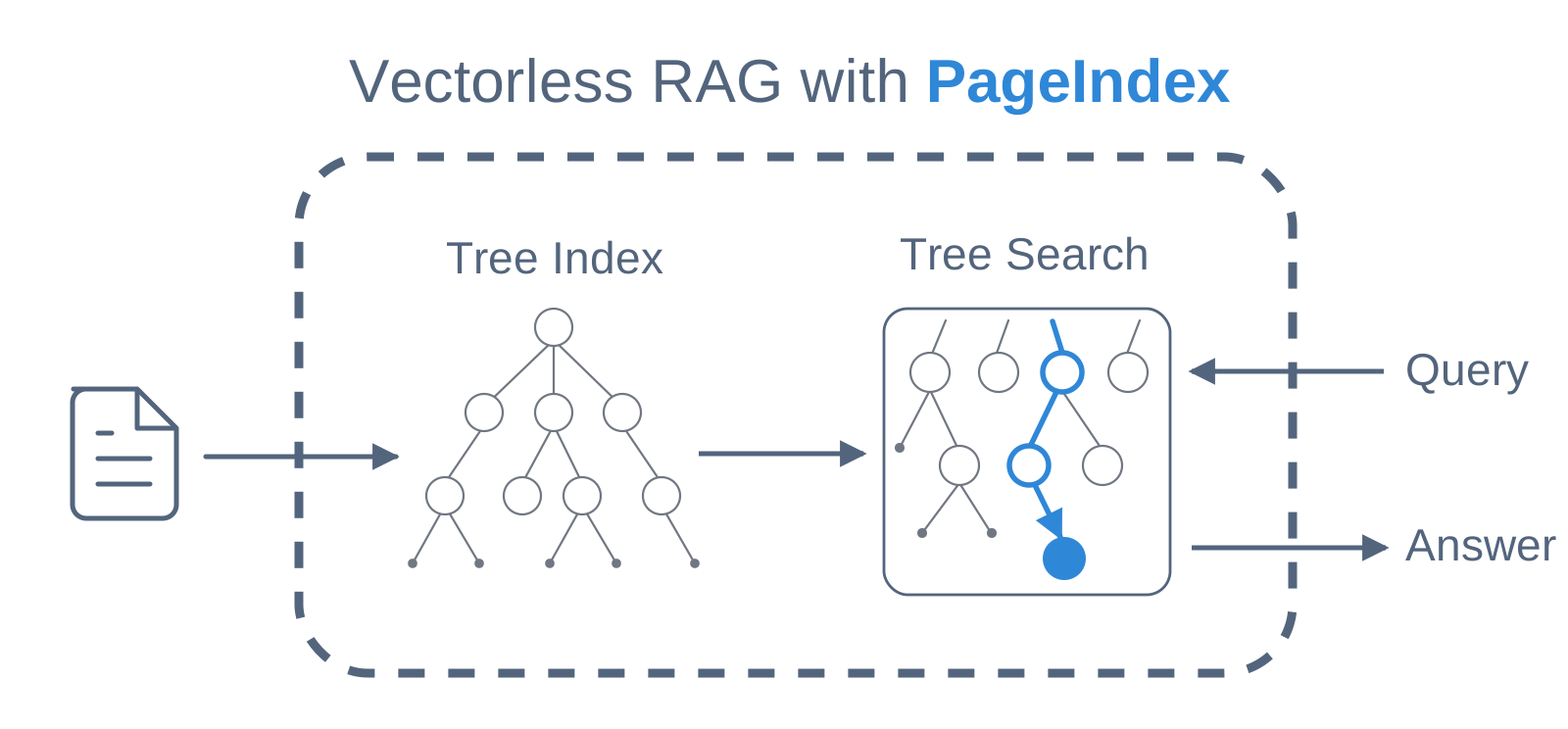
Tree nodes resemble a table of contents: titles, page ranges, and summaries. During retrieval, the LLM decides which branch to follow instead of computing vector distances over text. The inspiration comes from AlphaGo. Both the index and the documents stay in the local .pageindex directory; no separate vector store is needed.
Data: Accuracy and Cost
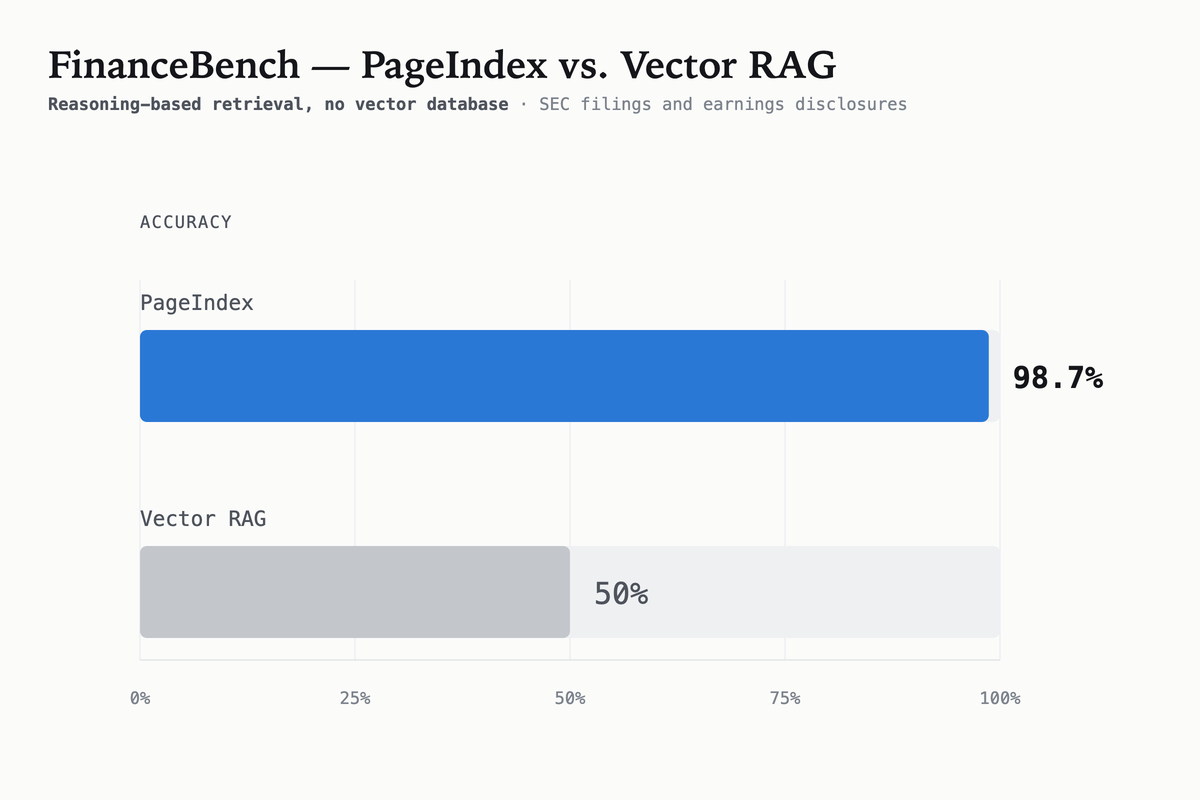
PageIndex scores 98.7% on FinanceBench, while vector RAG scores roughly 50% in the official comparison. The gap is large, but note that FinanceBench is financial document QA with clear structure, which is exactly where tree indexing excels.
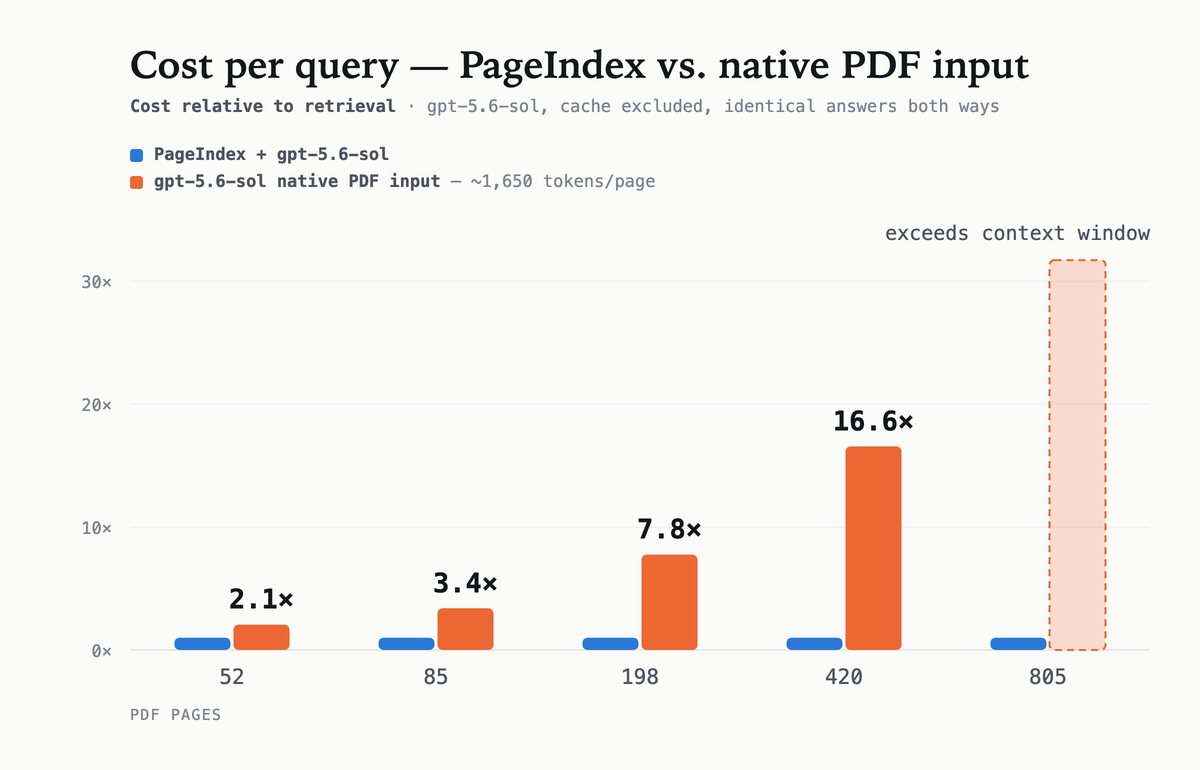
On cost, local indexing costs about $0.001 per page; a 1,000-page document costs around one dollar and takes a few minutes. Query cost does not grow with document length, because the LLM only reads the nodes on its reasoning path. Compared with feeding a PDF directly to the model, 52 pages are 2.1x more expensive, 420 pages are 16.6x more expensive, and 805 pages simply exceed the context window.
The code is simple:
from pageindex import PageIndexClient

client = PageIndexClient(
    index='gpt-6-luna',  # 建索引的模型
    chat='gpt-6.2-sol',  # 检索的模型
)
doc_id = client.submit_document('report.pdf')['doc_id']
answer = client.chat('What was the 2023 operating margin?', doc_id=doc_id)
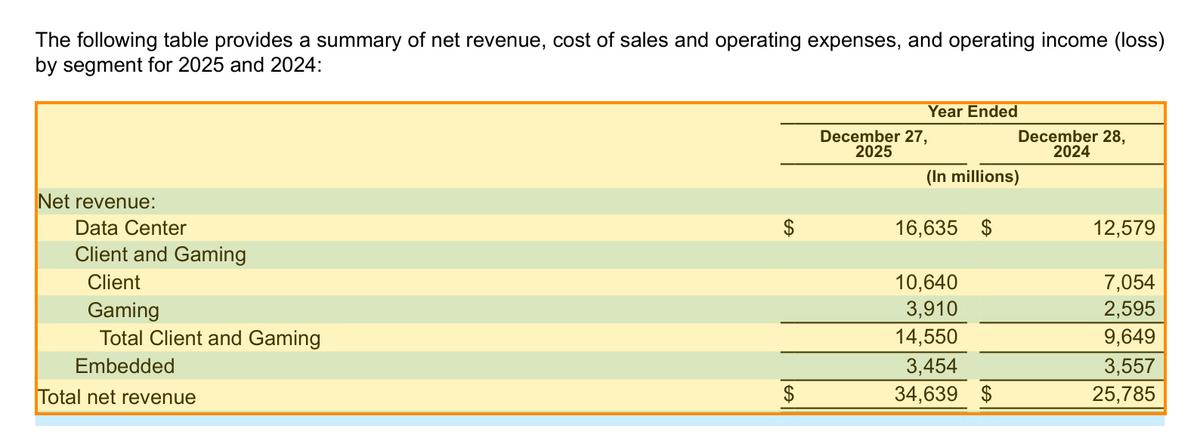
Local mode supports text-based PDFs. Scanned and image-based documents require PageIndex Cloud. The Cloud version provides bounding-box citations, so answers can be pinpointed to specific pages and evidence regions. For example, asking about total net revenue in AMD's 2025 10-K returns $34.639 billion and points to the table bounding box on page 71.
What the Community Thinks
Under the tweet, some people cheered and others poured cold water.
One commenter said PageIndex does not kill RAG; retrieval has merely switched from vector search to tree traversal, and it is still RAG at its core. It suits long documents with clear tables of contents, such as annual reports and policy documents. But with thousands of unstructured, catalog-free tickets, chat logs, or wiki pages, the tree is hard to build. Moreover, each query requires multiple LLM calls, so latency and cost rise with tree depth.
A commenter noted that PageIndex's scanned-document handling is not open source. Another, after hands-on testing, said scanned PDFs struggle with complex tables and footnotes, and that they stabilized results only with adaptive chunking (roughly 200 to 1,000 tokens) and by testing actual retrieval performance.
Some thought building knowledge trees with cheaper domestic models might offer better value for money. Others said this idea is not new and has just been repackaged recently. Someone joked that RAG gets cooked every month.
A liked observation: the project's name is refreshingly plain—it didn't call itself HyperC or NovaFlux, which deserves bonus points.
Conclusion
PageIndex is an open-source project worth testing, especially for long documents with strong structure. But 'the entire RAG industry is cooked' is clickbait. It has not ended vector retrieval. It merely adds an interpretable, traceable option to retrieval. On document collections without clear structure, traditional vector RAG remains the pragmatic choice.
Project URL: https://github.com/VectifyAI/PageIndex
Official docs: https://docs.pageindex.ai
发布时间: 2026-11-21 17:58