Inkling 2 Mini: Mainstream Open-Source Models Are Starting to Loop
Thinking Machines has open-sourced Inkling 2 Mini, replacing residual connections with Attention Residuals and looping the middle layers three times. This piece breaks down the architecture, along with some counterintuitive mechanisms discovered by Goodfire.
Thinking Machines open-sourced Inkling 2 Mini this week. The model isn't large, but it packs two uncommon architectural designs: Attention Residuals and Looped Transformer. A developer wrote a dedicated blog post to study it, calling it possibly the first open-source looping model from a mainstream model company.

Attention Residuals: Replacing Equal-Weighted Accumulation
Standard Transformer residual connections sum all sublayer outputs with coefficient 1 by default. The Kimi team's Attention Residuals paper points out that this uniform accumulation causes hidden states to grow disorderly with depth; the deeper the layer, the more early contributions are diluted.
AttnRes's idea is to let the current sublayer decide which historical outputs to read and how much of each. Inkling 2 Mini uses Block AttnRes, dividing 24 layers into 4 blocks of 6 layers each, making selections at block granularity to reduce overhead.
Each block maintains a Block Running Sum with shape [sequence_length, hidden_size]. At the same token position, the outputs of each Attention sublayer and MoE (Mixture of Experts) sublayer are added element-wise into this sum. The sublayer input does not read the entire residual stream; instead, a set of learned queries performs softmax weighting over the readable block vectors. B0 is the RMSNorm of the embedding.

Looped Transformer: Middle Layers Looped Three Times
Inkling 2 Mini's B1 (L1-L6) and B4 (L19-L24) each execute once, while B2 (L7-L12) and B3 (L13-L18) loop as a group three times. Each round reuses the same set of weights, so the model only needs to store parameters for 24 layers but computes 48 layers. A later round can read the Block Sum of the previous round's B2/B3 through cross-loop attention, equivalent to 'fetching messages' from the previous round at the same token position.

Goodfire's Preliminary Findings
Thinking Machines gave Goodfire early access to the weights. Goodfire performed several analyses, and the conclusions are more interesting than the architecture itself.
Information flow decomposition. Each layer's input can be decomposed into a weighted sum of previous layer outputs. Goodfire observed that depth attention is like a sliding window, focusing more on recent layers; cross-loop attention in later rounds clearly favors Block 3, especially Block 3 itself, almost always reading its own result from the previous round.
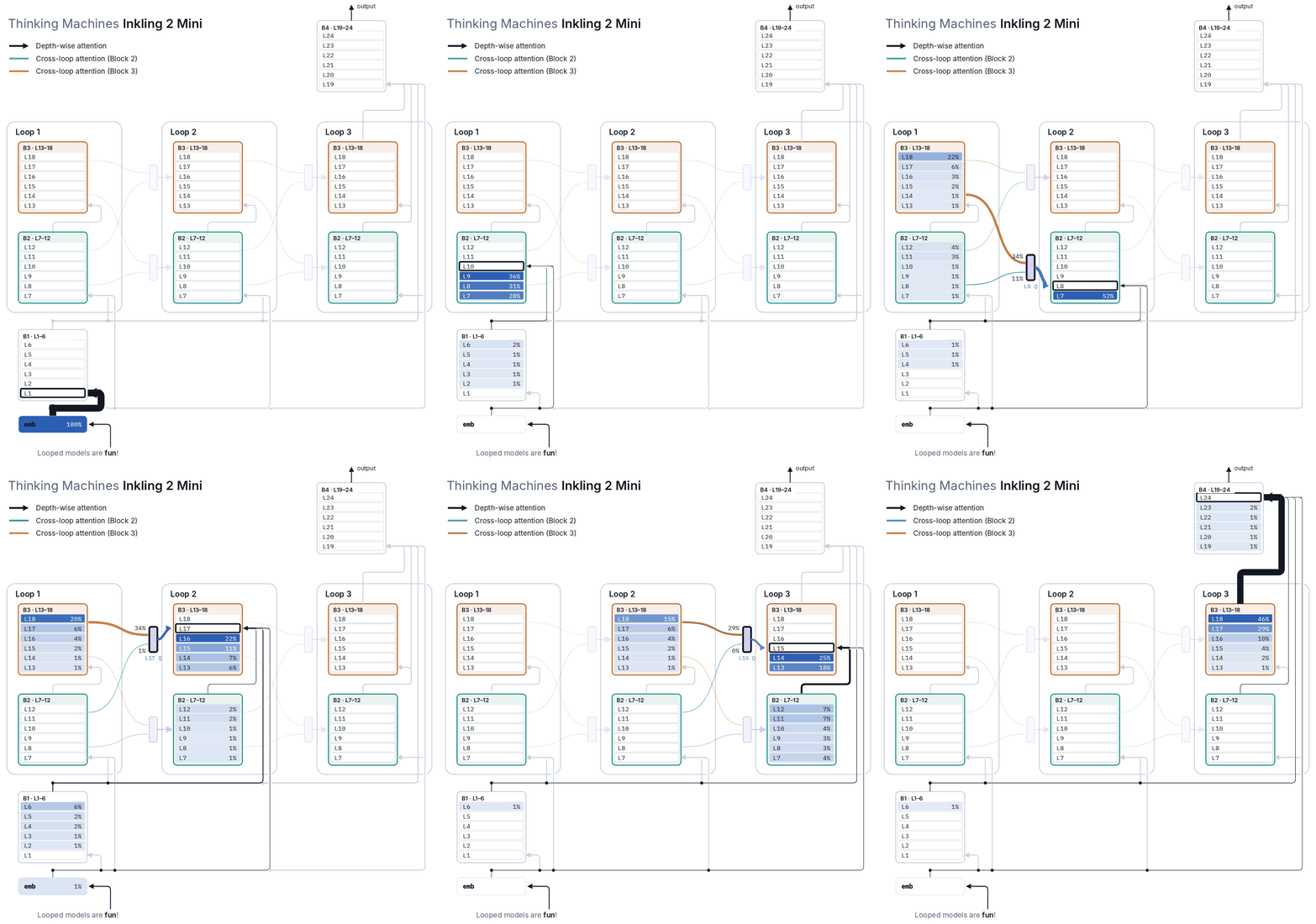
Inter-layer tagging. Weight-space analysis shows that the MoE neurons in the last layer of each block (L6, L12, L18) contain many vectors highly aligned with reader weights. Goodfire interprets this as these layers tagging activations, telling later layers which block to read from.
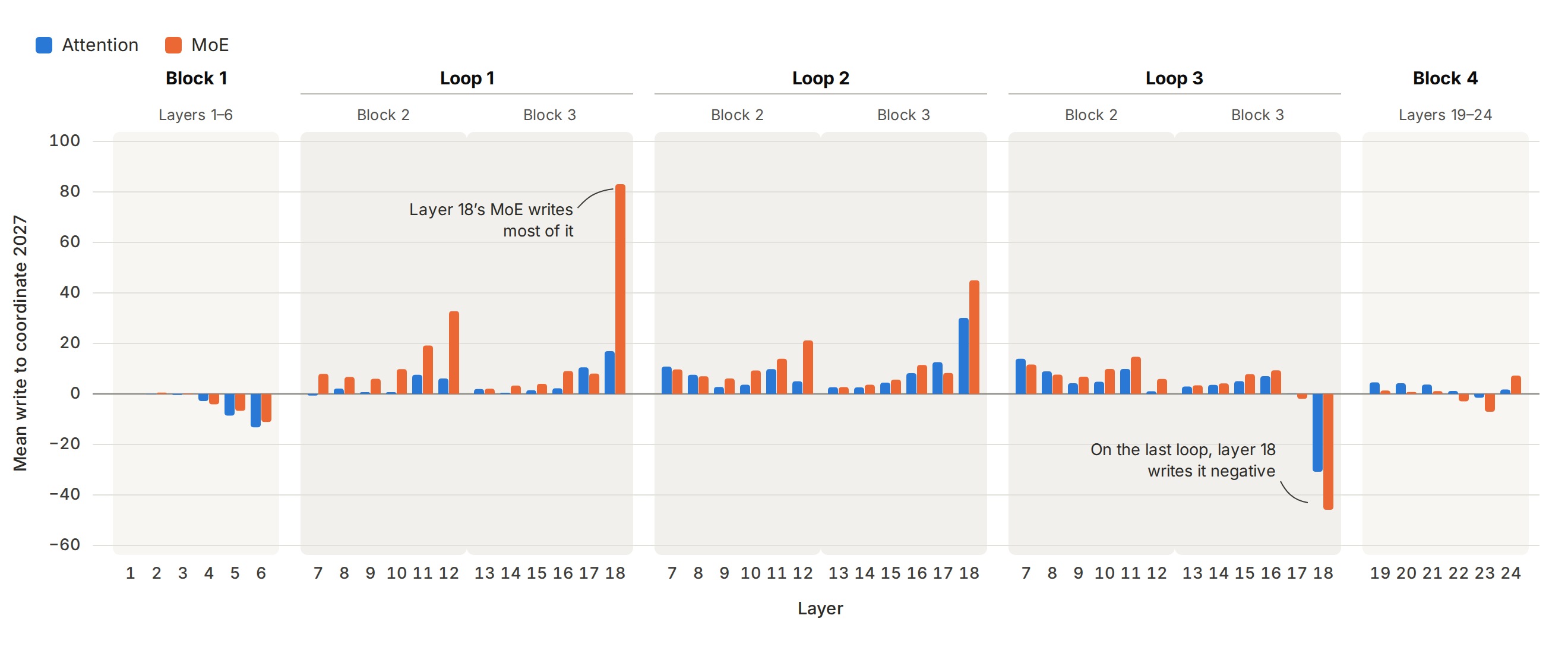
Outlier activation. There is an extreme outlier in activation space: coordinate d2027, whose single-coordinate RMS-normalized value averages 32.4, accounting for 46% of the entire squared norm of activations. It shows a large positive spike at L18 at the end of the first and second rounds, and a large negative spike at the end of the third round. Goodfire believes this is a cross-loop coordination mechanism: the first two rounds tell future loops to read Block 3, and the final round knows there is no future, so it clears the tag.
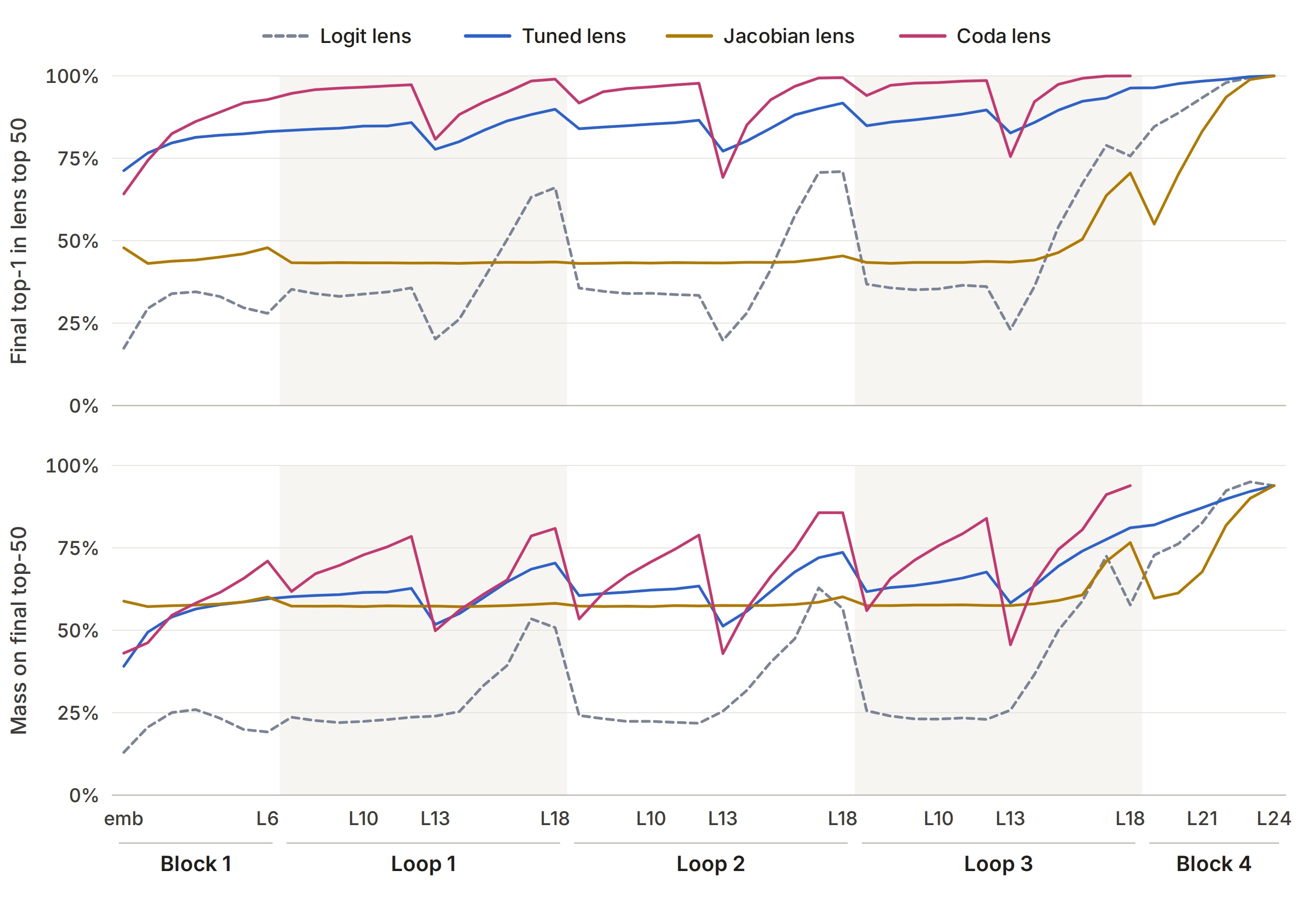
Interpretability did not collapse. When decoding intermediate layers with logit-lens, ordinary logit-lens performs poorly in early loop layers, but tuned-lens and coda-lens work very well. This shows that even with looping and attention residual, the model's internals can still align with interpretable representations.
A Few Observations
AttnRes and Looped Transformer are both not yet mainstream. Inkling 2 Mini puts both into one open-source small model at the same time, effectively providing the community with a convenient research sample. A developer mentioned that only after studying AttnRes did they understand its motivation: adding optional information routing in the depth direction, not merely replacing residual connections.
References:
- Kimi Team. Attention Residuals. arXiv:2603.15031
- Goodfire. Interpreting Inkling 2 Mini
- Thinking Machines Lab. Introducing Inkling 2 Mini
- Daniel Wang. Inkling 2 Mini Architecture
发布时间: 2026-11-23 07:01