Looped Models Are No Longer Only for Training from Scratch: LoopRes Boosts Existing LLMs by 29.1%
LoopRes adds two small modifications on top of Attention Residuals, enabling pretrained LLMs to gain large improvements after being fine-tuned into looped models. On Qwen3-1.7B, 2× compute is 29.1% higher than SFT; the 4B looped model surpasses 8B SFT. Code, data, and models have been open-sourced.
Looped Transformer has been appearing frequently recently. The idea is straightforward: execute the same set of layers repeatedly, add no new parameters, only increase computation, and during inference it can still be extended on demand. The problem is that this idea has consistently performed well only on models trained from scratch. When fine-tuning an existing pretrained LLM into looped mode, the gains are usually not much higher than ordinary SFT.
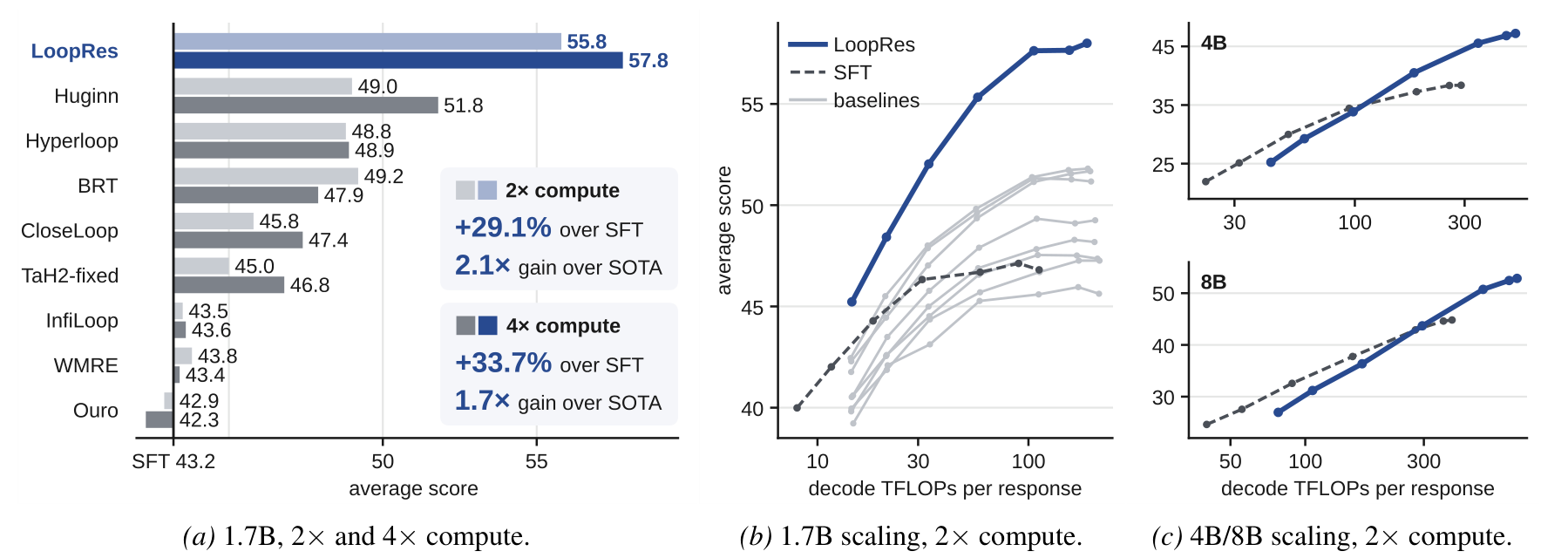
LoopRes comes from a team at the National University of Singapore and independent researchers, and is specifically designed to solve this. It is based on Attention Residuals (a mechanism that lets each layer directly attend to previous outputs), but makes two key changes. On Qwen3-1.7B-Base, under 2× compute, the average score is 29.1% higher than SFT, more than twice the previous strongest baseline (+13.9%). Under 4× compute, it improves by 33.7%.
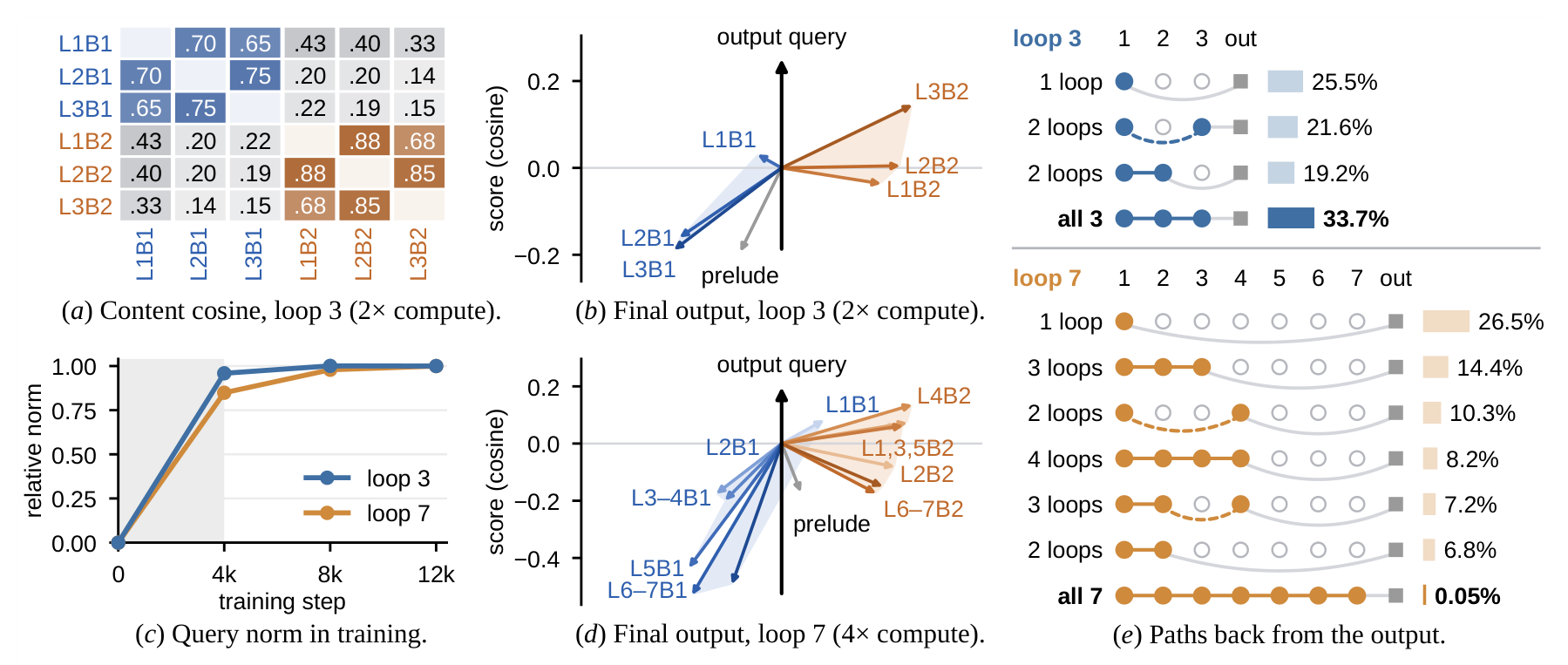
First, look at the problem. The team initially tried Attention Residuals (AttnRes): each layer directly attends to the outputs of all previous loops. The result was almost useless. There are two reasons:
- The loop outputs come from the same set of layers and are highly similar in content, so the attention scores cannot distinguish them. This gets worse as the loop depth increases.
- The number of sources keeps growing, and layers can skip intermediate loops. At 7 loops, the path weight that fully traverses all loops is only 0.05%.
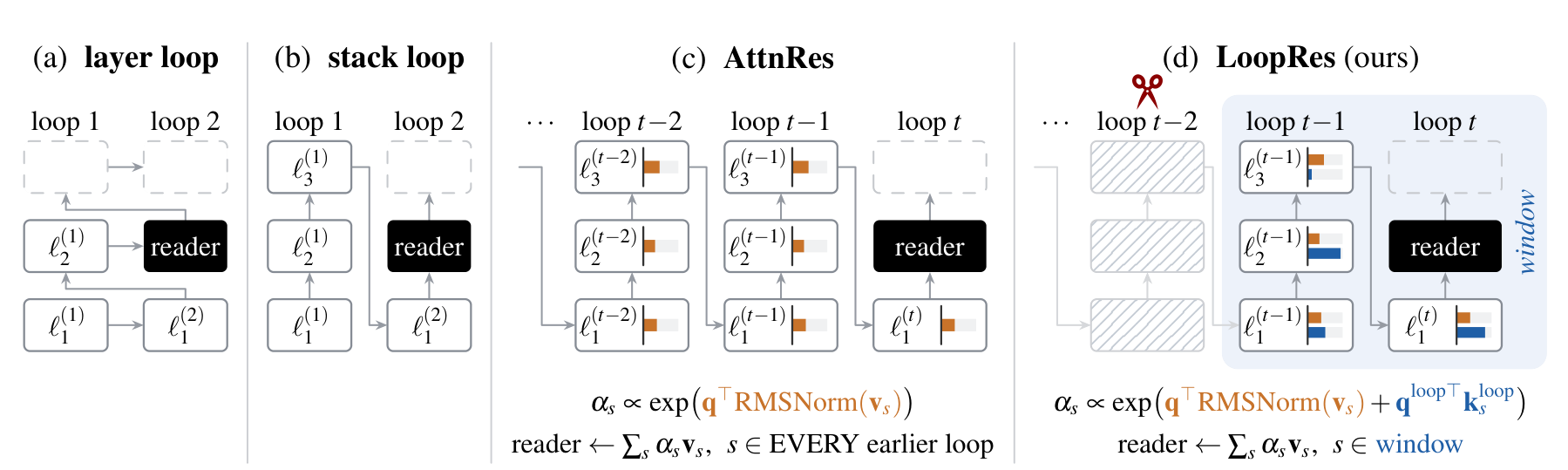
LoopRes's solution is two modifications:
- Loop-aware keys: each block has a trainable key in each loop, marking which round this output came from. Layers can distinguish iterations from different loops.
- Residual window: each layer only attends to the outputs of the most recent W loops. W=1 works best, forcing each round to build on the latest round.
The effect is consistent across multiple models. The Qwen3 family from 1.7B to 30B-A3B, plus Llama-3.2-1B and Qwen3.5-2B—6 models and 9 benchmarks in total—all show improvements. The most noteworthy aspect is scalability: loop depth becomes a new test-time scaling axis. From 1.7B to 8B, LoopRes's score curve is steeper than SFT's; a 4B LoopRes model's average score exceeds that of an 8B SFT model.
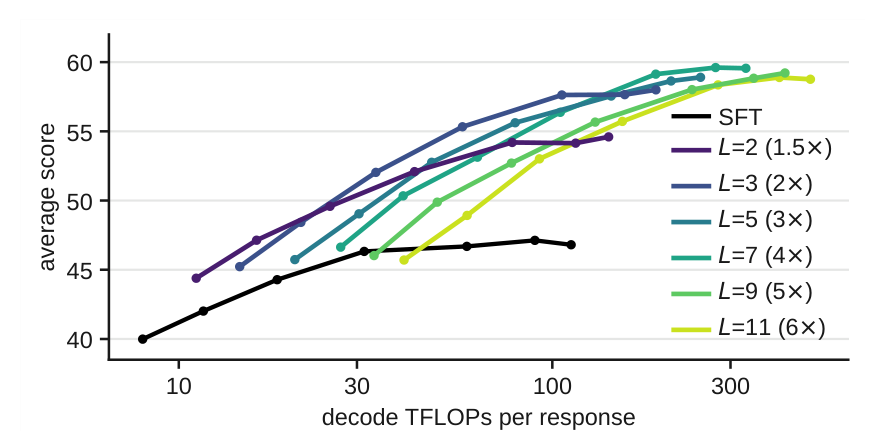
The overhead is acceptable. Training step time increases by only 4.8%, and peak activation memory increases by 0.7%. When compute doubles, the gains far exceed the cost.
The entire project is open-sourced. The training data is SFT data generated by Qwen3-8B and Qwen3-235B-A22B; model weights are on Hugging Face; training and evaluation scripts are on GitHub. To reproduce on your own model, just follow the README and run scripts.train and scripts.eval. Model loading uses transformers, plus one line import loopres.
Looped models were previously thought to require training from scratch. LoopRes provides contrary evidence: existing models can also obtain extra computation through looping. More worth watching is whether this window mechanism remains effective for larger models and more complex tasks. All the code is open-sourced, so you can verify it at any time.
发布时间: 2026-11-24 00:49