Switch Agent Tools and Lose Your Memory? HarnessRouter Gives Memory Back to Users
What Claude Code learns about you disappears when you switch to Codex. HarnessRouter has open-sourced Agent Memory 2.0: memory is owned by the user, and any harness can read and write it through a unified protocol. The video demonstrates memory migration from one harness to another without handoff code.
Every Agent harness has its own memory. Preferences you've specified in Claude Code have to be repeated when you switch to Codex. This is the norm for Agent tools today, and it's the problem HarnessRouter wants to solve.
Avi Chawla announced Agent Memory 2.0 in a tweet, taking ownership of memory away from the harness. Memory belongs to the user, not the tool. Any harness can read and write it through the same standard protocol, and the underlying engine can be swapped for Mem0, Graphiti, Hindsight, ReMe, or one you write yourself.
In a demo video, Avi Chawla gives Claude Code's agent some travel preferences. He then opens a brand-new Codex session, and that session recalls these preferences on its own and uses them to plan dinner. There is no handoff code in between.
How memory works: it is loaded when a session starts, searched on every turn, and saved at the end of a turn. Each user's memory is isolated from other users'. Recalled memories are passed to the agent as data, not as instructions. This is critical. Memory that exists as instructions amounts to a ready-made injection path.
HarnessRouter can do this because it already puts multiple harnesses behind the same interface. It implements UHP (Unified Harness Protocol), a standard that defines the task lifecycle, sessions, files, cancellation, and errors. UHP's API shape is compatible with the OpenAI Responses API, so existing clients can use it directly. Akshay's article explains the engineering details of the interface and why harness routing and model routing are two different things.
The UHP website uses one diagram to explain the protocol's role:
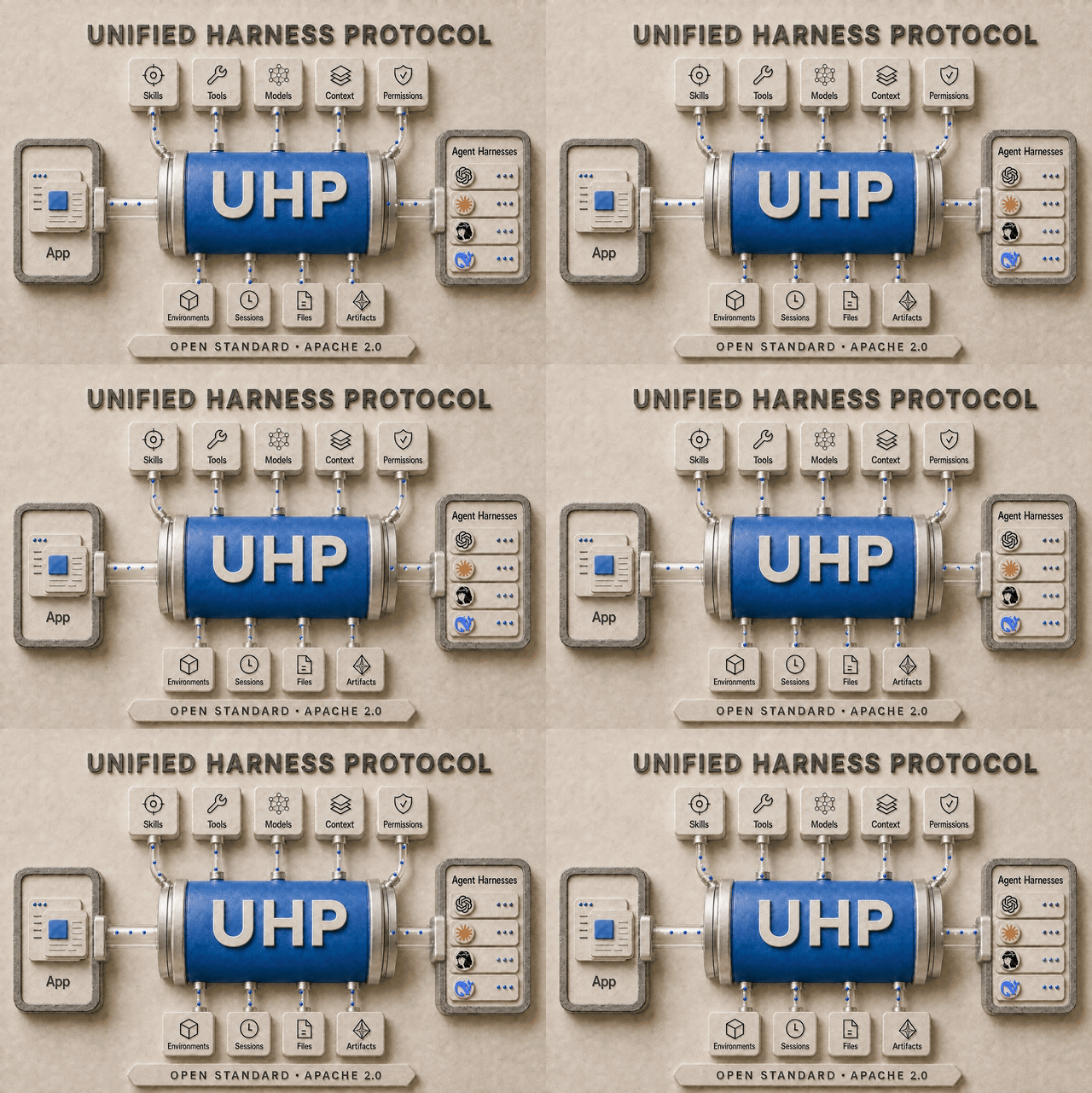
A harness is a complete agent runtime responsible for planning, calling tools, editing files, and reporting results. Codex, Claude Code, and Hermes are all harnesses. Every harness can do work, but there is no consensus on 'how a product should drive it': how to start a task, track progress, continue a conversation, cancel, retrieve artifacts, and interpret errors. UHP locks down these answers. HarnessRouter is the reference implementation of UHP, is Apache 2.0, supports 31 harnesses, can run locally, and comes with a Console and API.
HarnessRouter's README has a comparison diagram showing why a unified interface is needed:

HarnessRouter Community Edition can be launched with a single Docker command and comes with a Console, Gateway, and Runner. Configure a model API key in the Console, choose a harness, and you can send tasks. In code, use metadata.harness_id to specify which harness to use; the same API can switch backends.
After the post went out, reactions in the comments were mixed. Some users said they finally don't have to repeat the same things to every tool. Others worried: if memory follows you, a bad memory will follow you too. Who cleans it up? Can users see what is stored and delete it? Some also said a note that holds true in Claude Code may not hold true in Codex. These are indeed the questions portable memory has to answer.
Returning ownership of memory from tools to users is the right direction. But once 'remembering' becomes easy, 'forgetting' and 'correcting' will become the next hard problems.
Related resources: HarnessRouter GitHub repository · UHP website
发布时间: 2026-11-24 03:07