The End of Inference Speed Is Physics: Super-Reasoning-Engine Lets Codex Approach the Limit on Its Own
An agent skill called Super-Reasoning-Engine first derives the physical limit of the hardware, then lets Codex iteratively improve the inference framework in a closed loop. Performance is expressed as a percentage of the physical limit. Includes a laya-mlx case study.
If you are still bouncing back and forth between vllm and sglang flags, this project may change how you think about inference optimization.

Super-Reasoning-Engine (SRE) is an agent skill. It first derives the physical limit of your model's inference on your GPU, then lets Codex automatically iterate the inference framework under that constraint, gradually approaching the limit.

What is conventional inference optimization? Try a flag, try a kernel, see what happens. If you are lucky, you get a 20% improvement; if not, you waste time. SRE's approach is to calculate the upper bound first. It uses the roofline model, the number of bytes each token needs to read, Little's law, along with datasheet peak values and measured ceilings, to calculate the Speed-of-Light (SOL) for a given model, hardware, and workload. Then it measures how far the current engine is from this limit and breaks the gap down into waterfall terms such as kernel efficiency, launch gap, host overhead, and batching.
Next comes the Codex loop. One supervisor proposes a hypothesis and predicts the gain, while another worker implements it. The supervisor owns benchmarking, correctness checks, and final judgment; if it is not satisfied, it sends the work back for a redo. One hypothesis at a time, one diff at a time, one number at a time. Performance is reported as "88% of HBM SOL, B=64," not "2x faster than baseline."
Installation is not complicated. Codex users clone it into .agents/skills/super-reasoning-engine, and Claude Code users clone it into .claude/skills/super-reasoning-engine. Then you can ask:
Use super-reasoning-engine to build the fastest possible decode path for Qwen3-32B on one H100 SXM, FP8 weights allowed, TPOT ≤ 30 ms.
Fox mentioned in a reply to the tweet that the PR he submitted to laya-mlx (an inference library that runs Laya models natively on Apple Silicon) was largely iterated out with this skill. laya-mlx's specialty is low-latency decision-making: a median of 13.4 ms for short English questions (M3 Max, FP16); the Snake demo runs truly locally, with the model making three decisions per step, reaching 75.4 steps/s.
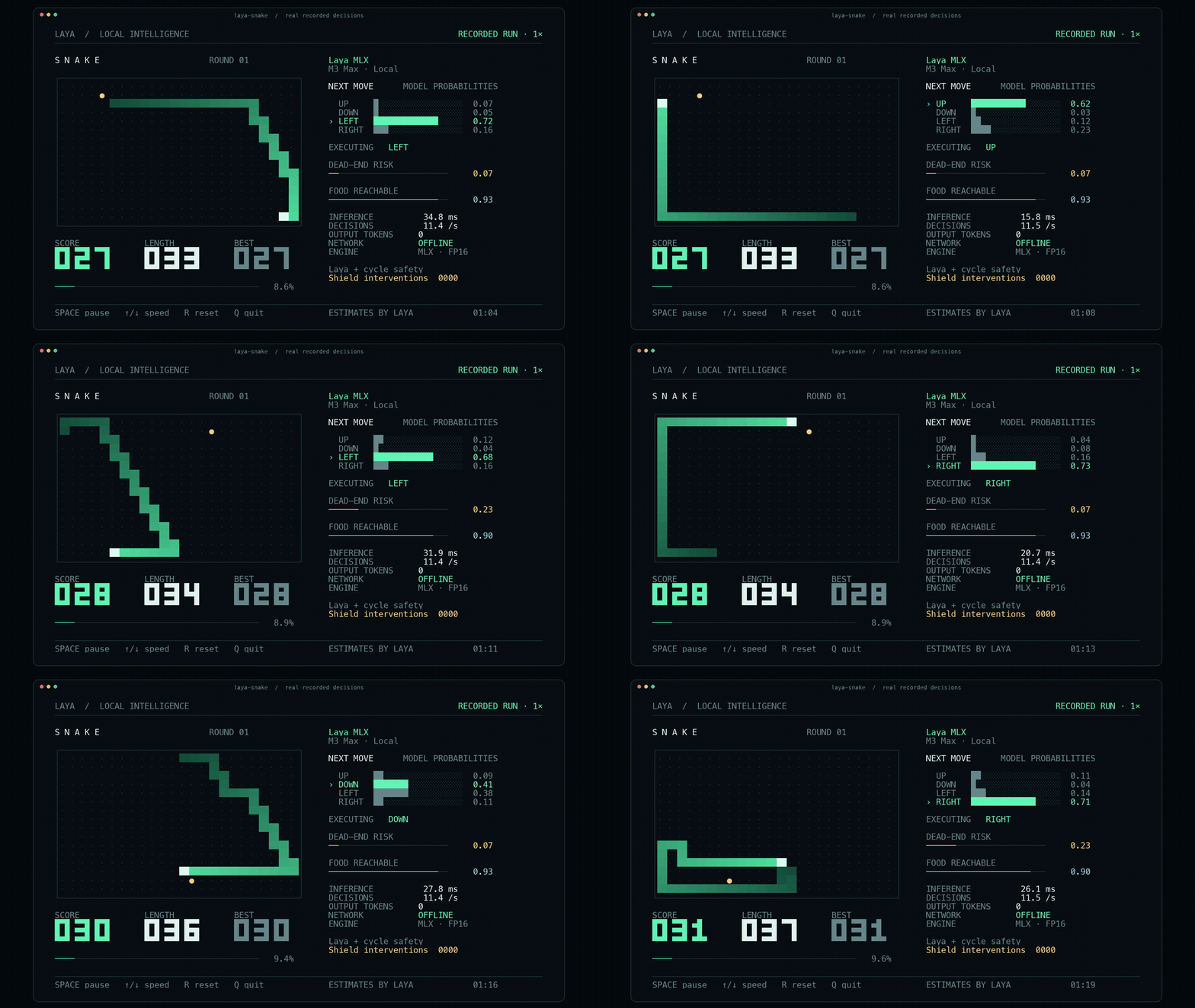
In the comments, a user mentioned that the speedup mainly appears in scenarios where the same batch of images is queried repeatedly; if a new image is queried only once, it is roughly on par with vLLM, and the advantage is most useful for box selection and follow-up questions. Fox added that image encoding is basically the most time-consuming part of model inference. Also, a user reminded everyone that some of the speedup numbers in circulation come from Glance, not this project, so do not use them to endorse SRE.
Finally, the significance of SRE may not lie in any single optimization trick, but in turning optimization from "experience-driven" into "physics-driven." The upper bound is there, the gap is there, and the rest is letting AI figure out how to fill it. You just need to watch it and keep it from going off track.
发布时间: 2026-11-24 02:14