After fitting a 26.4B model into 16GB of memory, Unsloth gets another 1.9x speedup
Three days after Inkling 2 Mini was released, Unsloth's quantized version ran at 125 tokens/s on an RTX Pro 6000. This 26.4B looped Transformer model can run on just 16GB of memory, and its DeepSWE score beats Qwen3.8-27B. Someone in the community has already reached 565 tokens/s on an RTX 5090.
Thinking Machines released Inkling 2 Mini on November 20 under the Apache 2.0 open-source license. Three days later, Unsloth released a llama.cpp optimization for it, claiming up to 1.9x higher local decoding speed with no loss of accuracy.

Unsloth's tests were based on UD-Q4_K_XL quantization (17.63GB) and generated 1024 tokens. On the RTX Pro 6000 Blackwell, decoding speed rose from 81.35 tokens/s with mainline llama.cpp to 125.24 tokens/s; on the B200, from 68.00 to 110.77. The A100 40GB was 67.02, and AMD Ryzen AI Max on Linux was 32.78. Unsloth also fixed the issue where the Q8_0 KV cache used more VRAM than F16.

Inkling 2 Mini has a fairly unusual architecture. It is a 26.4B-total-parameter MoE with 3.4B active parameters; the middle 12 layers loop 3 times per token, for an equivalent active parameter count of 5.4B. It supports image-text input and a 1M context. It scores 48.2% on DeepSWE v1.1 and 77.9% on SWE-bench Pro v2 (Hard), both the highest among open-source models under 100B; Qwen3.8-27B scores 42.2% on DeepSWE.
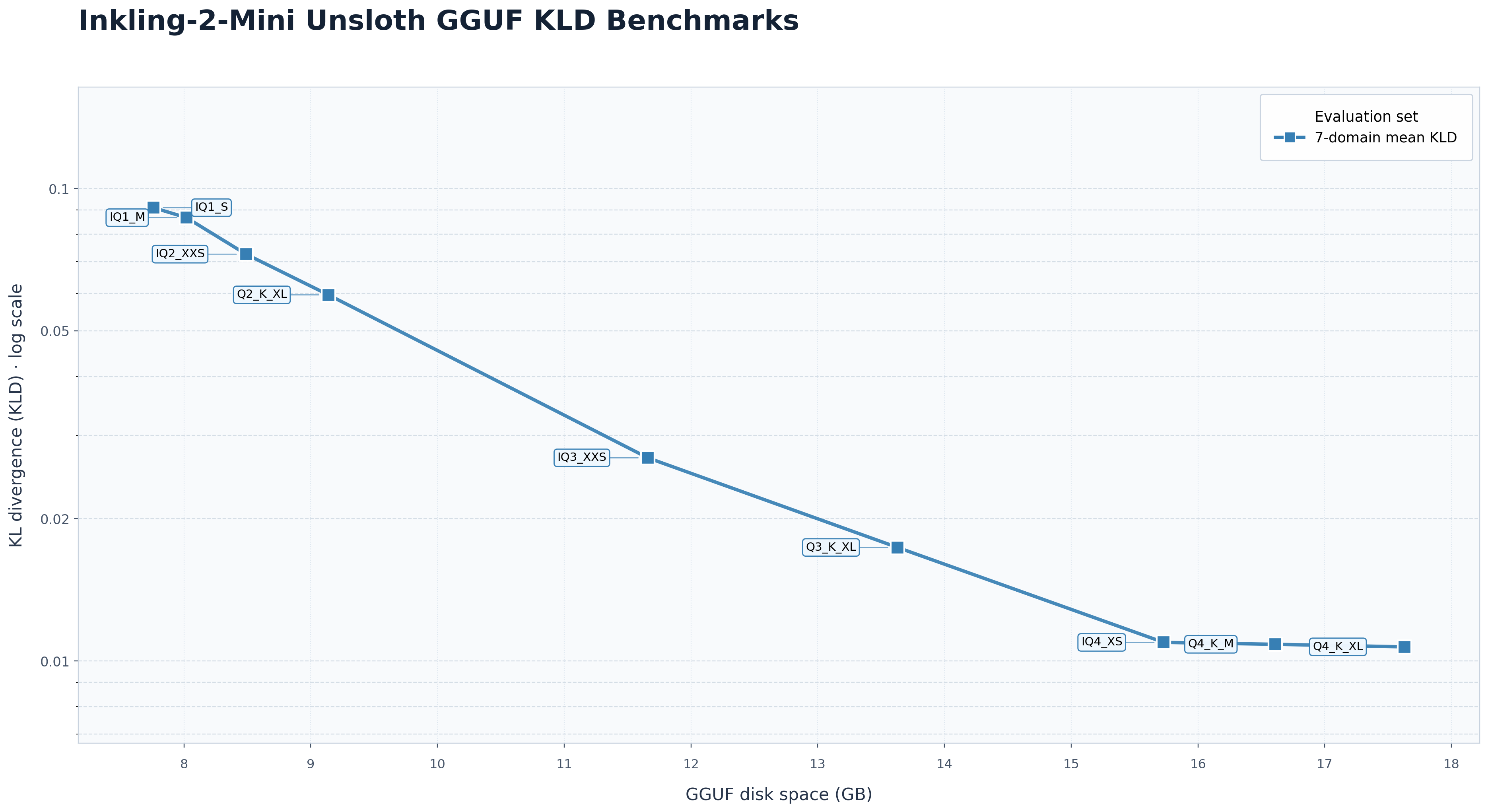
The official checkpoint is about 20GB and recommends 32GB of memory. Unsloth's GGUF lowers the bar to 16GB: 1-bit UD-IQ1_S is only 7.76GB and has an 89.4% top-token agreement rate with the 8-bit reference; 2-bit UD-IQ2_XXS is 8.49GB with 90.6% agreement; 4-bit UD-Q4_K_XL is 17.63GB with 98.0% agreement. For a 16GB machine, UD-IQ3_XXS (11.66GB) is more practical, while UD-Q4_K_M (16.61GB) is already close to the limit.
Looped architectures bring new problems for monitoring. The model does extra computation before outputting a token, which shortens the reasoning chain and makes it harder for outsiders to read its thought process. Thinking Machines' test conclusion is that with 3 loops the reasoning chain is still readable, the model has very little control over its own CoT, and no obvious hidden behavior emerged. The variable-loop version TML-d24-varloop-research was also open-sourced, for teams doing monitoring research.
Community benchmark results are more aggressive than the official numbers. Developer eishan says an uncensored version ran on an RTX 5090 and reached 565 tokens/s. Another developer, Marco Franzon, hooked the model up to a 2018 Quadro RTX 6000 (24GB), used NInfer-all and the DSpark draft model to reach about 110 tokens/s, then connected it to a Pi coding agent and had it write code, run tests, and fix bugs, all done locally.
If you want to run it yourself, search for Inkling-2-Mini-GGUF in Unsloth Desktop and download the corresponding quantized version. llama.cpp users are recommended to use Unsloth's precompiled package, plus the 0.4GB DSpark draft model, with --spec-type draft-dspark --spec-draft-n-max 2. Unsloth says this is the fastest configuration. The model and GGUF are both public: Hugging Face, usage guide.
Some people in the replies asked whether these speedups will be merged into mainline llama.cpp. Unsloth has not given a clear answer yet. For now, the speedups are only in its own fork and desktop app, and it is unclear how long mainline will have to wait.
发布时间: 2026-11-24 02:38