8.1M parameters, 426 ms per page on CPU: LlamaIndex open-sources OCR model OCRia-nano-1
An OCR model with only 8.1M parameters parses a page in just 426 ms on CPU, with accuracy higher than Marker and Tesseract, and supports tables and multiple languages. LlamaIndex has open-sourced it.
LlamaIndex today released OCRia-nano-1, an OCR model with 8.1M parameters. It can parse documents on CPU at an average of 426 ms per page without needing a GPU. The weights are fully open source and run through LiteParse.
OCR (optical character recognition) is the technology that turns text in scans and images into text. In RAG and agent automation, it is the first step in many enterprise data pipelines. The reality is that organizations have massive numbers of PDFs and scans in wildly different formats, some of which do not even have a text layer. Existing open-source tools are either fast but fragile and collapse when they hit complex tables, or accurate but too heavy: a VLM takes several seconds to run one image and also consumes GPU. Nano targets exactly this gap.
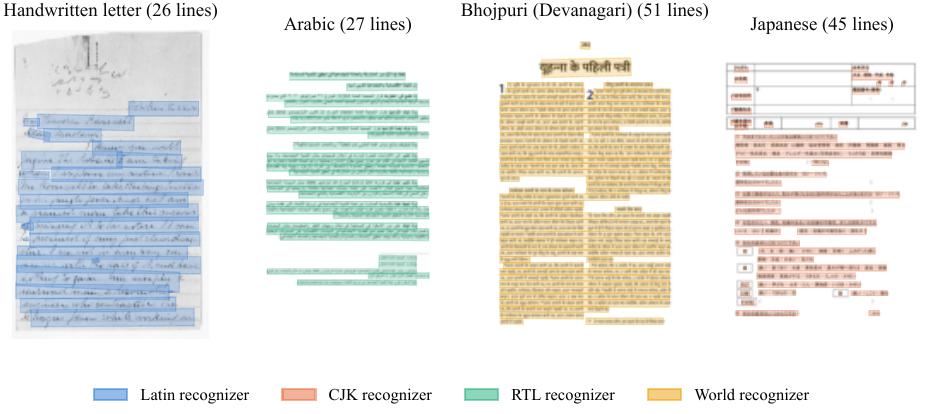
Nano is actually a combination of 7 models: a text-line detector, a script router, four recognizers (Latin, CJK, right-to-left, and world scripts), plus LayoutNet for table and layout recovery, totaling 8.1M parameters. It is distilled from LlamaIndex's own 4B-parameter VLM OCRia-1 and is only 1/500 the size of its teacher.
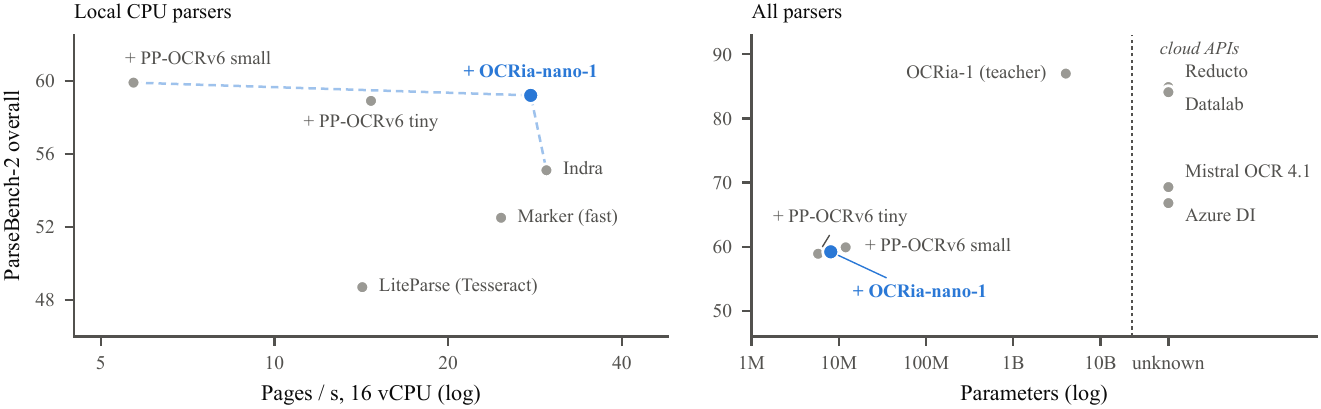
On accuracy, Nano scores 59.2 on ParseBench-2, with 59.5 on the table sub-item, surpassing Indra 1.1.2's 55.1 and Marker 2.2.0's 52.5. On speed, with 16-core parallelism it processes 27.8 pages per second, and 90% of pages finish within 862 ms. The official claim is that it is 2 to 5 times faster than Tesseract.
Usage is simple. Install LiteParse, pull the model, and parse:
pip install liteparse
lit models pull ocria-nano
lit parse doc.pdf --format markdown
The model runs on ONNX Runtime and supports Python, Node.js, CLI, and even WASM in the browser.
For licensing, the weights use modified Open RAIL-M. Academic research, personal use, and companies with annual revenue below $2 million can use it commercially for free. Beyond that scale, or if you want to use it to build a product that competes with LlamaParse, you need to contact LlamaIndex for a commercial license. LiteParse itself is Apache 2.0.
The interesting part is that this direction is distilling large models into extremely small models and squeezing them into existing pipelines. Nano cannot handle the hardest documents, but most everyday documents do not need that level of understanding at all. Solving 80% of problems with 8.1M parameters on CPU is more practical than putting everything on a GPU.
发布时间: 2026-11-24 03:36