Event Sourcing ≠ Event-Driven: Stop Confusing the Two
Event-driven architecture and event sourcing are often conflated. In a note, David Boyne clarifies their boundaries and what Event Sourcing is truly suited for.
Event-driven architecture and event sourcing are treated as synonyms more often than most architecture terms. David Boyne posted a tweet with a note specifically to correct this.
Event Sourcing is a storage pattern; its core principle is that events are append-only, never modified, never deleted. It is not responsible for pushing messages to services; it is responsible for recording facts. Event-driven is concerned with how events flow and are responded to between services; Event Sourcing is concerned with how state is reconstructed from events. The two can be used together, but they are not the same thing.
A commenter shared their own experience: they built an order service with Kafka, messages flew between services, and the architecture was indeed event-driven, but they were not using Event Sourcing because the current state was still stored in a database. This example is very typical.
Event Sourcing starts with an append-only log. Things that happen in the system are appended to this log as events. Past events cannot be changed or deleted. To correct something, you append a new event. Accounting ledgers are a ready-made analogy—the transaction record only records; it does not rewrite.
State is not stored directly; it is calculated from events. Different applications need different views, so materialized views exist. A web application and an analytics platform can see different states, but the data is all derived from the same event log. Combined with CQRS, this is the most common way to use event sourcing.
The practical benefits this pattern brings: auditing, traceability, and compliance become easier because all changes are recorded. When debugging a system, you can replay events from the beginning to reproduce problems. Products can also show users detailed historical transaction records.
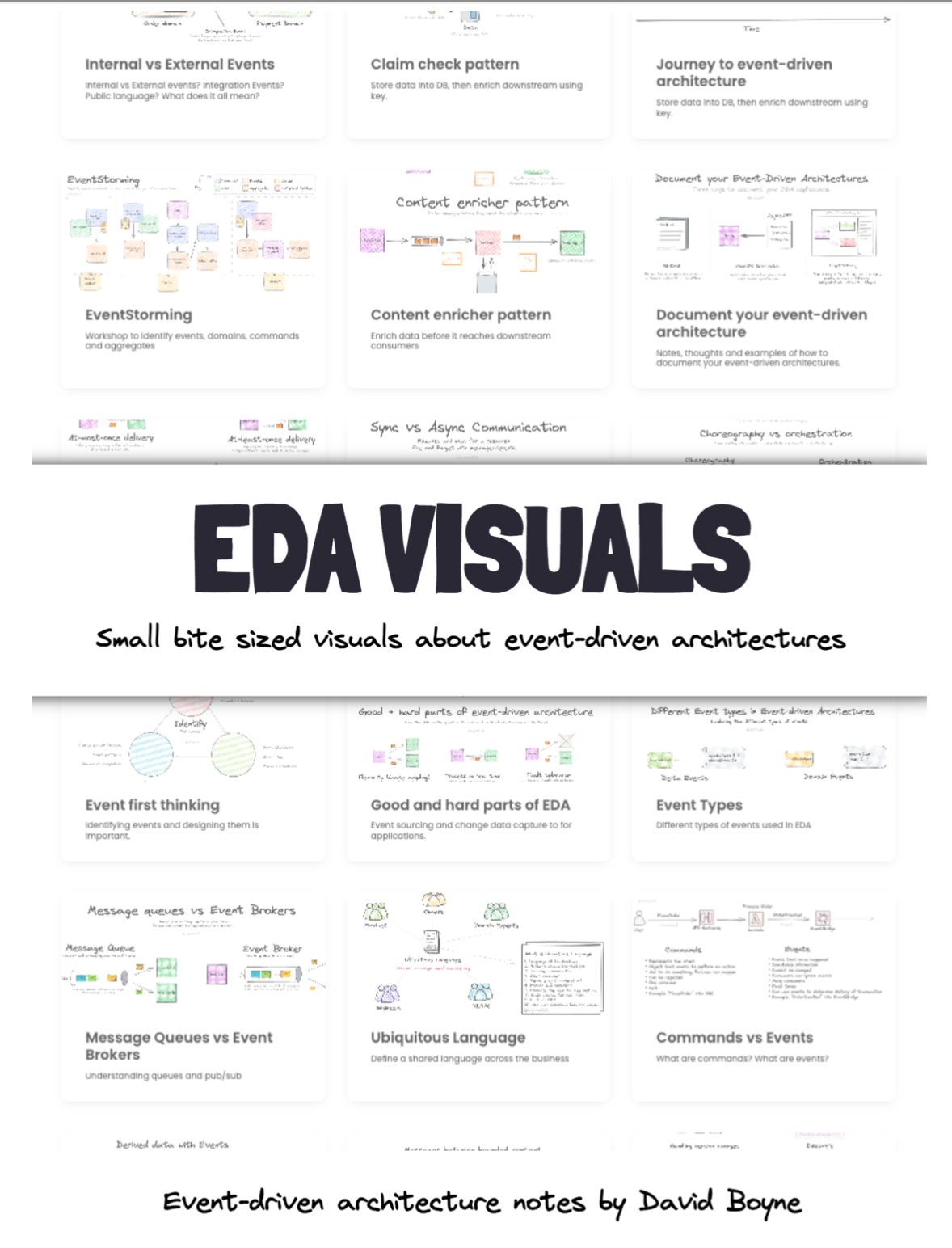
In the note, Boyne offers several resources for deeper study. Martin Fowler wrote an overview of Event Sourcing back in 2005, and it is still worth reading today. Boyne himself created EDA Visuals, a free set of architecture diagrams with more than 60 illustrations; the download page is at eda-visuals.boyney.io/download.
Someone in the comments added: event naming is critical. First determine clearly whether an event should serve as a notification, a delta, or a full state, then standardize naming conventions across the organization. This advice is very practical.
Boyne is the author of EventCatalog, an open-source documentation tool for event-driven architecture, and he previously worked at AWS and Postman. He deals with this kind of architecture problem every day, so this note is clean and gets straight to the point.
If you are studying message-driven systems, remembering this distinction is enough: event-driven is an architectural style, event sourcing is a data pattern. Teams that use the latter well have usually thought clearly about the question of where the current state comes from.
发布时间: 2026-11-24 03:49