8.1M-Parameter CPU-Runnable OCR Model: LlamaIndex Open-Sources It
LlamaIndex releases OCRia-nano-1, an 8.1M-parameter OCR model that parses a page in 426 ms on CPU, exceeds Marker and Tesseract in accuracy, and is up to 5x faster. Weights are open source and run locally via LiteParse.
LlamaIndex today released OCRia-nano-1, an 8.1M-parameter OCR model. No GPU is required; it parses a page in an average of 426 ms on CPU. The weights are fully open source on Hugging Face and run locally via LiteParse.
Document parsing has always been an awkward job. Free open-source parsers are fast but fall apart on complex tables; VLMs are accurate, but their compute and latency are not sustainable in every scenario. OCRia-nano takes a third path: distilling the 4B-parameter OCRia-1 down to 8.1M to produce a lightweight parsing pipeline that can run on CPU.
The 8.1M parameter count covers the entire pipeline, not a single model. It consists of 7 specialized models: a text-line detector, script routing, 4 recognizers (Latin, CJK, right-to-left, and rest of world) and LayoutNet. LayoutNet handles table structure and layout reconstruction, outputting Markdown, JSON, or plain text with bounding boxes.
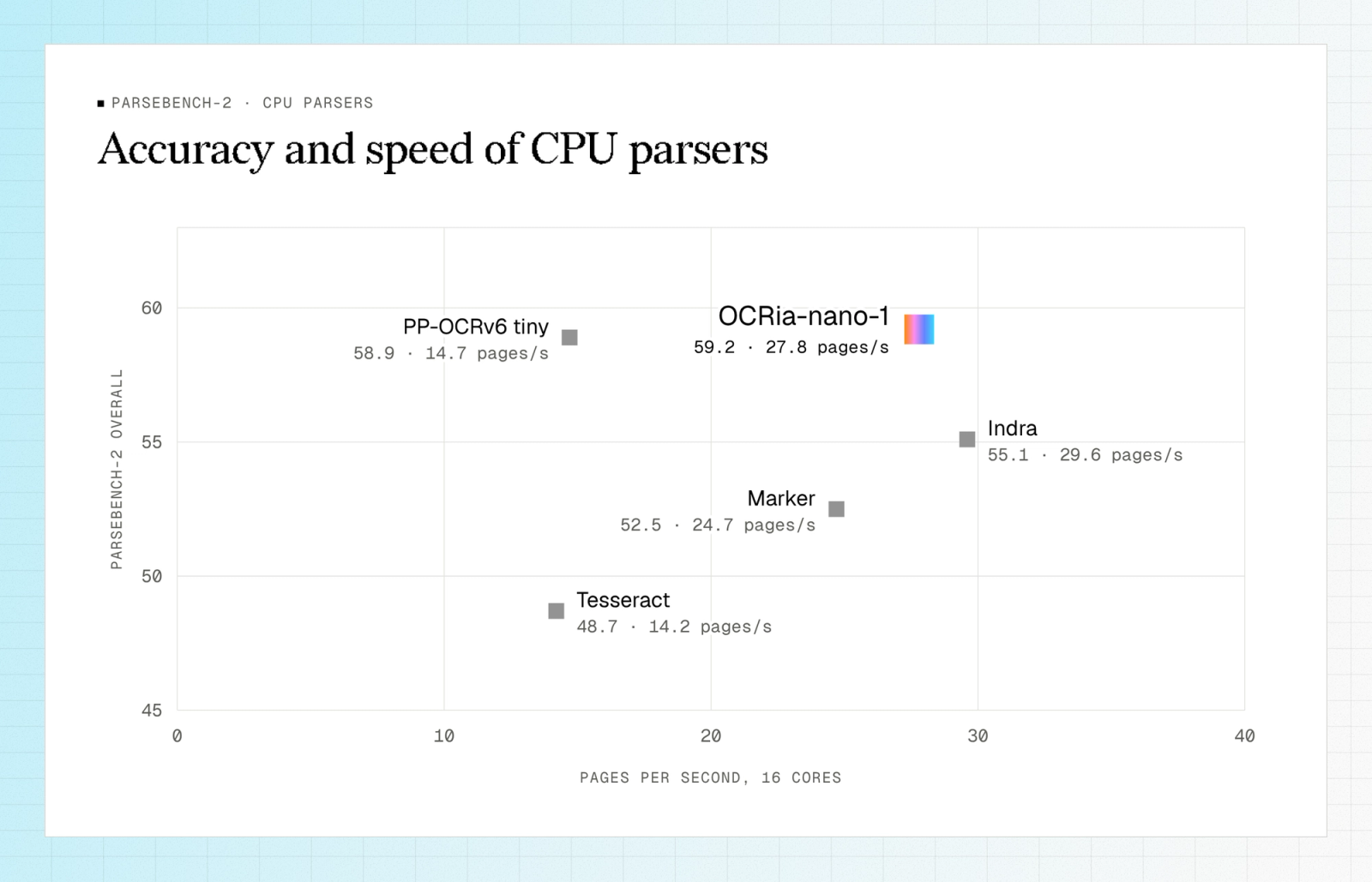
On ParseBench-2, its total score is 59.2, with 59.5 on the table sub-item. For comparison: Indra 1.1.2 is 55.1, Marker 2.2.0 (fast) is 52.5, and LiteParse's previous default configuration Tesseract is 48.7. On speed, a single core parses one page in 426 ms, P90 862 ms, and 16 cores in parallel process 27.8 pages per second. The official claim is that it is 2 to 5 times faster than default Tesseract.
| System (CPU) | ParseBench-2 | pages/s |
|---|---|---|
| LiteParse + Tesseract | 48.7 | 14.2 |
| Marker 2.2.0 (fast) | 52.5 | 24.7 |
| Indra 1.1.2 | 55.1 | 29.6 |
| LiteParse + OCRia-nano-1 | 59.2 | 27.8 |
The pipeline is interesting: digital PDFs already have a text layer, which LiteParse uses directly; the OCR model only steps in when the text layer is missing or unreadable. The OCR results are then merged with the PDF's native text and passed to LayoutNet to reconstruct tables and layout. It is not simply throwing the whole page image at the model.
The use cases are clear: large-scale batch ingestion, such as indexing a PB-scale RAG knowledge base; or agents processing temporary uploaded files. The official recommendation is that complex documents requiring higher visual accuracy—such as handwriting, heavily degraded scans, scanned math formulas, and charts-to-tables—should use the larger OCRia-1 (4B VLM).
In the comments, a developer did the math: a 500-page data room finishes in under 4 minutes on CPU, without opening a GPU budget meeting. Others value the pure-CPU aspect: invoices, contracts, and other documents that are not allowed to leave the customer's network finally have a parsing solution. Someone else said that at 8.1M parameters, the entire model can fit in a Slack attachment.
Regarding licensing, note: the weights use a modified Open RAIL-M License. Research and teaching are free, personal use is free, and organizations with annual revenue below $2 million and cumulative funding below $2 million can use it commercially. Above that threshold, or any document parsing, OCR, or extraction product that competes with LlamaParse/LlamaCloud, requires a commercial license. LiteParse itself is Apache 2.0.
Quick start:
bash
pip install liteparse
lit models pull ocria-nano
lit parse doc.pdf --format markdown
Model files on Hugging Face: https://huggingface.co/llamaindex/OCRia-nano-1
LiteParse repository: https://github.com/run-llama/liteparse
Technical report: https://www.llamaindex.ai/ocria/ocria-nano-1-report.pdf
发布时间: 2026-11-24 06:34