Patch Isn't Out Yet, AI Agents Have Already Written the Defense: OpenAI and Cisco Open-Source Shirudo
OpenAI and Cisco have released Shirudo, an open-source Linux runtime that lets AI agents generate dynamic eBPF controls to mitigate vulnerability exploitation without any downtime. It is a first step toward self-defending infrastructure.
OpenAI and Cisco have released an open-source Linux runtime called Shirudo. Its purpose is straightforward: it lets AI agents generate dynamic eBPF controls to mitigate vulnerability exploitation without interrupting system services. This means that during the dangerous window between a vulnerability's disclosure and the arrival of a patch, defenders no longer have to just sit and wait.
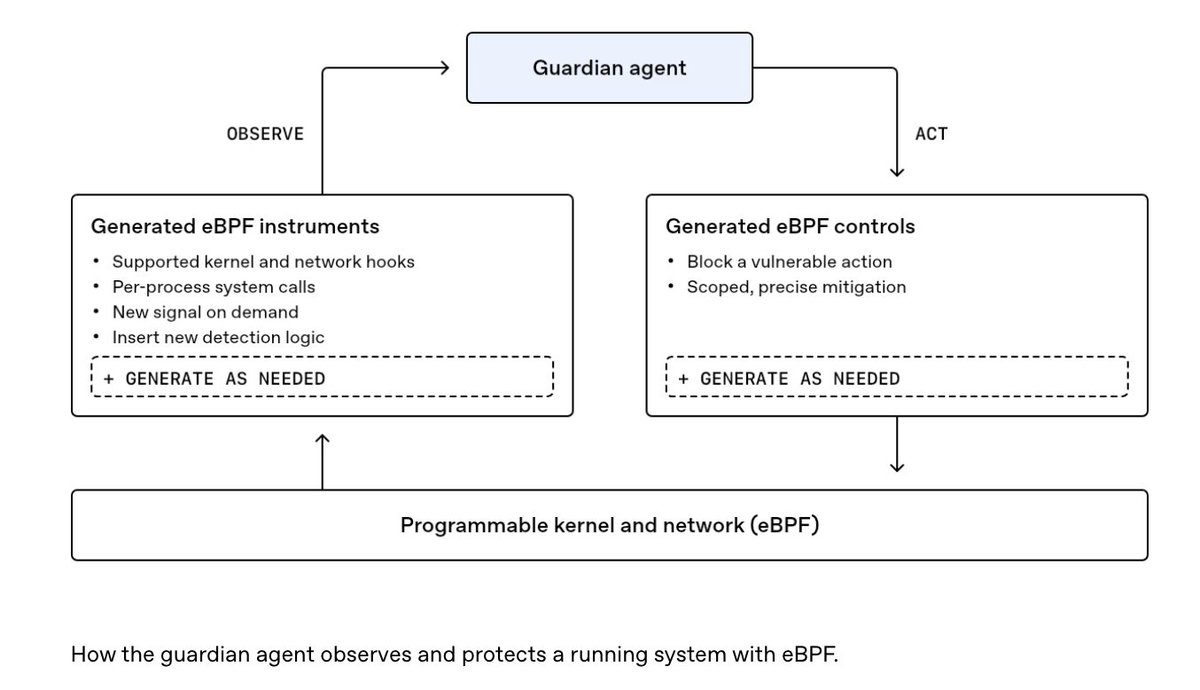
If you're not familiar with eBPF, think of it as a sandbox slot in the Linux kernel. It lets you drop in a small program that changes network or system behavior in real time, without modifying kernel code or rebooting the machine. Security has long used it for traffic filtering and behavior blocking; Shirudo hands that capability to AI agents.
In practice, the AI agent generates the corresponding eBPF control, acting like a temporary shield placed in the path of vulnerability exploitation. Once the official patch is ready, the temporary control is removed. The entire process doesn't require taking services offline.
In a tweet, OpenAI said Shirudo was built jointly by Cisco and OpenAI, with the goal of letting defenders work together with AI agents to find affected systems, test and share these shields, and finally deploy them without interruption. They called it the first step toward self-defending infrastructure that can adapt to new threats.
Notably, in the past AI in security was more about helping analyze vulnerabilities and suggesting fixes. Shirudo pulls AI into the execution layer—directly generating defensive code and applying it to a running kernel. That goes a step further than recommending a patch. eBPF controls aren't a silver bullet, but at least when a patch is late, something is there to hold the line.
Shirudo is currently open-source and aimed at Linux systems. For security researchers and operations teams, that means they can audit it, modify it, and deploy it themselves. For ordinary users, there's no need to understand the details of eBPF—just know that in the future, servers may no longer have to face unknown vulnerabilities with no protection.
This is not the end. OpenAI calls it the first step—letting infrastructure learn to defend itself. And that first step has already made quite an impact.
发布时间: 2026-11-24 06:20