At $1,279 Each, AI Produces 948 Linux Kernel Privilege-Escalation Vulnerabilities in One Run
OpenAI ran GPT-6 Cyber through a Linux kernel security audit: it verified 948 local privilege-escalation vulnerabilities, generated patches, and cost $1.2 million in API usage. Calculated using historical bounties, the potential value of these vulnerabilities is 16 to 55 times the cost. Kernel maintainers are busy patching, and the security assumption around low-privilege accounts may need to change.
OpenAI's Cyber team published a study titled "A thousand fewer paths to root." They used the GPT-6 Cyber model to run an autonomous pipeline for vulnerability discovery, verification, exploitation, and patching. In a single run, on a common Linux desktop distribution, it dynamically reproduced 1,724 vulnerabilities and generated 291 information-disclosure PoCs and 948 usable local privilege-escalation (LPE) exploits—exploits that let an unprivileged local user obtain root.
Cost: $1,213,430 in API credits, or an average of about $1,279 per usable LPE. If converted at historical Pwn2Own and TyphoonPWN bounties for Linux kernel LPEs ($20,000 to $70,000), the potential value of the 948 vulnerabilities is $18.9 million to $66.3 million, or 16 to 55 times the cost. In other words, using AI for security auditing is much cheaper than relying on bounties to get people to find vulnerabilities.
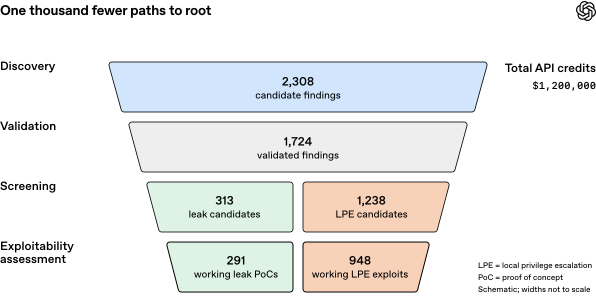
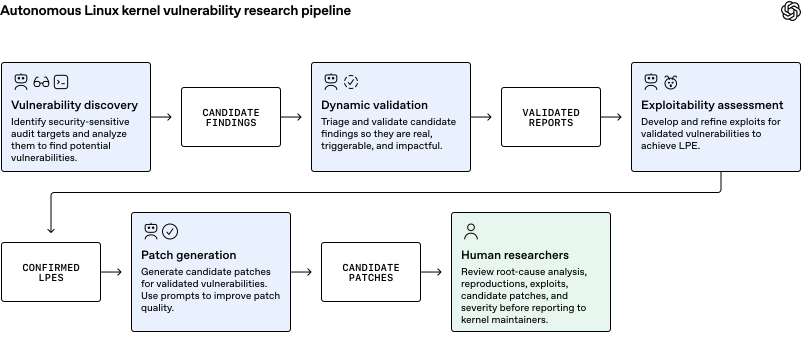
This pipeline isn't simply throwing code at the model. It has five stages: Scout agents first scope out audit targets, scanning only about 7% of kernel code, or 2.8 million lines; Analyst agents produce 2,308 candidate findings within 12 hours; then dynamic verification—generating and running PoCs in isolated VMs with KASAN, reproducing 74.7% of them; next, exploitability assessment, testing whether vulnerabilities can escalate privileges or leak information; finally, patch generation, reviewed by human researchers before being reported to kernel maintainers. The process output includes root-cause analysis, minimal crash PoCs, candidate patches, and full exploits.
There are several noteworthy takeaways behind the numbers.
Stronger models find more vulnerabilities. In July, GPT-5.6 Sol found and exploited 166 LPEs under the same research framework; in October, the new cyber model found 948, with three months of hardening in between. Scanning with the same harness produced more than a 5x difference.
The model also came up with new exploitation techniques on its own. Researchers sampled and analyzed 166 exploits and confirmed that at least 10 exploitation techniques were previously unknown, including two new persistent resilient objects, two page-grooming techniques, and five data-only privilege-escalation techniques. Third-party kernel exploitation experts confirmed they had not seen them before.
There was also a hiccup along the way. An early run reported 200 successful privilege escalations; manual review found that 20 of them obtained root through another 0-day vulnerability, not the vulnerability specified by the task. Later they added independent verification to ensure each exploit used the designated vulnerability.
Another observation: Linux maintainers are already patching quickly. In the 10 days from scanning to the end of manual analysis, 61 LPEs had been fixed upstream, 43 had staging patches, and 299 were being publicly discussed. OpenAI said that, following kernel community advice, it first sent reports and patches for critical vulnerabilities, and is advancing the rest with Patch the Planet partners.
In the harder kernelCTF environment, this pipeline also obtained 21 LPEs at a cost of about $33,000. If accepted by bounty programs, the corresponding rewards would be about $1.5 million, 45 times the cost. For comparison, from 2026 to date kernelCTF has accepted 26 confirmed 0-day LPEs in total. In less than 5 days, AI output nearly matched a full year of human results.
OpenAI also dropped a somewhat counterintuitive conclusion: on a system that hasn't had the latest patches applied, if an attacker already has a low-privilege account, that basically equals root—for a well-resourced attacker. It recommends using sandboxes and isolation to reduce the blast radius. Translation: stop treating "I already have a low-privilege account" as a security boundary.
The replies under the tweet naturally got lively. One commenter said, "So this is why there have been all those outages lately"; another asked, "How many of the 948 have already been merged upstream?"; someone else said, "Linus is about to write the angriest mailing-list post of 2026." Others thought of the maintainers: "948 patches to review—buy the maintainers a drink."
Most interesting was a commenter who said: "I found a bug in my apartment, so I moved."—while AI produced 948 in one run.
发布时间: 2026-11-24 09:51