Pelicans on Bicycles Reveal GLM-5.4's Abrupt Style Shift
GLM-5.4 is released, Z.ai's first recurrent Transformer model. Simon Willison used the pelican-on-a-bicycle test to compare four generations of GLM and found an abrupt style shift from 5.2 to 5.3. Pandaily disclosed architecture details: 5.4 was further trained from the pretrained GLM-5 750B base model into a recurrent architecture.
GLM-5.4 has been released. It is Z.ai's first recurrent Transformer model.
Simon Willison said on X that he tested four versions—5.4, 5.3, 5.2, and 5.1—with the pelican-on-a-bicycle test, and found the style change between 5.2 and 5.3 to be very pronounced.

First, the architecture. The difference between a recurrent Transformer and a standard Transformer is that a standard Transformer runs each layer once, while a recurrent Transformer runs a group of weight-sharing layers for multiple rounds, with each round refining the hidden state from the previous round. The parameter count does not increase, but the network becomes deeper. This is the second recurrent Transformer this week; the first was Thinking Machines Lab's Inkling 2 Mini, released on November 20, whose middle layers run three times per token.
At max difficulty, the pelican generated by 5.4 looks like this:

Not particularly impressive. The pelican is recognizable, but the bicycle fork's connection structure is awkward and looks like it cannot steer.
The key point is the four-generation comparison.
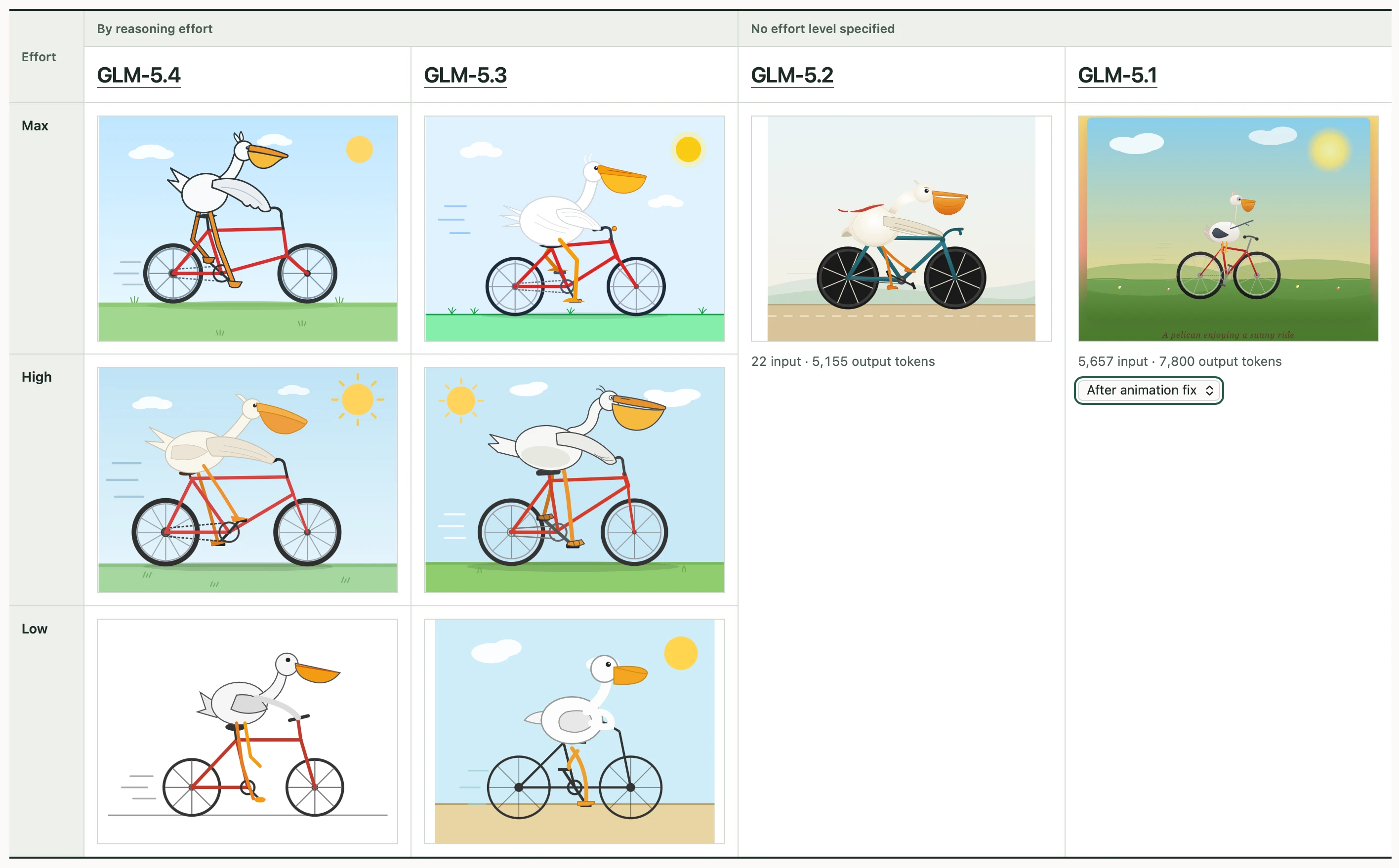
The pelicans from 5.1 and 5.2 had GLM's own recognizable style. The 5.2 one was riding a cyberpunk bicycle, while the 5.1 one was more colorful and more cartoon-like. By 5.3, the style suddenly shifted to a mainstream approach, similar to outputs from OpenAI and Anthropic. 5.4 continued 5.3's style.
In a reply, Pandaily mentioned a more fundamental change. GLM-5.4 is not a recurrent Transformer trained from scratch; instead, the pretrained GLM-5 750B base model was further trained into a recurrent architecture. It is surgery on an existing model.
Some users noted that Z.ai said 5.4 would generate shorter answers because part of the reasoning process was moved into the recurrence. This may explain why the pelican generated by 5.4 at low difficulty did not even draw the sky.
This leads to a general lesson. One commenter said visual regression tests are more useful than aggregate scores. Script checks report 0.0 degrees of shoulder roll and an all-green console, but a side-by-side visual comparison lets you see the style shift between 5.2 and 5.3 at a glance. They encountered similar problems when working on Blender and Three.js pipelines: all the numbers were correct, but a contact-sheet comparison revealed wrist clipping.
Currently, 5.4's weights are not open, and it is not accessible through the regular API; you need to subscribe to Z.ai's Coding Plan. Simon wrote an llm-glm plugin to call the new model, then discovered that Tommy Hughes's llm-zai plugin already existed. llm-zai does not yet support the new model, so he is using his own for now and will retire it after llm-zai is updated.
Next time a model is released, it may be worth lining up versions from different generations side by side with the same prompt. You might discover something unexpected.
发布时间: 2026-11-24 11:42