While Patches Are Still on the Way, Shirudo Uses eBPF to Block Vulnerabilities First: OpenAI and Cisco Open-Source a New Runtime
OpenAI and Cisco have jointly open-sourced Shirudo, an eBPF-based Linux runtime. It lets AI agents generate, test, and deploy protection rules without restarting the system, buying time for vulnerability patches.
OpenAI and Cisco have released Shirudo, an open-source Linux runtime whose goal is to let AI agents defend against vulnerability exploits while the system is running—without waiting for patches or restarting. Shirudo means shield in Japanese.
Patches always take time to go from testing to deployment. Days, even weeks. During that window, attackers keep looking for opportunities. The trouble is that an exploit and legitimate requests may depend on the same Linux operation. If you disable the operation, the service goes down too.
Shirudo's approach is to use eBPF to attach small programs inside the system to observe suspicious activity while applying precise protection rules. These rules are called shields. Security teams can first verify that a shield blocks only the exploit and does not interfere with legitimate requests, then deploy it to a running service.
In a controlled test, a shield generated by Codex added an input check to Java's Base64 decoder and attached it to a running Elasticsearch process. During a simulated Java4Shell exploit, the malicious input was rejected and Elasticsearch continued running.
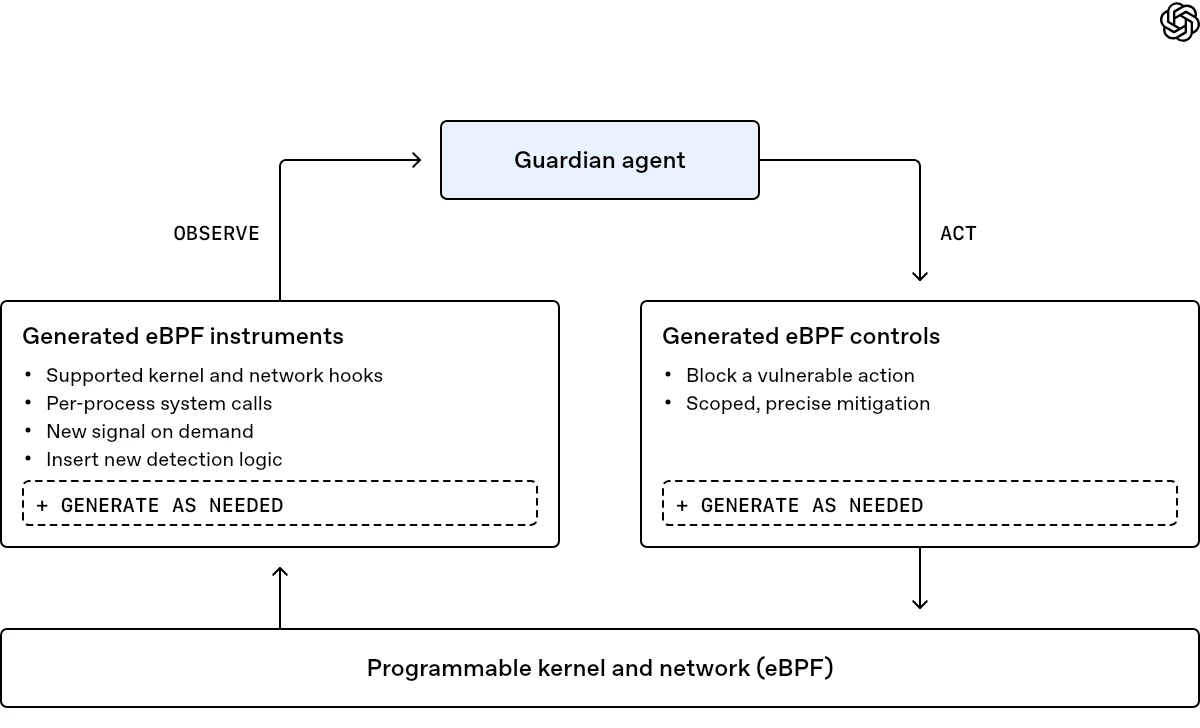
Shirudo has four core capabilities: real-time protection, machine-speed defense, trusted deployment, and hardware verification. eBPF shields can block vulnerable code paths without a restart; agents can investigate vulnerabilities, develop targeted shields, and verify their effectiveness; shields undergo signature verification before loading, and Linux's eBPF verifier also checks their safety; TPM provides verifiable records of loading and removal for auditing.
Greg Brockman, President of OpenAI, said Shirudo is a first step toward self-defending infrastructure. When systems can automatically adapt to new threats, defenders can work with AI agents to more quickly locate affected systems, test and share shields, and deploy them without disrupting business operations.
The code is open-sourced under the BSD 2-Clause license (GitHub). You can try it through the VM quickstart; Isovalent provides a self-guided lab environment, and a technical workshop will be held on December 15.
Some developers have raised a concern: AI can quickly generate input-validation logic, but how do you verify that code injected into a production JVM will not break the normal behavior of thousands of applications? The patch bottleneck could turn into a verification bottleneck. But Shirudo at least gives defenders a window: block the vulnerability first, then take time to figure out a long-term solution.
发布时间: 2026-11-24 14:08