AI's Biggest Value Comes from Changing Organizations, but Employees Are Resisting
After interviewing 58 companies, Anthropic found that the greatest business value of AI lies in organizational restructuring. But there is widespread employee resistance to it. Ethan Mollick adds: apart from programming, enterprise use of AI is far from cutting edge.
Ethan Mollick offered a precise summary of Anthropic's new report: AI's greatest value comes from changing organizations; at the same time, there is broad employee resistance to AI adoption, partly because of organizational change itself. He adds a point not in the report: apart from programming, even the most cutting-edge AI use cases companies are trying are not actually that cutting-edge. The capability surplus is very large.
The report is titled 'Working with AI' and comes from Anthropic's economics team. They conducted 66 interviews with 58 Anthropic enterprise customers, covering AI-native startups, established manufacturers, law firms, dental clinics, and hedge funds. The sample is not random, but it is sufficient to reveal patterns.
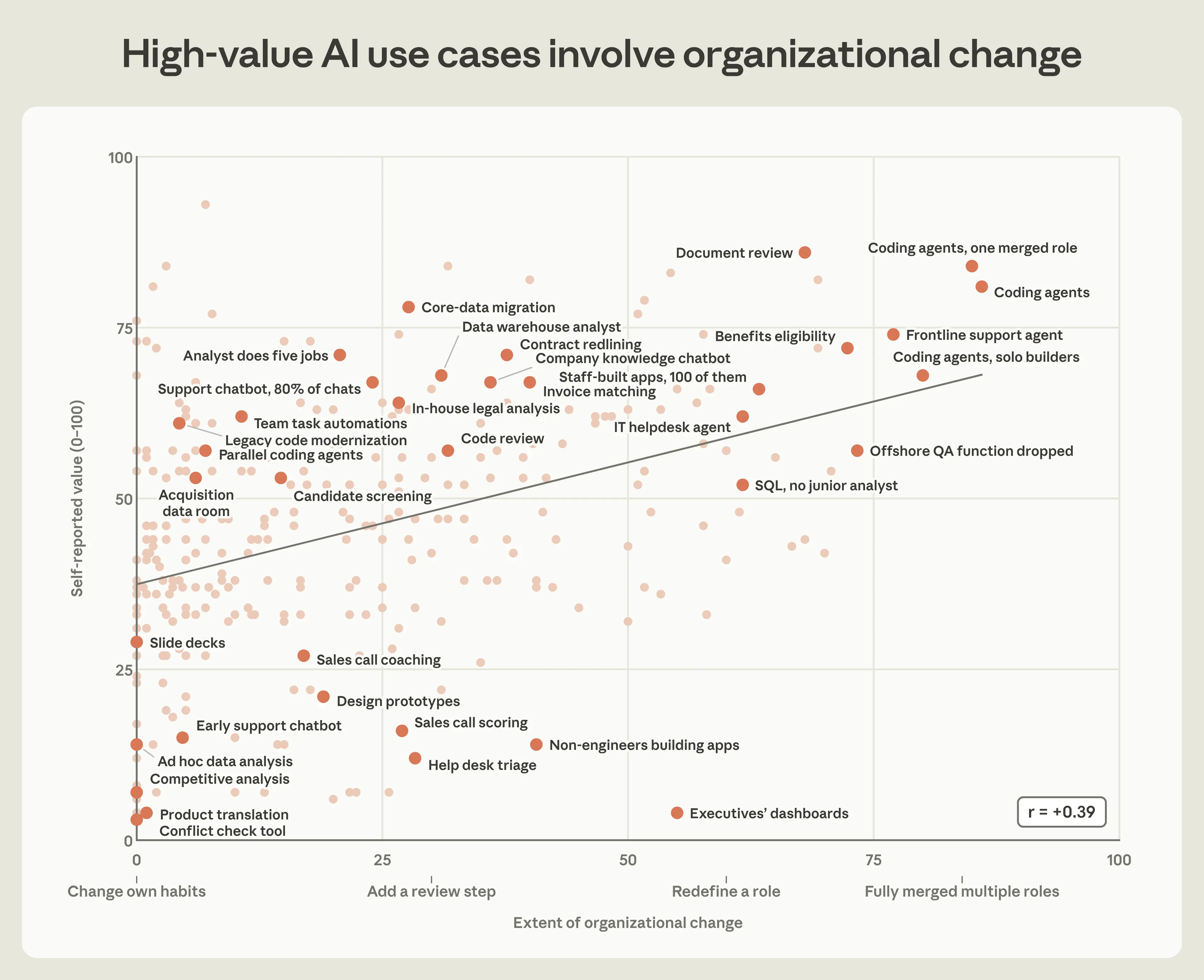
The core finding is straightforward: AI value is not evenly distributed. The report maps nearly 300 AI applications, arranged by degree of organizational change and self-assessed value. Lightweight applications are easy to embed in existing workflows but have limited value; high-value applications almost all require changes in processes or roles, for example, having AI review every code commit, or putting brand guidelines into skill.md maintained by a marketing manager, rather than into each design document.
Most of the value AI creates comes from increasing output; cost cutting is a minority. About half is speeding up existing work, and the other half is improving products or creating something new. Only one-tenth of the value directly reaches employees, showing up as less workload or more interesting work. One manager complained that employees hide the efficiency gains from AI because 'they want to use the 10 hours saved each week to walk the dog.'
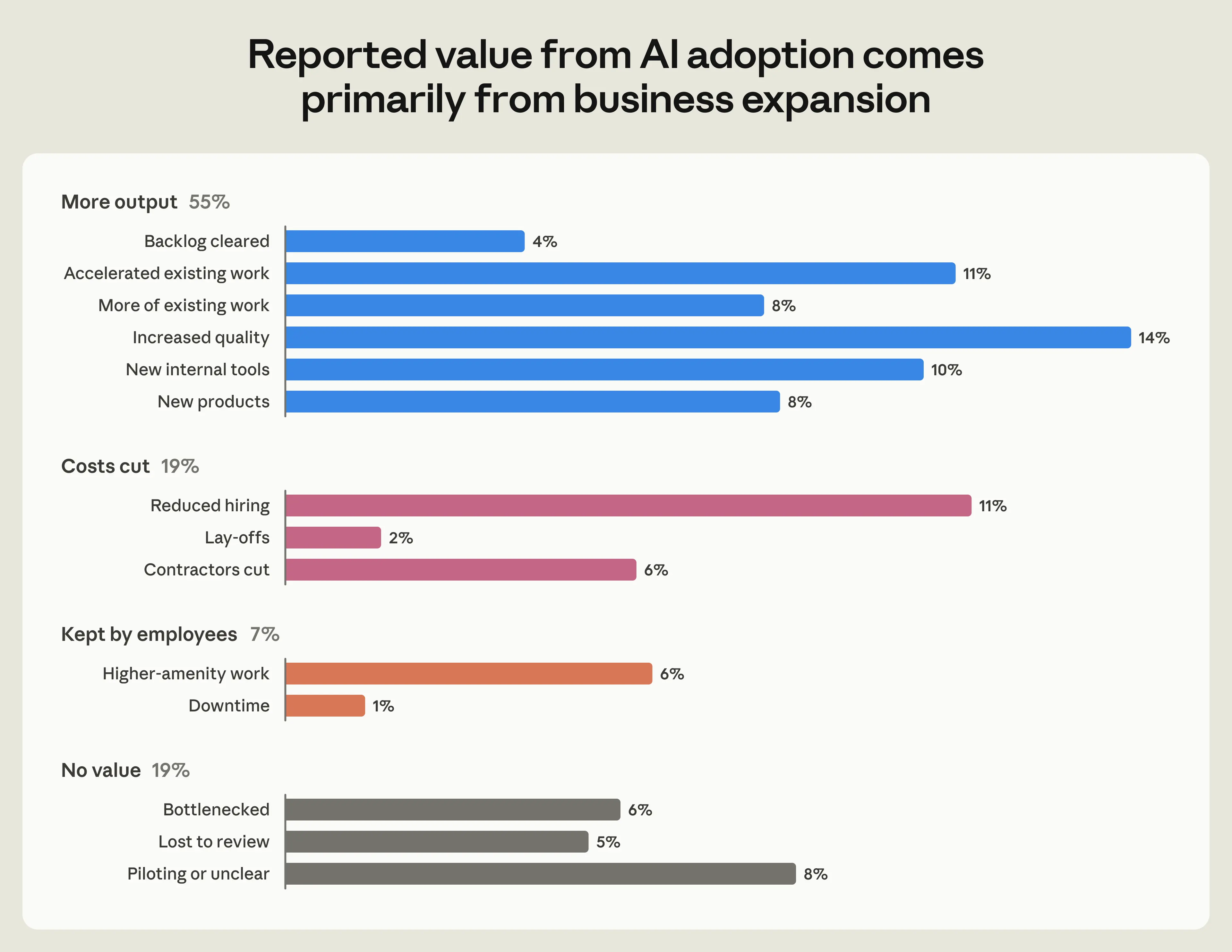
The employment impact is milder than expected, and also more complex than expected. It is rare for AI to directly replace roles: only 5 companies mentioned laying off employees who refused to adopt AI, and 2 saw roles completely replaced by AI. But two-thirds of the companies reduced hiring; nine companies cut contractors, especially offshore outsourcing. One financial company laid off more than 100 offshore data and development contractors. One software company said that after AI handled contract review, 'the legal bills completely disappeared.'
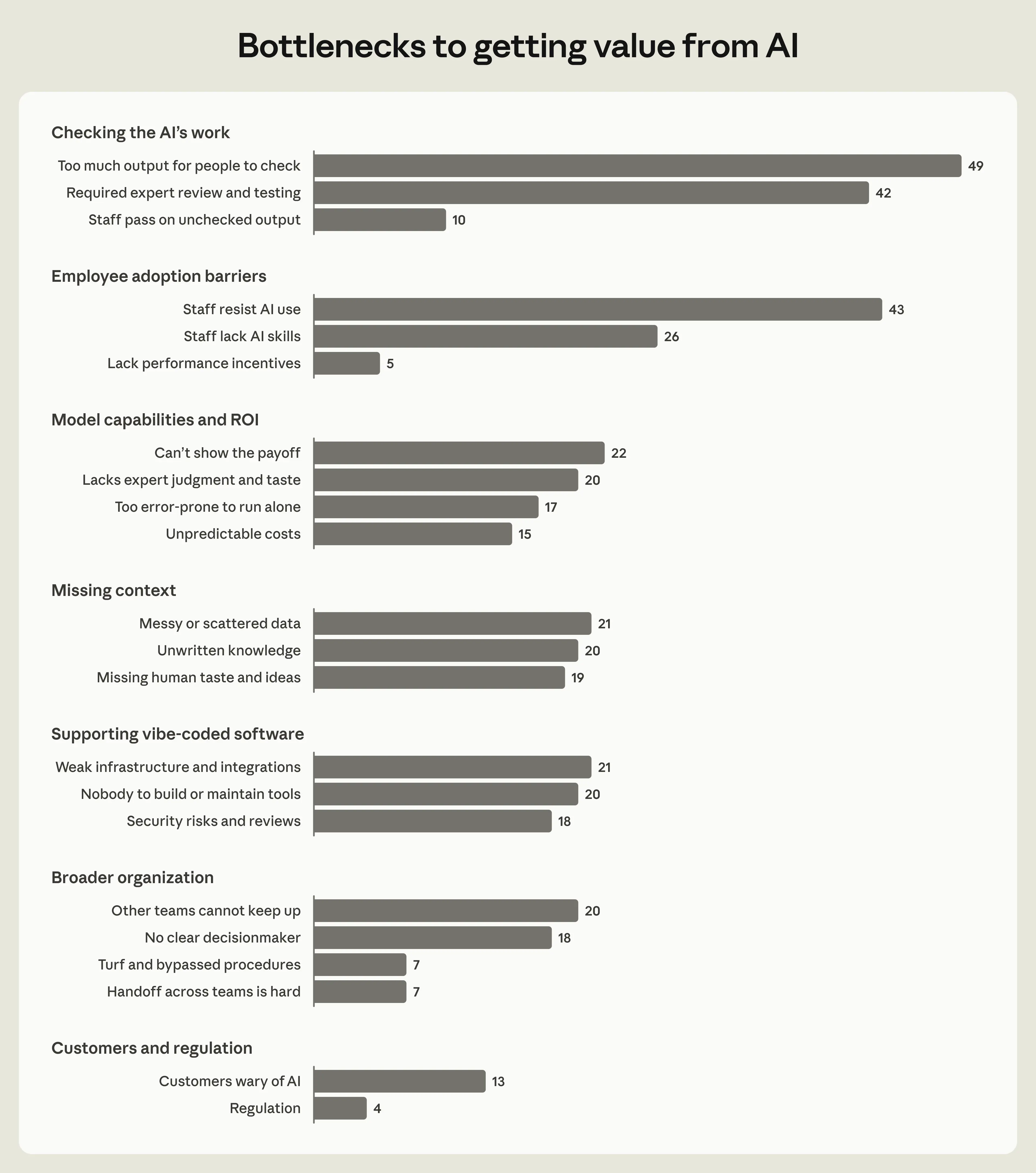
The real bottleneck is people. The report finds that resistance from experts is one of the main obstacles. One company wanted to use AI to automate its approval process, expecting to double reviewers' output and reduce hiring by 90%, but the reviewers did not cooperate: some spent only 2 minutes reviewing, while others insisted on taking 10 minutes or more. At another law firm, an AI conflict-check workflow shifted complex conflicts from lawyers to conflict checkers who had previously done miscellaneous tasks; they resisted, and the process was ultimately shelved.
The report distinguishes between top-down and bottom-up adoption. Top-down adoption easily creates job insecurity and can even be treated as a surveillance tool; bottom-up adoption, by contrast, produces 'pockets of success' but is hard to scale, and can even create a situation in which 'mediocre engineers using AI become a threat to society.'
Highest-value use cases come from organizational restructuring. Approaches include expanding employees' responsibilities so they own an entire process from start to finish; redeploying staff to bottleneck tasks that AI cannot yet handle, such as code review, customer communication, and strategic judgment; and building shared data and infrastructure so non-technical employees can also build applications. The report emphasizes that, under current model capabilities, experts must still be involved in building and reviewing AI workflows. This means that companies willing to share the gains and redesign roles are most likely to benefit both employees and the company.
Some commenters under Ethan Mollick's tweet remarked: when workers hear 'organizational change,' they automatically translate it as 'layoffs.' Another said that once the gains from AI show up on paychecks, resistance will disappear quickly. The report hints at this as well. Expanding responsibilities alone is not enough; the key is to share the gains with the participants.
Ethan Mollick's 'third point' is worth highlighting separately: even for leading companies, most AI use cases remain low-hanging fruit, with programming as the only exception. Model capabilities far exceed how organizations use them; this gap is both a threat and an opportunity. Technology will not stop and wait for organizations, but organizations can decide how to use it.
发布时间: 2026-11-24 14:37