264 AI Agents Crowd Into 12 Categories—Who Will Survive?
264 products, 12 categories, from personal assistants to payment infrastructure. The AI Agent space is so crowded that it needs a map. But the comments remind us: with so many search engines, only one or two ultimately survived.
The AI Agent space is already so crowded that it needs a map.
David Pawlan's Assistant Benchmark (a website dedicated to testing AI assistants) published a market map, cataloging 264 products across 12 categories, with a one-line description, official website, and X account for each product. The author positions it as "the most comprehensive AI Agent market map available."
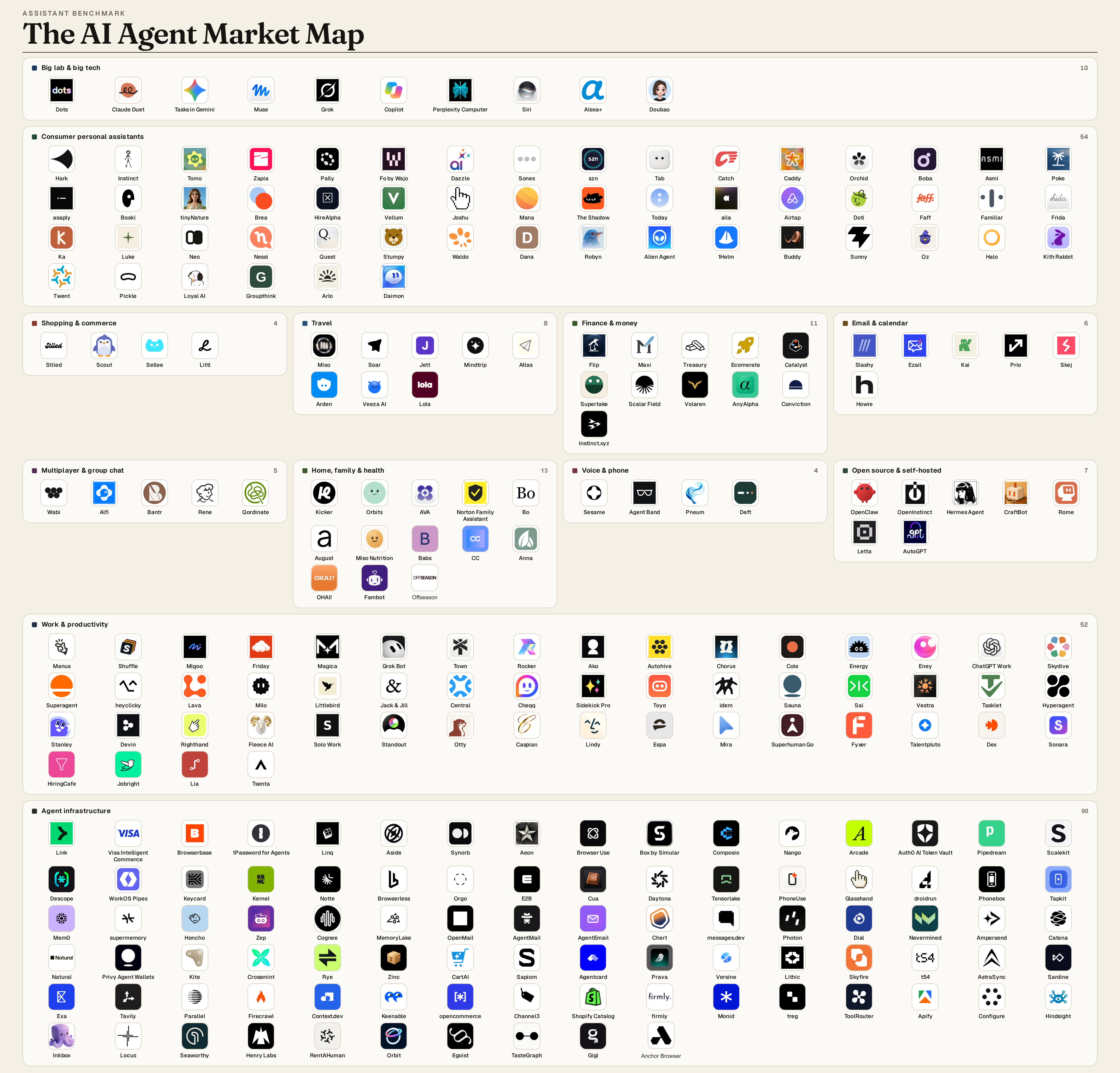
The 12 categories run from big-tech agents and consumer personal assistants all the way through shopping, travel, finance, email and calendar, group chat, family health, voice calls, open-source/self-hosted, and work productivity, ending with agent infrastructure.
The most crowded category is personal assistants. Dozens of products reach users via SMS or iMessage and do the same thing: run errands for their owners. Hark, Instinct, Tomo, Zapia, Pally... there are too many names to remember. Their real differences lie in execution quality and the degree of human involvement behind them.
The infrastructure layer is also taking shape quickly. Stripe's Link Agent Wallet lets agents initiate payments and users approve them; Visa has built Intelligent Commerce; Browserbase provides headless browsers; 1Password launched credential management specifically for agents. There are also a bunch of memory layers and payment APIs. This infrastructure enables agents to browse the web, remember context, and complete transactions.
For agents to do work, they need hands, a wallet, and memory. These parts are being built.
The comments are more interesting than the map itself.
One commenter reminded everyone: with so many search engines, only one or two ultimately survived. It's an uncomfortable truth, but history really does repeat itself.
Another commenter, Dovah, pointed out that the map missed Bitrefill. Bitrefill is a service that lets you use cryptocurrency to spend at mainstream merchants. It just demonstrated a concrete scenario: GrokBot used cryptocurrency to buy an item through its x402 payment endpoint (a protocol that lets agents pay directly). Someone in the comments joked: it's an IKEA table.
Agents spending money on their own has moved from demo to reality.
But there is still an unanswered question: when the buyer is a bot, who is responsible if something goes wrong with the product? Bitrefill's response is: refunds go back to the gift card balance. Whether the product actually arrives—and whether it's the right thing—is another story.
This map is a snapshot from November 2026. People in the comments have already added products that were missed, and others have dug up the June comparison, saying, "We've grown up." When the next version of the map is released, new names will come in, and a batch of names will disappear.
Who will survive? No one knows yet.
But one thing is certain: this space is already so crowded that without a map, you can't find your way.
发布时间: 2026-11-25 00:40