OpenAI and DeepMind Both Listed as Sponsors; Halo Post-training Competition Puts Up $1.5 Million in Compute
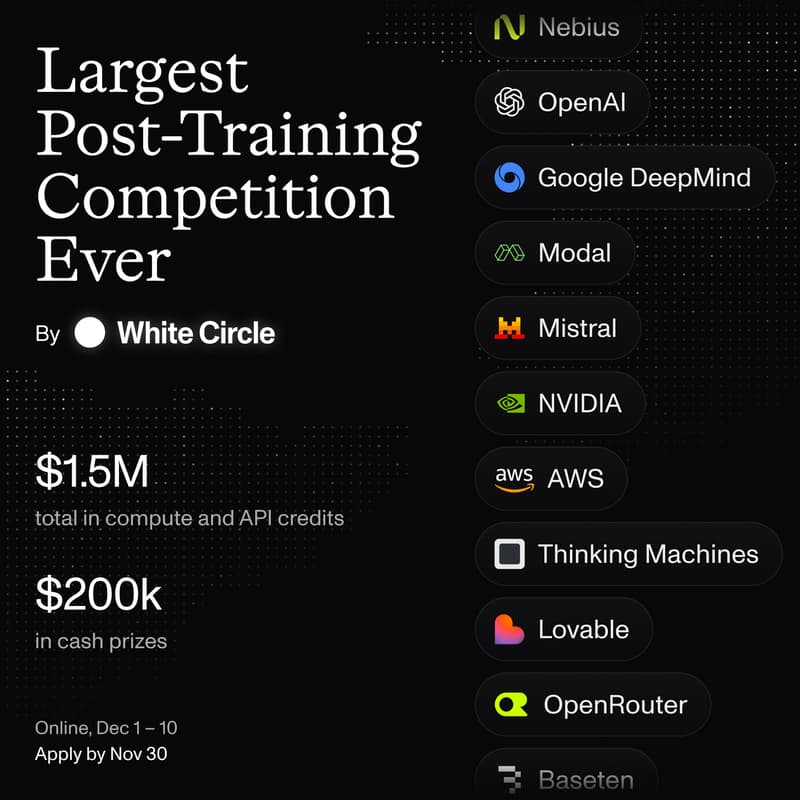
White Circle, together with OpenAI, Google DeepMind, Mistral, NVIDIA, AWS, and others, has launched the Halo Post-training Competition. It will be held online from December 1 to 10, with registration closing on November 30. There is $1.5 million in total compute and API credits, more than $200,000 in cash prizes, 17 tracks with cash prizes listed on the official website, teams of 1 to 4 people, and submissions must be open source.
White Circle, together with OpenAI, Google DeepMind, Mistral, NVIDIA, AWS, and others, has launched the Halo Post-training Competition. The competition will be held online. The official website says December 1 to 10, with registration closing on November 30; the registration page displays it in GMT+8 as from the early hours of December 2 to the early hours of December 11. Refer to the official page for the exact times. There is $1.5 million in total compute and API credits, more than $200,000 in cash prizes, and the official website lists 17 tracks with cash prizes.
The competition is based on White Circle's open-source post-training framework Halo. Halo supports pre-training, SFT, preference optimization, and asynchronous multi-turn RL, and can directly train HuggingFace models. For developers, what this practically means is that checkpoints are still standard SafeTensors, and from_pretrained can still load them; parallel strategies are configured separately by EP, CP, TP, ETP, PP, and FSDP2, and it can also run on multiple nodes. The official team provides Docker images for Blackwell and Hopper, and halo launch sft ... can directly run the YAML files in examples/.

The Halo repository provides some benchmarks. Halo 1.2.0 runs Qwen3.6-35B-A3B 64k on 8×B300; in the official website table it is 23,637 tok/s/GPU, Megatron Bridge is 21,559, and TRL is 16,126. Qwen3.5-122B-A10B 64k is 8,933, versus Megatron Bridge at 4,781 and TRL at 5,936. The official homepage also says "up to 4× faster" and gives gpt-oss-20b 8k as 3.82× faster than TRL and Gemma 4 16k as 3.57× faster than Megatron Bridge. These numbers have specific hardware, precision, and configuration conditions and cannot be treated as general conclusions. What is certain is that Halo puts distributed training, RL rollout, and checkpoint management into one open-source framework, lowering the engineering barrier for post-training.
The competition tracks are divided into two categories. One asks entrants to make Halo faster and more efficient on specified model families, covering gpt-oss, Gemma, Mistral, Inkling, and Nemotron. The other uses Halo to post-train these models, with tasks chosen by the entrants. There are also best-use tracks for Modal, Baseten, Token Factory by Nebius, OpenRouter, Lovable, and White Circle. The top three in each track receive $5,000, $3,000, and $1,000; the top three overall receive $30,000, $15,000, and $10,000, and there are additional partner special awards.
Registration is free and open to AI researchers, engineers, scientists, and PhD students, in teams of 1 to 4 people, online worldwide. Accepted participants will receive compute and API credits from sources including OpenAI, Mistral, Modal, Baseten, Nebius, OpenRouter, AWS, Lovable, and White Circle. You can participate even without your own GPUs. Submissions must be open source, and the organizers will rerun the results on their own hardware; you can enter multiple tracks and build on existing work, but submissions must use Halo and the technology of the corresponding track partner. Works belong to the participants, and the organizers and partners may rerun and publish the results.
Post-training can be understood as continuing to train an existing model so that it better fits a certain task or preference; pre-training a large model from scratch is not within this scope. Halo covers methods such as SFT, DPO, KTO, and GRPO. For readers who do not write training code, the competition's results will show up in whether the model is better at doing something and whether training uses fewer GPUs. For developers, the cookbook, Docker images, and CLI in the repository are more worth browsing than the prize numbers.
Some people in the replies mentioned that seeing OpenAI and Google DeepMind on the same sponsor list was unexpected. Others wrote, "There goes the weekend." The scarce part of this competition is access to compute, not the prize numbers. Registration closes on November 30, the competition runs December 1 to 10, and results will be announced on December 18.
- Official website: https://whitecircle.com/halo/competition
- Registration page: https://luma.com/ykoj0t48
- Halo GitHub: https://github.com/whitecircle/halo
- Original tweet: https://x.com/dongxi_nlp/status/2125280770826662360
发布时间: 2026-11-25 04:28