GPT-6 Designs Proteins: 322 Designed, 35 Bind in Lab
OpenAI released a preprint stating that the GPT-6 series can design proteins using reasoning and code, without specialized models. Wet-lab experiments showed 35 designed proteins bound their targets, and antibody loop redesign retained binding in 70% of cases. But structure prediction still lags far behind ESMFold2.
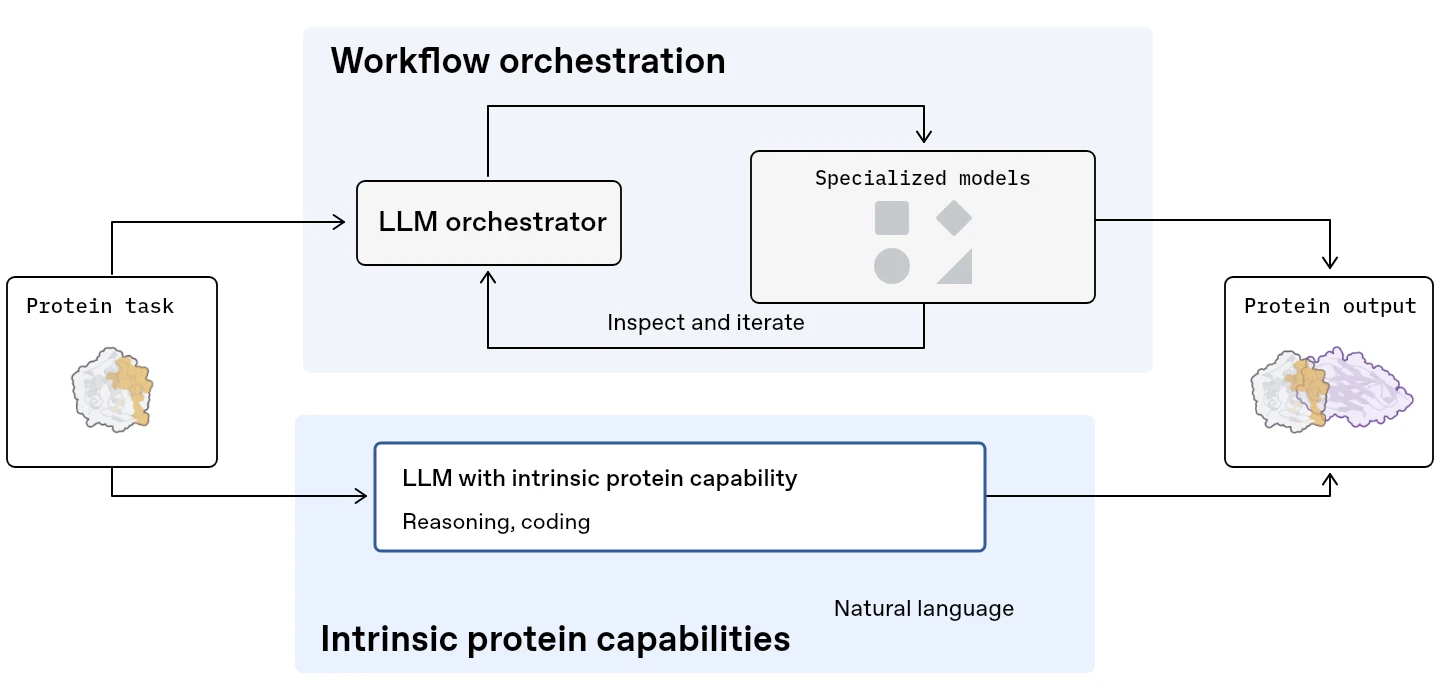
OpenAI today released a preprint titled “GPT-6 as a Universal Foundation Model for Protein Biology: Beyond Specialized Models.” The core claim: GPT-6-series models can design new proteins using reasoning and code, without needing specialized models like RFdiffusion.
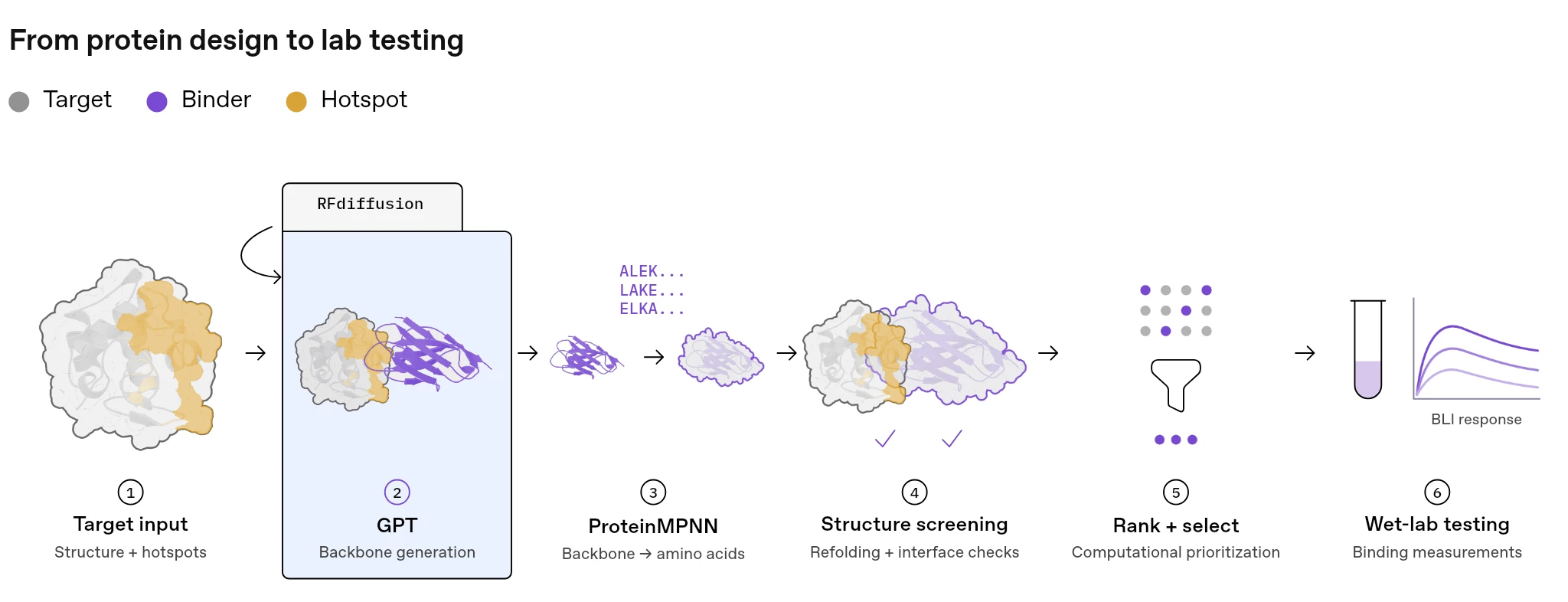
Protein design usually works like this: you start with a desired function—for example, blocking a certain signal—then design a three-dimensional structure that can perform that function, and then find an amino-acid sequence that folds into that structure. Along the way you need multiple specialized models, each good at one step, with fixed input formats. Adding a new constraint means modifying software or retraining.
OpenAI’s approach is to let a general-purpose model do the job directly. Give GPT-6.2 the structure of a target protein, mark in natural language where you want the new protein to bind, and specify the secondary structure (all-helical, all-beta, or mixed). It writes code to generate a three-dimensional structure. Want a different design? Just change the prompt.
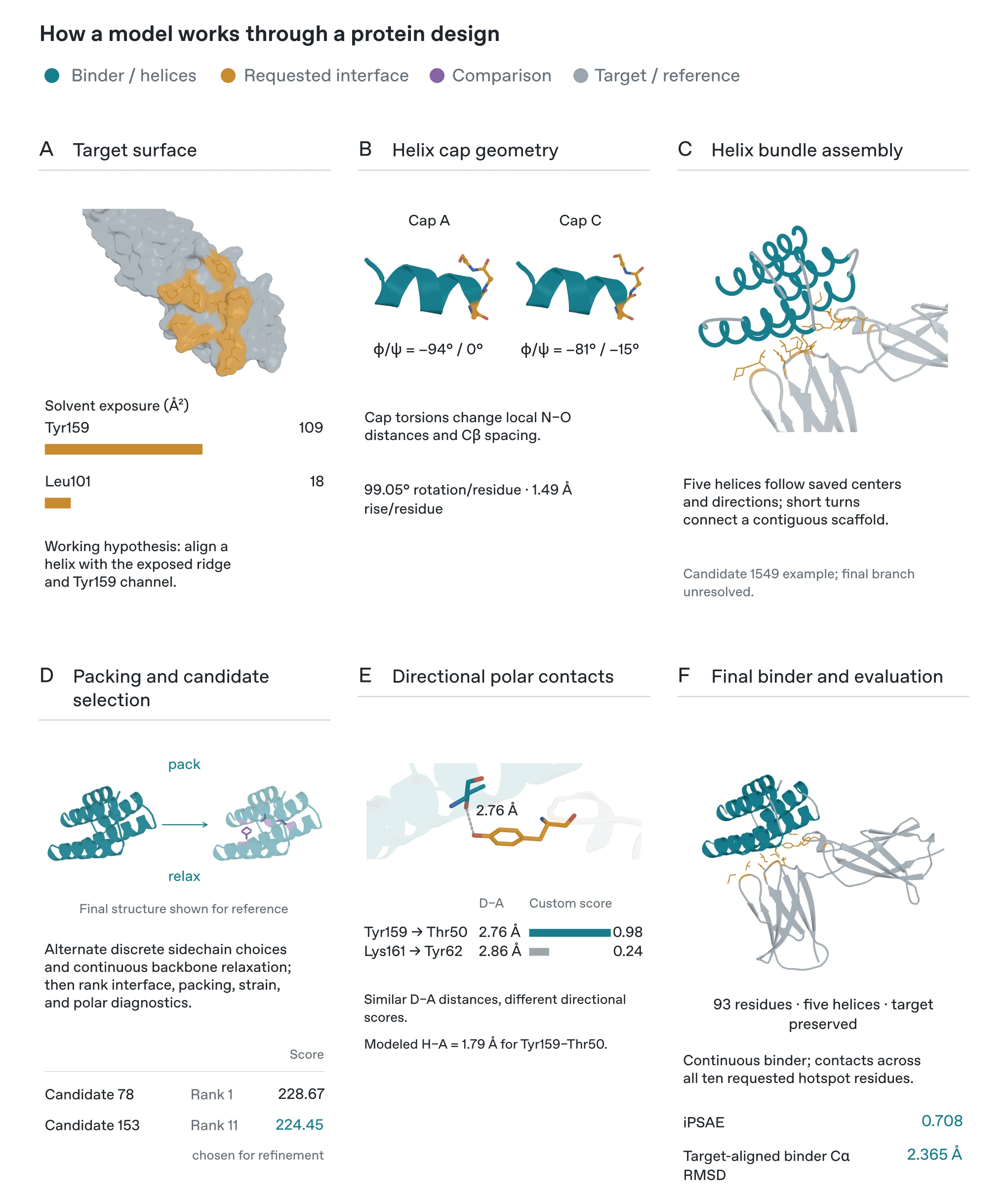
The model’s design process is interpretable. For example, when designing a small protein targeting IL-7Rα, it first analyzes the target surface, then proposes several interaction models, and then writes code to evaluate different scaffolds and amino-acid combinations. OpenAI argues that the model’s reasoning text shows it is performing combinatorial reasoning with knowledge of mathematics, physics, chemistry, and biology.
This counts as a frontal attack by general-purpose models on specialized models. But between the attack and the occupation lie many lab failures.
OpenAI and the biotech company Onava ran wet-lab validation. Experiment 1: GPT-6.2 designed minibinders for five target proteins. It generated three-dimensional scaffolds; the specialized model SolubleMPNN filled in the amino-acid sequences; other specialized models then screened the candidates. A total of 322 proteins were tested, and 35 (10.9%) showed binding to the target. All five targets had at least one hit: PD-L1 5, IL-7Rα 3, TrkA 1, VEGF-A 8, IL-17A 18.
For comparison, the original RFdiffusion paper reported a higher hit rate, but OpenAI points out that screening stringency and the definition of “binding” differ, so the numbers cannot be compared directly. That is fair enough.
Experiment 2 tested GPT-6.2’s ability to design sequences. Given known three-dimensional structures with the original sequences hidden, it was asked to redesign the amino-acid sequences. For existing minibinder structures, in the initial lab screen, designs for the MDM2 target bound in 85% of cases (75/88), for VEGF-A in 62% (26/42), and for PD-1 in only 14% (8/59). For new structures generated by GPT-6.2 itself, 14 of 107 proteins bound.
Interestingly, the sequences designed by GPT-6.2 differ substantially from the original sequences. The median difference for the VEGF-A target was 50%. For the same PD-L1 minibinder structure, it designed two sequences that differed by 44 amino acids (out of 90 total). This suggests it is genuinely designing, not memorizing.
For antibodies, GPT-6.2 redesigned the three loop regions in VHH antibodies responsible for binding their targets. All six antibodies were directed against IL-4Rα; of 182 designs tested, 128 retained binding (70%). In another test, it altered the binding loops of therapeutic antibodies: five antibodies, 272 fragments, and 179 bound (66%).
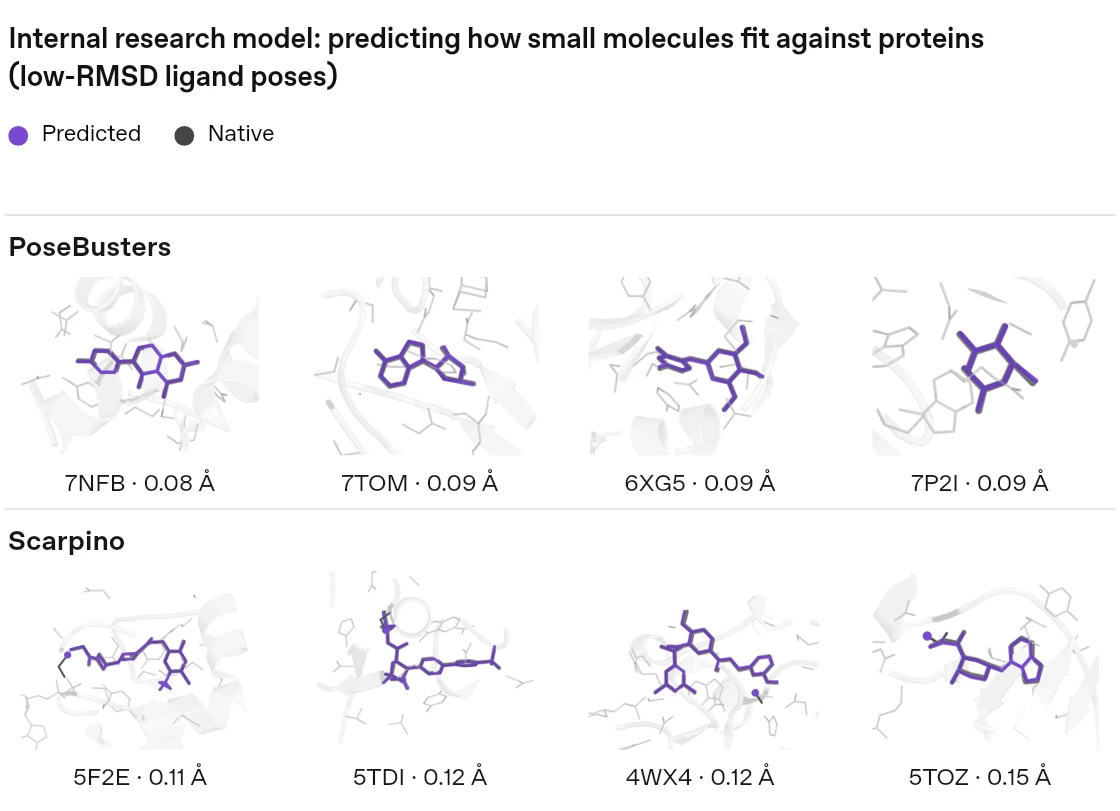
Beyond binding ability, GPT-6 also demonstrated several related skills. Small-molecule docking: on the PoseBusters dataset, 93% of GPT-6.2’s predictions were close to experimental structures, the latest internal model 96%, and the specialized model DiffDock-L 50%. On the Scarpino dataset, when told which two atoms form a bond, it predicted correctly in 92% of cases (GPT-6.2) and 97% (latest internal model), versus 60% for DiffDock. Mutation-effect prediction: across four datasets, GPT-6.2 and the internal model outperformed ESM2-650M in ranking accuracy.
But there is one clear weakness: predicting full protein structure from sequence. GPT-6.2’s average TM-score was only 0.26, the latest internal model 0.38, and ESMFold2 0.93. That is a large gap. OpenAI also admits that the full pipeline still relies on specialized models to fill in sequences and screen candidates, so it has not achieved end-to-end zero-shot. In addition, some high benchmark scores may stem from memorization. In the lab, “binding” is not the same as “function,” let alone “becoming a drug.”
The value of this preprint is that it demonstrates the potential of general-purpose language models in biomolecular design while drawing a clear capability boundary. For researchers, being able to adjust design constraints in natural language is genuinely convenient. But we are still far from “a scientist designing a drug with one sentence.”
OpenAI’s listed next steps include harder targets, functional validation after binding, and more molecule types such as RNA and PROTACs. At the same time, they do not avoid biosecurity risks.
For now, more wet-lab results are needed before general-purpose models can truly become protein designers. At least this is a start.
发布时间: 2026-11-25 05:02