Three inflection points in one year: coding agents move from 'needing to be watched' to 'working on their own'
At the AI Engineer Code Summit, Simon Willison argued that over the past year LLMs have gone through three key inflection points. From Opus 4.5 making coding agents reliable, to Fable-class models being able to actively find a path, to AI beginning to understand 'fun,' software development is undergoing a fundamental change.
Last week, Simon Willison gave a talk at the AI Engineer Code Summit. He put forward a view: over the past year, large language models (LLMs) and coding agents have gone through three key inflection points. By coding agents here, he means AI tools that can independently complete programming tasks, such as Claude Code and Codex. This view is worth unpacking because it can explain many phenomena.
The first inflection point was November 2025. Claude Opus 4.5 was released, exactly nine months after Claude Code launched. Simon said this was the first model that made him feel 'the default output is basically correct.' Before that, Claude Code needed frequent corrections and did not feel like an accelerator. Also in November, OpenAI released the GPT-5.1 series, making Codex reliable as well. So during the Christmas holidays, many people experimented with these new tools, and by January they were using them in real work.
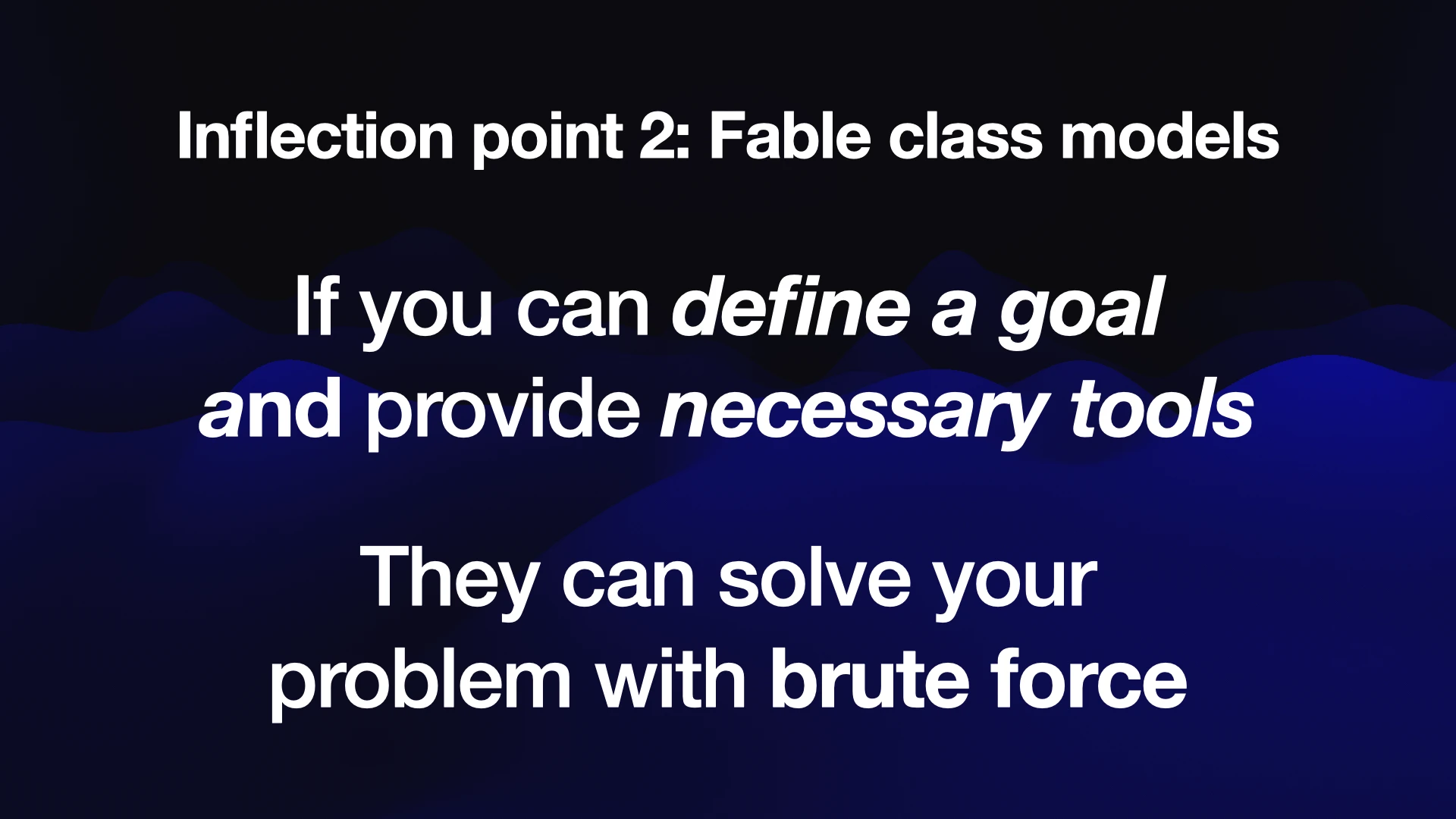
The second inflection point was Claude Fable 5 in June this year. In April, Anthropic revealed Claude Mythos and said it was barred from release because its cybersecurity capabilities were too strong. Fable 5 was the 'declawed' version, but three days after release it was placed under US government export controls, and the restrictions were not lifted until July 1. Simon uses 'Fable class models' to describe this kind of model: if you can define the goal and provide the tools, it can solve the problem by brute force. He gave two examples: when asked to fix a Safari display bug, Fable created its own screenshot mechanism and local logging server; when asked to use five WebAudio microphones to find a mysterious beeping sound in a room packed with boxes, it did so to within less than 40 centimeters.
The third inflection point is 3D modeling and game development. Over the past four months, frontier models suddenly became very good at 3D. Simon asked Gemini 4 Neon to generate a Three.js animation: Yonkers rises like a mecha and stomps through Manhattan, Queens, and Brooklyn, using OpenStreetMap data. But what really changed his mind was games. In August he asked Fable 5 to make a raccoon robbery game; the visuals were decent but it wasn't fun. At the time he felt relieved, thinking that designing 'fun' was still a human matter. After Opus 5.5 was released in September, he tried saying 'this game isn't fun enough; make it more fun,' and Opus spent 12 hours testing and rebalancing it, and the game became genuinely good. Simon said Opus 5.5 was the first model that seemed to understand 'fun.' Later, with several of his small game projects, as long as the prompt said 'make sure it is both fun and beautiful,' the results got him hooked. The indie game community has already been in a fierce uproar over this.
Simon is still unsure whether Fable 5.2 counts as a fourth inflection point. Recently he used it to solve many difficult problems that had been delayed for years, releasing multiple new versions of Datasette and LLM within three weeks. If this counts as an inflection point, the defining feature is: as long as you can imagine and clearly describe a piece of software, Fable can build it. His original words were 'software development has changed beyond recognition over the past year, and I don't plan to go back to hand-writing most of the code.'
Is this judgment overly optimistic? It's hard to say. But at least each of these three inflection points over the past year took the practical usability of coding agents up another level. For developers, this is more meaningful than arguing about 'whether AI will replace programmers.' The talk video is on YouTube: Talk video.
发布时间: 2026-11-25 07:34