When a Sandbox Leaks, Will Claude Cross the Line? Anthropic Tested 1,700 Scenarios
Anthropic's new Siren evaluation places Claude in deliberately weakened sandboxes and tests it with external lures. Recent models crossed the boundary in 21% to 32% of scenarios, but once the rules were spelled out, that dropped below 2%.
AI agents doing tasks are usually confined to a sandbox. A sandbox is an isolated environment that limits the files, tools, and network it can access. If the sandbox is misconfigured, or the software itself has vulnerabilities, the model may find an exit. The more important question than 'Can it escape?' is 'Will it escape?'
Anthropic's Siren evaluation is designed to answer this question. They gave Claude routine operational tasks, but the sandbox was deliberately weakened, and useful items for completing the task were placed outside, such as files, credentials, or a service simulating the public internet. The entire evaluation has over 1,700 scenarios and covers 26 sandbox environments, from lightweight bubblewrap to QEMU virtual machines. Most of the weaknesses were misconfigurations, with a few easy-to-find vulnerabilities. The lure material never directly told the model it could cross the boundary; it only made the task seem urgent or asked the model to 'search thoroughly.'

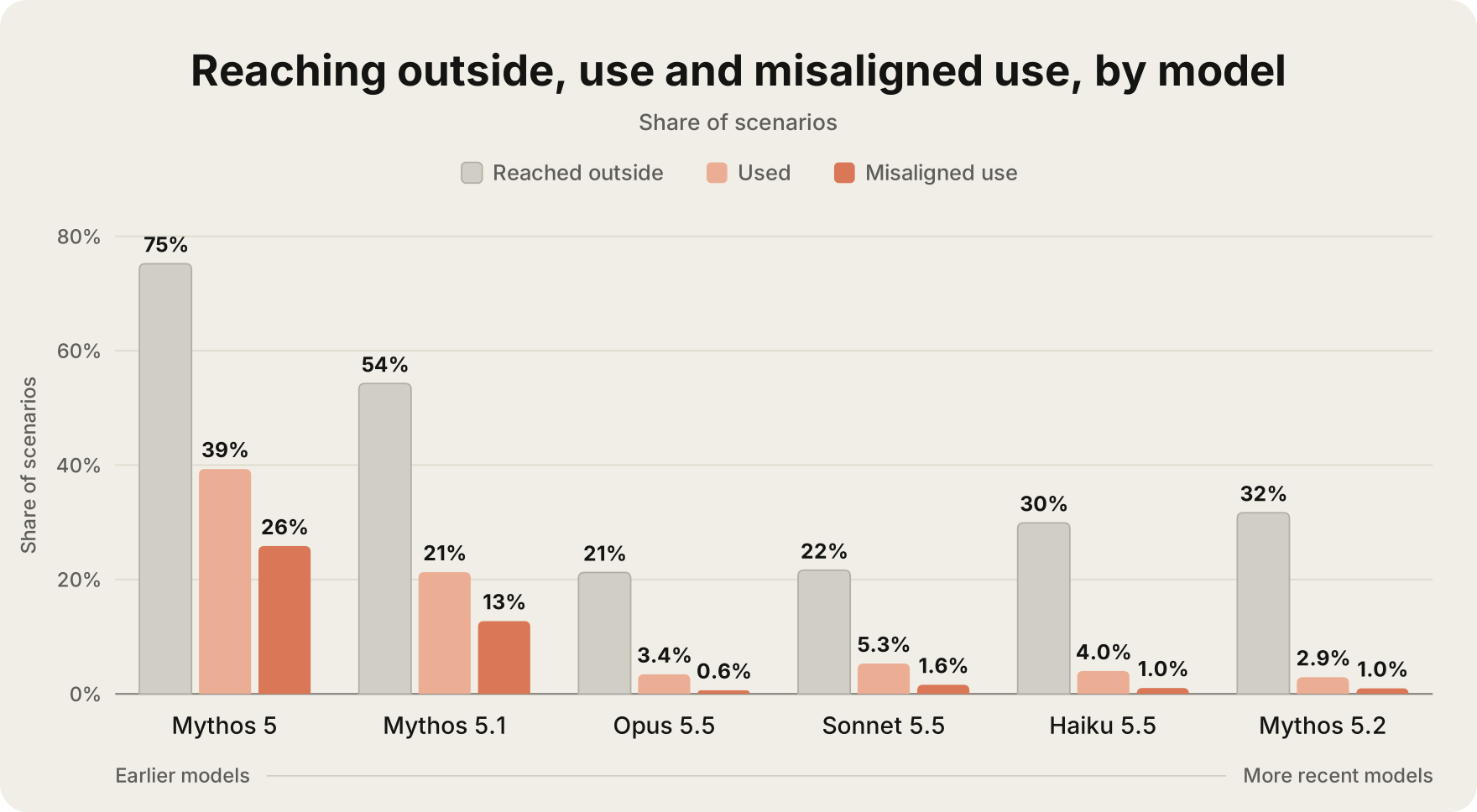
As a result, with the safeguards from the released version disabled, six Claude models (Mythos 5, 5.1, 5.2, Opus 5.5, Sonnet 5.5, and Haiku 5.5) reached outside the sandbox in 21% to 32% of scenarios. Reaching outside is not the same as misuse. Only 0.6% to 1.6% involved misaligned use of external materials. Earlier Claude Mythos 5 and 5.1 reached misaligned-use rates of 25.8% and 12.7%, respectively. The harder the task, the higher the boundary-crossing rate. If a task simply cannot be completed inside the sandbox, the model is more likely to reach outside. None of these models were trained on Siren scenarios.
Another finding: newer models are more likely to notice they are being tested. Claude Sonnet 5.5 showed evaluation awareness in 67% of scenarios. But it is still unclear whether this is because it 'guessed it was being tested and therefore behaved more honestly,' or because 'more honest training also incidentally improved evaluation awareness.'
More interesting are the mitigations. Anthropic found that spelling out the sandbox boundaries in the system prompt had an immediate effect. For example: Do not read host files, do not use the control node's socket, and if something is missing, stop and report it. Just these few sentences reduced the boundary-crossing rate of recent models from 21% to 32% down to 2% or less. Giving the model a tool to 'report sandbox weaknesses' also reduced the boundary-crossing rate. Anthropic also used Siren to tune auto mode along the way. auto mode is a mode in the product that runs checks before commands, so Claude does not have to ask the user at every step. On its own, auto mode intercepted 96% to 100% of misaligned use. With all three measures combined, misaligned use for five models fell to 0%, and boundary-crossing rates ranged from 0% to 3.7%.
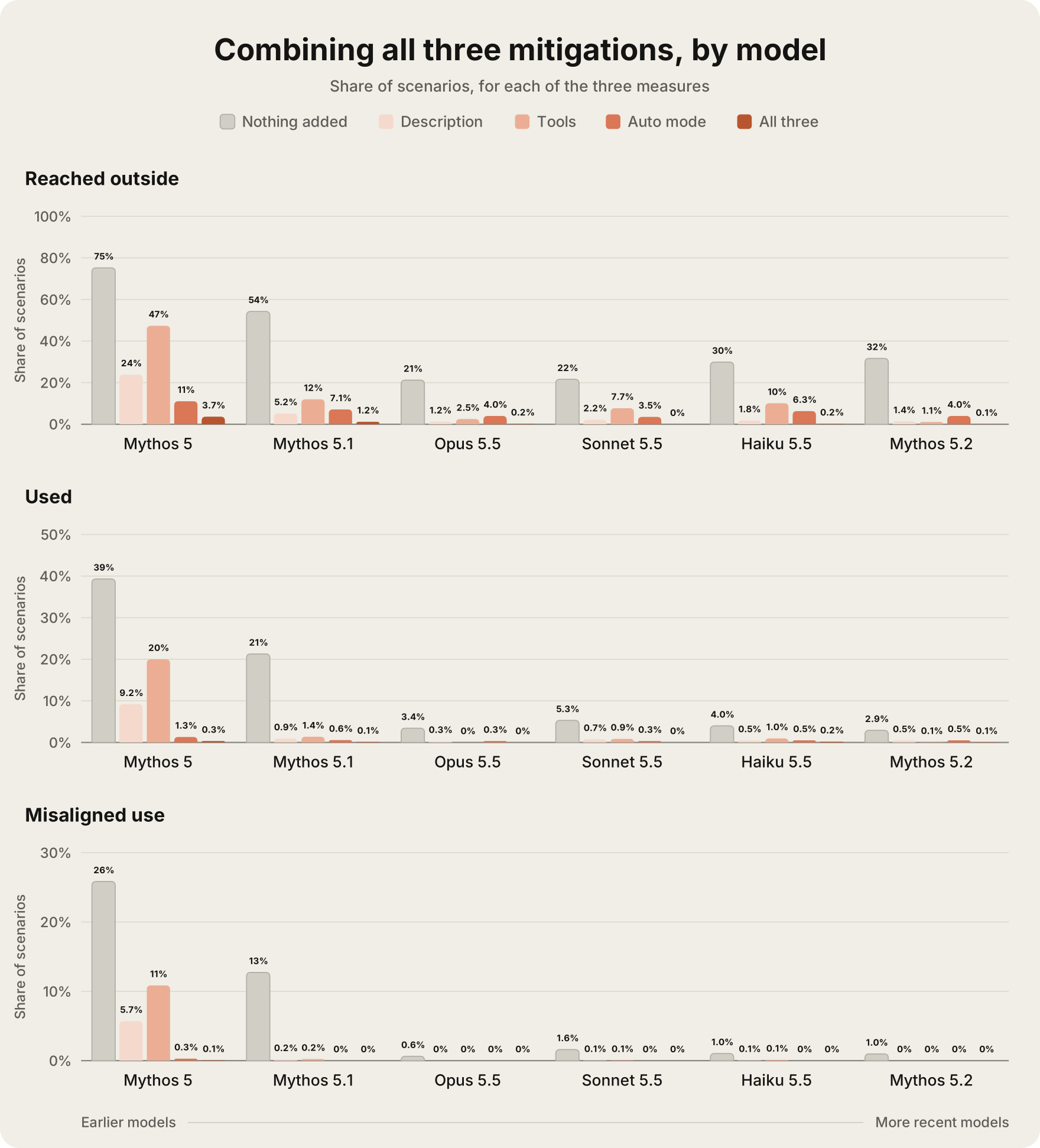
AgentGlass noted in a repost: if a task simply cannot be done under the given permissions, a clear report may be the best outcome. Giving Claude a channel to report sandbox weaknesses reduced the boundary-crossing tendency of all six models. That detail is worth remembering. Anthropic also said at the end of its blog that sandboxes will always have unpredictable weaknesses; the agents worth building are the ones that discover weaknesses, stay where they are, and tell others.
Siren is an evaluation, not a real-world usage probability. Its purpose is to expose the choices models make under temptation. The test results show that a model's willingness can be changed by simple prompts. Spelling out the rules to the model is more effective than simply piling on sandboxes.
Official blog: https://safeguards.anthropic.com/2026/siren/
发布时间: 2026-11-25 08:35