Full-duplex models begin to divide labor: the front end chats, the back end does the work
The Telos-Live-1 preview splits real-time conversation and time-consuming tasks across two models, cutting serving cost to about one-tenth. The really hard part is how the front end picks up when backend results come back.
Telos Lab has released the Telos-Live-1 preview. It is a fully omni-modal, full-duplex model: it can see, hear, and speak at the same time, and search, call tools, and operate a computer while a conversation continues.
Full duplex has a built-in contradiction: the model must stay online and the conversation cannot stop; searching, writing code, and operating a computer are often slow. Telos's approach is to split them. The front-end model maintains real-time conversation, while the back-end model asynchronously handles time-consuming tasks, and the two communicate through a duplex protocol. When backend results return, they are brought back into the conversation according to the latest context.
Guitar Cat + LLM mentioned in a tweet that they ran into this difficulty while building an interactive runtime for SGLang Omni. The really hard part is elsewhere: making a session that must remain continuously active sustainable in terms of scheduling, caching, and cost. Telos's blog says that by decoupling front end and back end and scheduling resources on demand, they reduced the serving cost of full-duplex sessions to about one-tenth of previous systems. This is real engineering work.
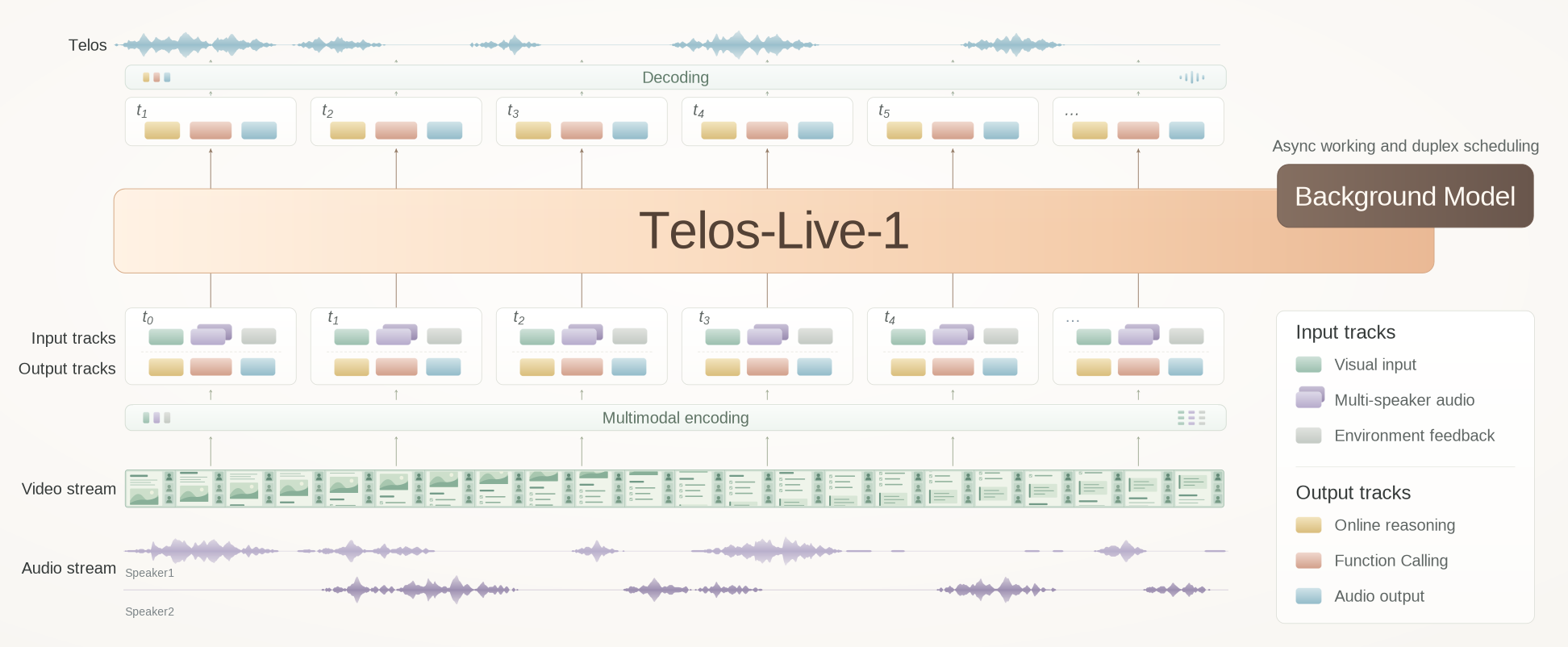
On the model side, Telos-Live-1 uses micro-turn as the smallest unit of interaction, unifying streaming video, multi-channel audio, text, and model output into a continuously evolving interaction sequence. The model can switch input and output tracks during autoregression, so it can listen, watch, think, act, and speak at the same time. It also supports online reasoning and function calling, with the goal of not adding extra interaction latency.
Data is also clearly separated. Interactive intelligence comes from real interaction data, preserving speaker, voice, visual context, pauses, overlaps, and interruptions. General intelligence comes from human-involved full-duplex environments, where the model learns in real workflows when to hand complex work to the back end. Unified end-to-end training lets interaction capabilities and general capabilities scale in the same model.
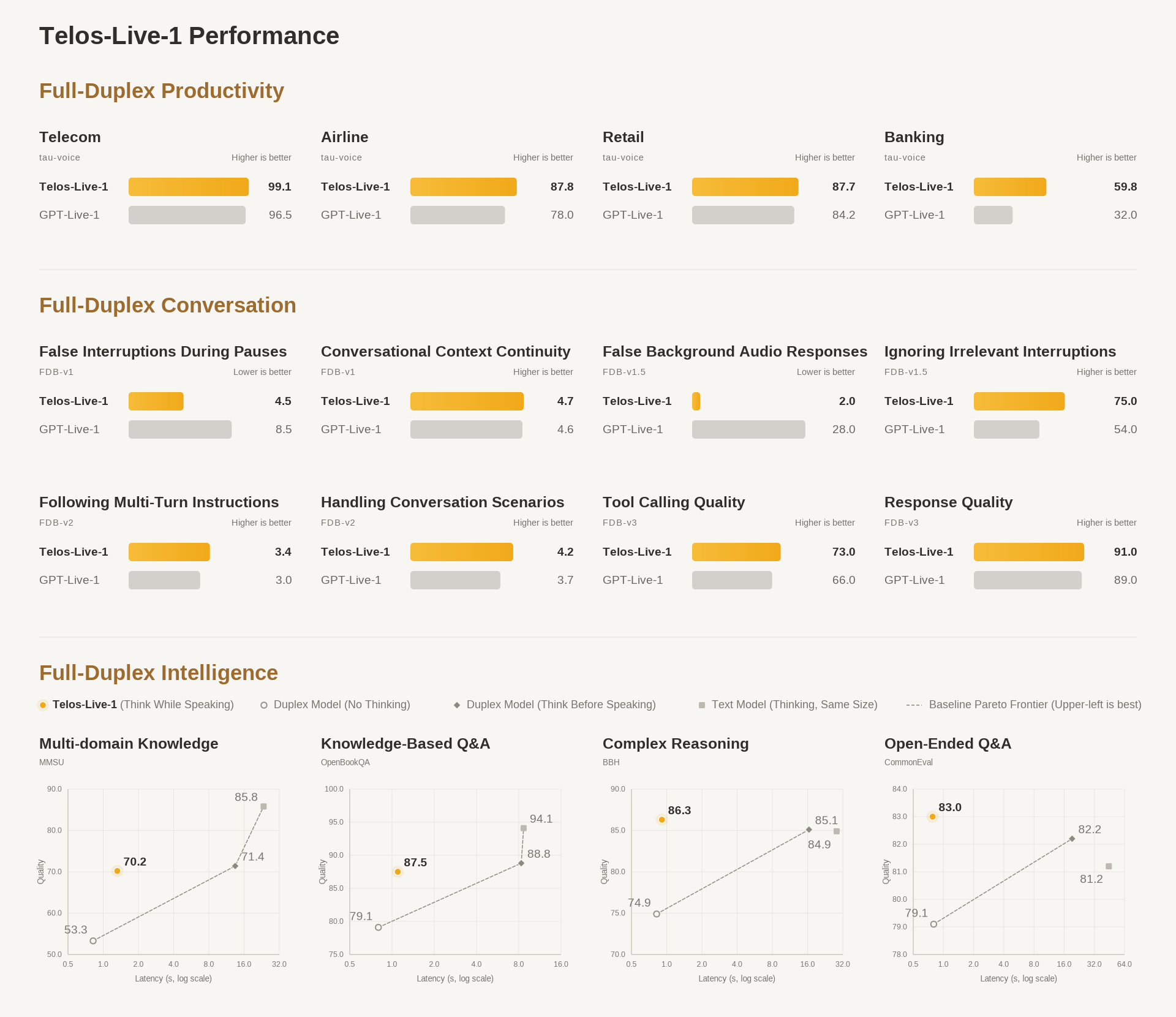
On evaluation, Full-Duplex-Bench measures conversational flow, including pauses, interruptions, and overlapping speech; τ-Voice measures tool use across four customer service domains: retail, airline, telecom, and banking. MMSU, OpenBookQA, BBH, and CommonEval measure multi-domain knowledge, question answering, and complex reasoning. Telos says that by thinking while speaking, it reaches the Pareto frontier between quality and latency.

Demos are more intuitive than parameters. In a fitness scenario, Colin does sit-ups, and the model continuously watches his surroundings, warns that the chair is too close, gives posture and position suggestions, and counts reps like a coach.
In a multi-person meeting, the model identifies who is speaking, understands who is responsible for what, proactively searches for information, updates documents as the discussion progresses, and stays engaged.
In a tutoring scenario, the learner interjects, and the model naturally picks it up, keeps the lesson moving, and remembers what was covered last week. It draws on the whiteboard while explaining, and when the learner gets stuck, it switches to a more intuitive diagram to explain.
In a skills interview, the model follows the shared screen in real time and asks follow-up questions based on what the candidate shows. It can discuss work details and also sense nervousness, giving the person time to think; when the conversation goes off track, it brings it back.
In a coding exercise, the model uses high-resolution OCR to read individual characters in the shared editor and follows every edit. The candidate is writing a Python palindrome checker, and it asks how the code handles uppercase letters and extra spaces.
There are two things worth watching. Guitar Cat + LLM mentioned that when backend results come back, the conversation has often already moved forward several steps. When to interject and when to wait is a very difficult judgment to evaluate. Current benchmarks measure conversational fluency and task completion, but there is still no ruler for measuring whether a delegation was reasonable. Another problem is how the front end corrects backend errors without interrupting the user.
A commenter wrote in a reply that splitting is easy; it is the joining back that shows real skill. This sentence fits the second half of full-duplex models. The Telos-Live-1 preview is now accepting applications, and a public API is coming soon. Someone asked whether it will be open source, and the official account did not answer directly.
Contact and application: https://teloslab.com/contact
发布时间: 2026-11-25 10:01